Showing posts with label Donggun Lee. Show all posts

Thursday, June 25, 2020

Abstract-Transformation of terahertz vibrational modes of cytosine under hydration


Donggun Lee, Hwayeong Cheon, Seo-Yeon Jeong, Joo-Hiuk Son
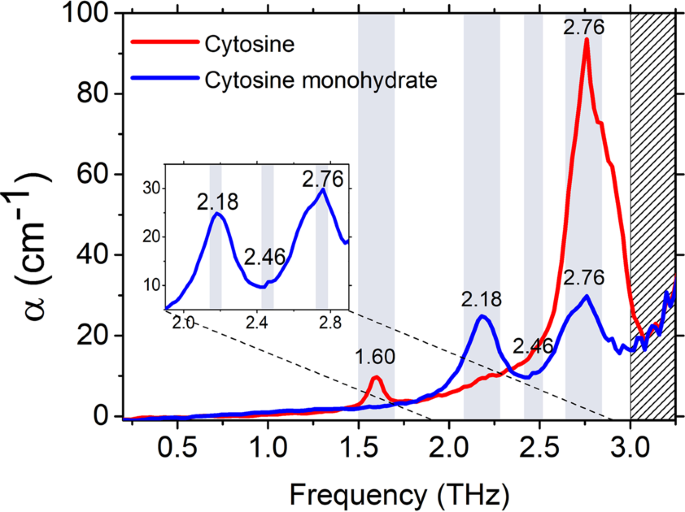
figure1
https://www.nature.com/articles/s41598-020-67179-z

Cytosine and cytosine monohydrate are representative biomolecules for investigating the effect of hydrogen bonds in deoxyribonucleic acid. To better understand intermolecular interactions, such as hydrogen bonds, between nucleobases it is necessary to identify the low-frequency vibrational modes associated with intermolecular interactions and crystalline structures. In this study, we investigated the characteristic low-frequency vibrational modes of cytosine and cytosine monohydrate using terahertz time-domain spectroscopy (THz-TDS). The crystal geometry was obtained by the powder X-ray diffraction technique. The optimized atomic positions and the normal modes in the terahertz region were calculated using density functional theory (DFT), which agreed well with the experimental results. We found that overall terahertz absorption peaks of cytosine and cytosine monohydrate consist of collective vibrations mixed with intermolecular and intramolecular vibrations in mode character analysis, and that the most intense peaks of both samples involve remarkable intermolecular translational vibration. These results indicate that THz-TDS combined with DFT calculations including mode character analysis can be an effective method for understanding how water molecules contribute to the characteristics of the low-frequency vibrational modes by intermolecular vibrations with hydrogen bonding in biological and biomedical applications.

Saturday, February 1, 2020

Abstract-Determining terahertz resonant peaks of biomolecules in aqueous environment


Seo-Yeon Jeong, Hwayeong Cheon, Donggun Lee, and Joo-Hiuk Son


Sample holder for maintaining constant temperature of the sample. (a) Structure of sample holder. Inside the holder, a pair of thermoelectric cooling devices were in contact with the copper plate. The thermoelectric devices were cooled by the water cooler. The copper plate had a hole in the middle, and the quartz window was mounted inside the hole. (b) Process of filling liquid sample inside the container. The z-cut quartz window was fixed with a cylinder ring. The 300-µm copper spacer was placed on the z-quartz window. The liquid sample was dropped in the middle of spacer and covered with a Teflon window for 5 min. The Teflon window was removed after the sample was fully frozen, and the experiments were performed at an equilibrium temperature of 250 K.

https://www.osapublishing.org/oe/abstract.cfm?uri=oe-28-3-3854

The resonant peaks of biomolecules provide information on the molecules’ physical and chemical properties. Although many biomolecules have resonant peaks in the terahertz region, it is difficult to observe their specific signals in aqueous environments. Hence, this paper proposes a method for determining these peaks. We found the specific resonant peaks of a modified nucleoside, 5-methlycytidine and modified HEK293T DNA in an aqueous solution through baseline correction. We evaluated the consistency of various fitting functions used for determining the peaks with various parameters. We separated two resonance peaks of 5-methlycytidine at 1.59 and 1.97 THz and for artificially methylated HEK293T DNA at 1.64 and 2.0 THz.
© 2020 Optical Society of America under the terms of the OSA Open Access Publishing Agreement