
Occupying a small slice of the electromagnetic spectrum, THz radiation is suited for medical imaging, security screening and space science. However, despite its vast potential, developers have yet to identify its so-called “killer app.”
MARIE FREEBODY, CONTRIBUTING EDITOR, MARIE.FREEBODY@PHOTONICS.COM
https://www.photonics.com/Article.aspx?AID=62608
Sandwiched between the infrared and microwave parts of the electro-magnetic spectrum lies the terahertz window — a valuable and largely untapped portion of energy that can reveal a huge variety of unknowns, from hidden weapons and suspicious foreign objects to the thickness of paint and quality of medicine.
Despite its vast potential to expose even more hidden secrets, there is one thing that still eludes terahertz waves — the discovery of the killer application that will see market demand explode and subsequently drive the investment and research that the field so badly needs to progress.
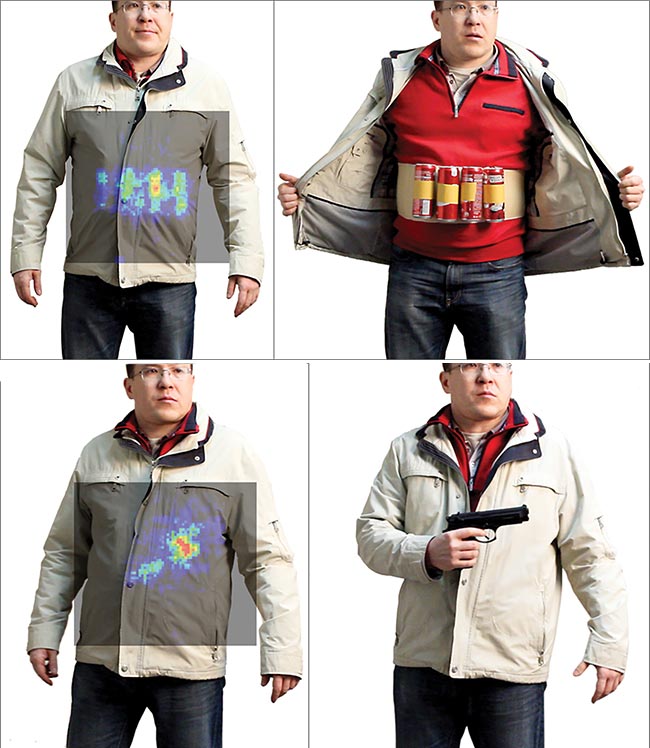
Stand-off terahertz imaging systems are nonionizing, which means that they can be safely used to scan for weapons and more. Courtesy of TeraSense Development Labs.
The challenges facing terahertz developers fall into two main areas. The first, as so often is the case, is economic. The parts that make up a terahertz imaging system are expensive, and until there is a great push to bring the cost of components down, the market will continue to favor existing imaging systems that do almost the same job for a fraction of the price. The second obstacle is technological: Terahertz systems remain uncomfortably slow in attaining meaningful high signal-to-noise ratio. They are also prone to false positives. What’s more, terahertz imaging is intrinsically limited by water absorption in certain bands and is therefore limited by atmospheric attenuation and in vivo biological materials.
If these challenges could be overcome, the wealth of applications could be tremendous and wide-ranging. Several companies are stepping up to the challenge, dogged in their pursuit of identifying the ultimate application that will reward their efforts.
Detecting weapons and explosives
Security has been the most widely publicized terahertz imaging application, and is also the simplest in principle, as it relies on the ability of terahertz waves to penetrate clothing in order to detect hidden metal and other objects.
With the rising level of violence and terrorism all over the world, companies staked in the security field are now receiving many inquiries for security screening systems similar to those used at airports, but based on THz imaging technology. Unlike x-rays, terahertz waves are absolutely harmless to humans and emit no ionizing radiation.
One such terahertz body scanner can be found at Munich Airport. Developed by German wireless communication and security firm Rohde and Schwarz GmbH, the scanner can detect objects such as steel weapons, fire arms, bombs, grenades and explosive belts hidden on a person. This opens the door to terahertz scanners being used wherever there may be crowds of people. Besides airport checkpoints, such areas include train stations and subways, secure areas, public places, high-profile events, customs checkpoints, border crossings, and many other fields with high throughput rates where lives might be jeopardized, or where there is a risk of smuggling prohibited objects.
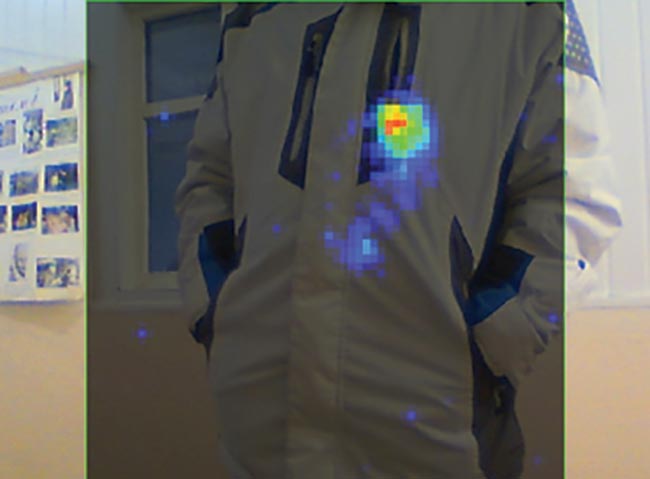
One of the main advantages of a terahertz body-scanning system is the possibility of distant detection of hidden objects. Courtesy of TeraSense Development Labs.
Another firm, TeraSense Group Inc., offers a stand-off body scanner that it claims can detect hidden objects beneath clothes. The body scanner system operates in reflection mode at a distance up to 3 m away from the target human body, with an effective field of view covering an area of approximately 70 × 70 cm, with resolution of 3 cm. The company currently offers two models — one with four terahertz sources and one with six — ranging from $59,500 to $74,500.
Dmitriy Romanyuk, sales and marketing manager at TeraSense, said that four units have already been sold, three of which were six-THz-source scanners. “From what we know, there are quite a few high-profile customers all over the world who are potentially interested in such systems.”
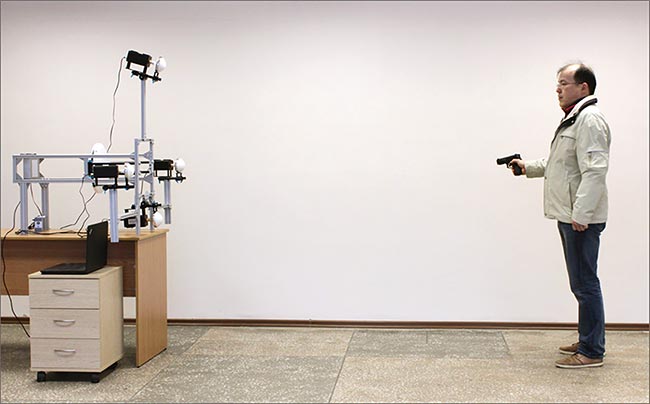
The TeraSense body scanner system operates in reflection mode at a distance up to 3 m away from the target (human body). Its effective field of view covers an area of approximately 70 × 70 cm on the target. Courtesy of TeraSense Development Labs.
The growing threat of chemical and biological agent use has precipitated the convergence of security applications with biological research. Here, terahertz offers a unique advantage in that it is able to image and also characterize intramolecular vibrations that occur in the terahertz regime.
Generating an image and performing spectroscopic analysis of samples has been a focus at laser system specialist Toptica Photonics AG. Researchers found that continuous-wave (CW) systems based on photomixing are promising candidates, thanks on one side to their broadband-tuning characteristics, and their ?exibility in the choice of frequency on the other.
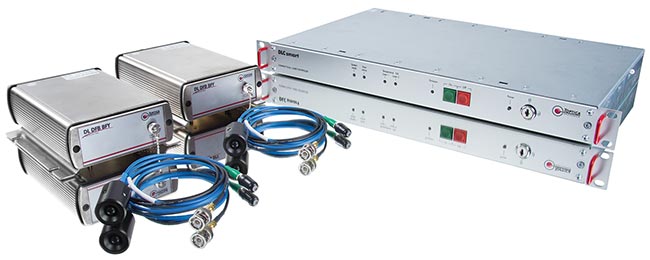
Toptica’s system for frequency-domain terahertz spectroscopy generates a monochromatic terahertz wave by converting the beat signal of two tunable lasers to terahertz light. One of the key elements is the so-called photomixer, which is illuminated by the two-colored laser light and, in turn, emits the terahertz wave. A second photomixer is used on the detection side. Courtesy of Toptica.
In a 2016 paper published in IEEE Transactions on Terahertz Science and Technology1, researchers at Toptica combined a photomixer as a CW-terahertz source with a broadband, DC-coupled Schottky receiver. The result was a proof-of-principle that both imaging and high-resolution terahertz spectroscopy could be carried out without the need for any beam-path realignments in between.
“We envisage that the system can be used for real-time monitoring of foreign bodies in plastics, nappies or cardboard boxes,” said Anselm Deninger, product manager and director of Terahertz Technologies at Toptica. “If a ?xed-frequency inspection reveals the presence of a suspicious object, additional spectral information can be gained — without shifting the sample or the measurement setup.”
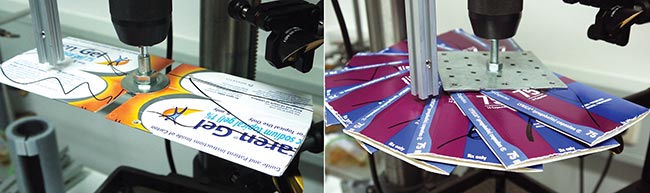
Exploring the capabilities of terahertz imaging. Folded cardboard boxes were mounted on a turntable in nonoverlapping (left) and shingled (right) arrangements. In each arrangement, a package leaflet was removed from one of the boxes. Courtesy of A. Deninger/Journal of Infrared, Millimeter, and Terahertz Waves.
Quality control
Quality and safety issues are a big concern, particularly when it comes to pharmaceuticals. One issue that Toptica is looking to address relates to European legislation that dictates all pharmaceuticals must be sold with patient information leaflets enclosed. This requirement means that every folded cardboard box used for packaging pharmaceuticals must be inspected. Traditionally this is carried out by weighing large batches of boxes, either in the production line or in post-production measurements; however, should the scales come up short, there is no way to tell which box is missing its leaflet. Pinpointing the deficient box would save time on the production line, and terahertz is ideal for the job. By combining a high-power photoconductive switch and a fast, AC-coupled Schottky receiver to measure the intensities of individual terahertz pulses at repetition rates of 100 MHz, scientists found that signal patterns of folded cardboard boxes with and without package inserts differed significantly.
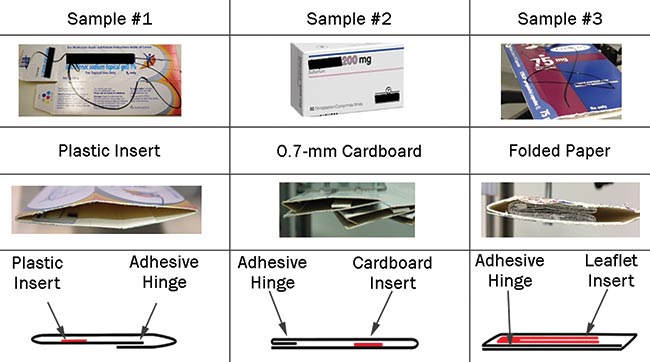
Terahertz imaging is capable of discerning different types of inserts in pharmaceutical packages. Courtesy of A. Deninger/Journal of Infrared, Millimeter, and Terahertz Waves.
“We developed a ‘superfast’ imaging method that is capable of measuring the intensities of individual terahertz pulses,” Deninger said. “Our femtosecond lasers produce 100 million pulses per second, and a new generation of detectors are so sensitive, and at the same time so fast, that they can detect each and every pulse.”
In other words, an imaging speed of 100 MHz becomes feasible, proving that the approach is suitable for fast and reliable screening of pharmaceutical packages.
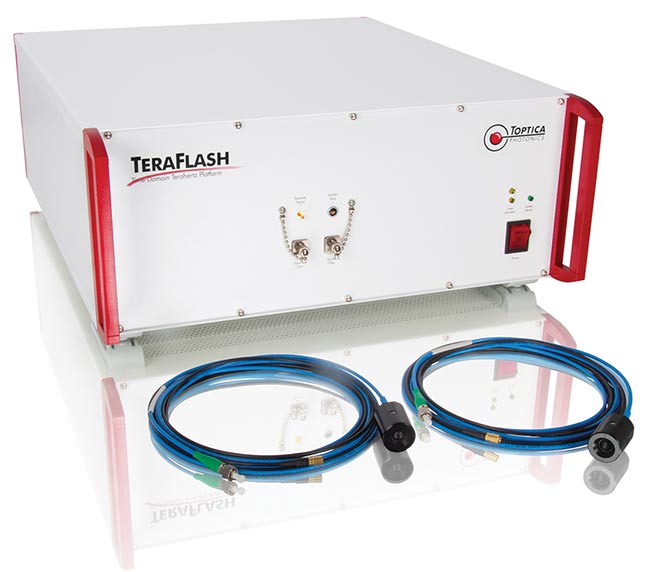
One antenna generates the terahertz beam and a second one acts as THz receiver. Having fiber-coupled rather than free-space antennas means that the antennas can be positioned in any configuration (transmission, reflection, or even move them around). This system is used for high-bandwidth spectroscopy, and also for the assessment of thin layers. Courtesy of Toptica.
Speedy scanning, which is useful in pharmaceutical quality control applications, lends itself well to any production line. TeraSense created the world’s first sub-THz multipixel imaging camera in 2014 and it remains the company’s flagship product line. It’s designed to provide nondestructive testing and quality control for various industrial applications. Due to its compact size and high-speed capability, the camera is a good option for imaging the contents of sealed pharmaceutical packages or food products without causing damage.
In the future, the company aims to combine its latest TeraFAST-256-HS high-speed linear camera with a terahertz source that emits up to 1 W of power to increase the number of “transparent materials” at the 100-GHz range.
TeraView, a spinout of Toshiba and Cambridge University, has teamed up with semiconductor giant Intel to inspect the hundreds of millions of semiconductor chips the company manufactures every year.
Today’s advanced integrated circuits are getting smaller and more complex. They are susceptible to a variety of faults and quality variations, including solder ball defects that may not be captured by logic or electrical testers — even if there is good electrical continuity present.
TeraView’s EOTPR (electro-optical terahertz pulsed reflectometer) 5000 is based on time domain reflectometry that can detect minute shifts in impedance changes from weak or marginal interconnects after accelerated life tests or high-temperature cycle tests.
An emerging application for TeraView is measuring coatings in car paints using its TeraCota system. The terahertz sensor is noncontact and suitable for working on curved surfaces. One of the main advantages over existing methods is it is noncontact, which means that no couplant is needed. The TeraCota system can be applied to flat or curved surfaces and can be operated handheld or fully automated.
“TeraView has developed a system [that] can determine the individual thickness of multiple paint layers on both metallic and nonmetallic substrates,” said Alessia Portieri, senior scientist at TeraView. “The automotive industry has been very positive on taking on board terahertz alongside their routine measurements.”
Measuring the stratosphere
From discovering hard-to-detect faults to analyzing metal to studying climate change, by taking terahertz imaging into space, scientists are taking advantage of the most common form of radiation found in the Universe.
Spectroscopy in the terahertz regime is ideally suited for investigating the chemical compositions of interstellar medium and planetary atmospheres, including our own stratosphere and mesosphere. By launching imaging systems above our planet’s atmosphere, one of the key issues of water absorption is bypassed. The economic challenge remains, however — not just with the cost of the imager itself, but also the cost of launching it into space.
Drastic demands are placed on the size, weight and power consumption of potential systems for launch; nevertheless, a few forays into space have been successful. For example, a terahertz payload, known as the Superconducting Submillimeter-Wave Limb-Emission Sounder, was launched to the International Space Station and, although no longer in operation, it provided experts with invaluable data to help evaluate the accuracy of climate models.
The system was able to provide important insights into the ozone trend, especially chlorine and bromine compounds related to ozone chemistry. By evaluating the recovery and stability of the ozone layer, scientists attempted to shed light on the considerable uncertainties in factors affecting the ozone layer. According to Seongsin “Margaret” Kim, associate professor of electrical and computer engineering at the University of Alabama, terahertz technology has the potential to revolutionize the future and open new opportunities that will benefit society. “Our community needs to be more patient than ever and focus on exciting science that can lead to this revolution coming in the near future,” she said.
Reference
1. M. Yahyapour et al. (2016). A flexible phase-insensitive system for broadband CW-terahertz spectroscopy and imaging. IEEE Transactions on Terahertz Science and Technology, Vol. 6, Issue 5.


 QUICK LINKS


