Showing posts with label Anselm Deninger. Show all posts

Thursday, October 3, 2019

Abstract-Industrial Applications of Terahertz Sensing: State of Play


Mira Naftaly ,Nico Vieweg,  Anselm Deninger

https://www.mdpi.com/1424-8220/19/19/4203

This paper is a survey of existing and upcoming industrial applications of terahertz technologies, comprising sections on polymers, paint and coatings, pharmaceuticals, electronics, petrochemicals, gas sensing, and paper and wood industries. Finally, an estimate of the market size and growth rates is given, as obtained from a comparison of market reports.

https://www.mdpi.com › ...


Friday, April 5, 2019

Abstract-Fastest Thickness Measurements with a Terahertz Time-Domain System based on Electronically Controlled Optical Sampling


Milad Yahyapour, Angelika Jahn, Katja Dutzi, Thomas Puppe, Patrick Leisching, Bernhard Schmauss, Nico Vieweg,  Anselm Deninge

https://www.mdpi.com/2076-3417/9/7/1283

We apply a fast terahertz time-domain spectroscopy (TDS) system based on electronically controlled optical sampling (ECOPS) to contact-free thickness gauging. Our setup achieves a measurement speed of 1600 terahertz pulse traces per second, which—to our knowledge—represents the fastest thickness measurement performed with any terahertz system to-date. Using a silicon wafer as a test sample, we compare data of the ECOPS experiment to results obtained with a conventional terahertz TDS system and a mechanical micrometer gauge. We show that all systems provide consistent results within the measurement accuracy. Moreover, we perform thickness measurements of a rapidly moving sample and characterize the ECOPS setup with respect to time-domain dynamic range, signal-to-noise ratio, and spectral properties

Wednesday, August 1, 2018

Terahertz Spectroscopy on the Cutting Edge of Material Testing


Terahertz measuring instruments are entering a phase of industrial application and now represent a significant potential market.

ANSELM DENINGER, LISA GRAY AND TIM PAASCH-COLBERG, TOPTICA PHOTONICS

Just a few years ago, the application of terahertz radiation seemed obscure at best. If experts were asked for killer applications, few could be named. In 2018, however, terahertz measuring instruments are showing significant market potential. Applications in the field of civil safety, nondestructive testing, and industrial quality control all profit from a new generation of terahertz systems. Depending on the actual applications, several different types of technologies have merit. 

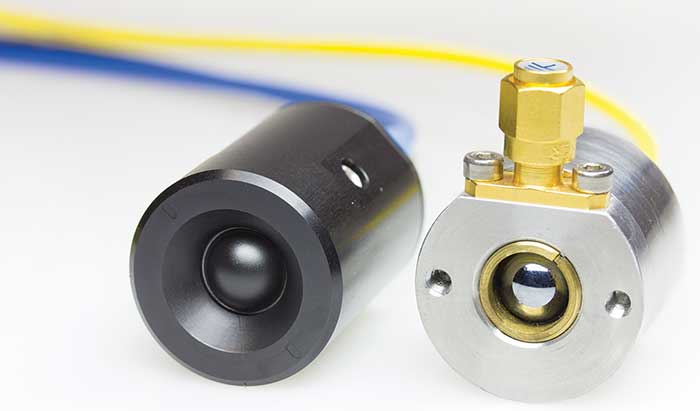
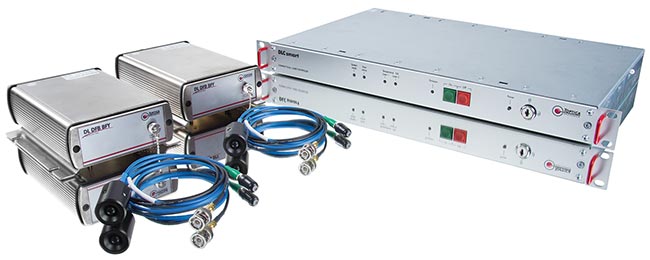
Photomixers with fiber pigtails.

Photomixers with fiber pigtails. The active structure sits at the center of the cylindrical package; the generated terahertz radiation is emitted through the silicon lens.


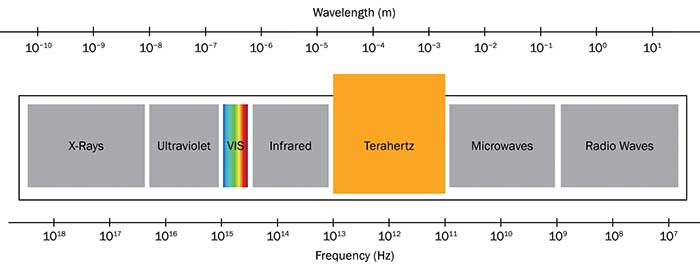
The terahertz spectrum contains frequencies from 100 GHz to 10 THz (wavelengths between 3 mm and 30 µm) and fills a gap between IR light and microwaves (Figure 1). The generation of terahertz radiation can be achieved using a multitude of techniques. The applications described below employ optoelectronic sources that rely on the conversion of NIR laser light to terahertz waves. Compared to alternative techniques — for example, frequency multipliers or quantum cascade lasers — optoelectronic systems are characterized by increased robustness, more compact footprints, and very broad, usable bandwidth. 
The terahertz range refers to electromagnetic waves between IR light and microwaves.

Figure 1. The terahertz range refers to electromagnetic waves between IR light and microwaves.


There are three emerging applications, each with differing systems and instrumentation: (1) the sensitive detection of trace gases, which calls for systems with high spectral resolution and where frequency-domain spectrometers appear best suited; (2) layer thickness measurements, which benefit from time-domain systems, as in the extrusion of plastic pieces and the characterization of paint layers in the automobile industry; and (3) real-time observation of samples on fast-moving conveyor belts, demonstrated with a rapid screening system that measures up to 500 kilosamples per second. In the interim, one can expect that increased market acceptance of these systems will lead to greater volume effects in the production of components. 

Gas detection 

Frequency-domain spectroscopy uses the principle of difference-frequency mixing of two tunable lasers. The light of two slightly different wavelengths illuminates a specific semiconductor component, or photomixer (opening image), which converts the beat signal of the wavelengths into terahertz radiation. The wavelengths of diode lasers, in particular, can be precisely controlled, so that the resulting terahertz radiation is also “on point” and can be set or scanned easily. A frequency resolution of just 1 MHz pays off in trace gas analysis; several gases possess distinct transitions in the terahertz frequency range, which narrow down at low pressure and can then be identified by their absorption fingerprint. 


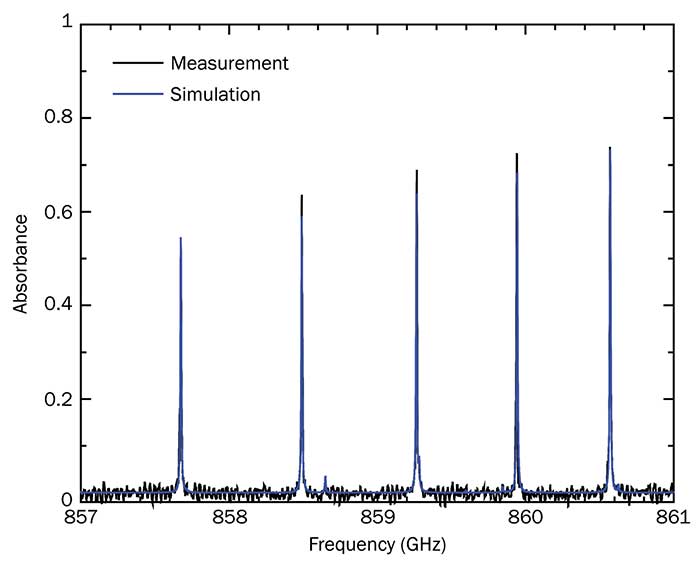
 Close-up of the terahertz absorption spectrum of sulfur dioxide

Figure 2. Close-up of the terahertz absorption spectrum of sulfur dioxide: The TeraScan resolves line profiles with a width of only a few megahertz. Experimental data (black line) and literature values (blue line) are in excellent agreement.


Germany’s Federal Ministry for Education and Research funded a project between 2014 and 2017 that looked at the precise detection of poisonous gases in industry buildings. The project consortium included TOPTICA Photonics, the Fraunhofer Heinrich Hertz Institute in Berlin, the Analytical Task Force of the fire department of Mannheim, Germany, and other partners. They conceived a mobile measuring station based on a high-precision frequency domain spectrometer and analyzed scenarios that included the protection of production lines from explosion and the clearing of a dangerous situation in case of emergency. In both cases, it was necessary to gather precise information about the type and amount of poisonous gases released. The measuring station reached a detection limit of approximately 10 ppm with ammonia, and 100 ppm with hydrogen sulfide and sulfur dioxide. Figure 2 shows a representative absorption spectrum of sulfur dioxide at low pressure. 

Layer thickness measurements 

Terahertz measurements in the time domain are based on pulsed sources. In contrast to frequency-domain spectroscopy, these systems use only one laser that emits short IR pulses with a duration of 50 to 100 fs. The laser pulses hit a photoconductive switch and create short current transients, which contain high (terahertz) frequency components. The best photoconductive switches currently available make use of indium gallium arsenide (InGaAs) semiconductor material and achieve bandwidths up to 7 THz. 


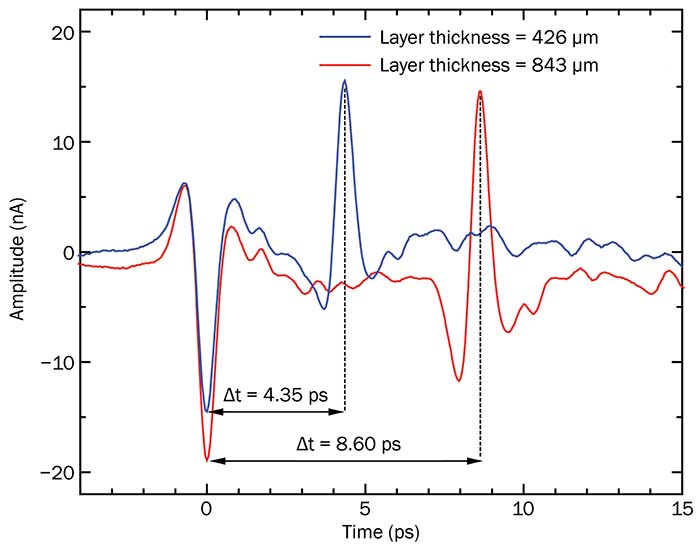
Terahertz pulses reflected off different spots of a plastic bottle.

Figure 3. Terahertz pulses reflected off different spots of a plastic bottle. In the same bottle, the wall thickness varies by a factor of almost two. Terahertz echolocation easily detects these inhomogeneities.


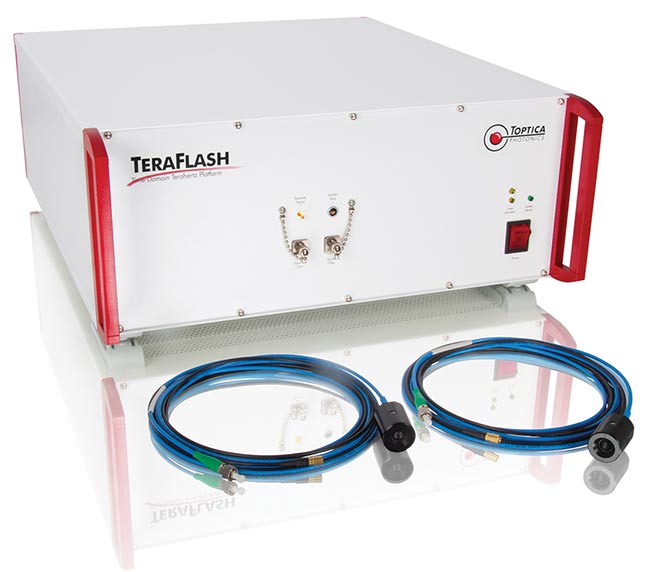
In the quality control of plastic pieces or the inspection of paint and coating layers, one of the most promising industrial applications — the measurement of thin, optically opaque layers — benefits from short pulses. The measuring principle is similar to echolocation. Terahertz pulses are focused on the layer under inspection, and the top and bottom side each reflect a part of the incident pulse. If the refractive index of the material is known, we can calculate the thickness of the layer based on the time-of-arrival of the pulses (Figure 3). This method even works with multilayered surfaces, as long as the individual materials have a different refractive index. The time-domain system TeraFlash has resolved layers of 10- to 20-µm thickness. 

Screening for quality assurance 

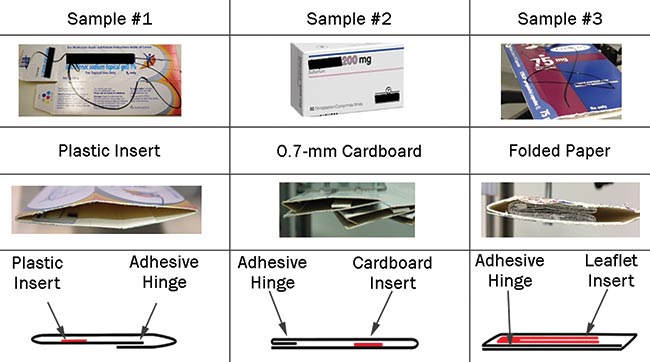
A third group of industrial applications requires neither spectral measurements nor thickness information but an extremely fast recording of intensity values. Rapid recording is nicely illustrated with this quality-control scenario. According to a directive from the EU Parliament, medications may only be distributed to patients if a delivery note with patient information is included. Production facilities must insert the delivery note into the packaging before inserting the medication. (Delivery notes are made of papers or plastics, and the folded medication boxes are made of cardboard.) Once delivery notes and medications have been inserted, the entire weight is tallied. However, should the sums not match, it is impossible for quality control to locate the individual packages without delivery notes. The speed of the conveyor belts — often greater than 10 m/s — is too fast for in-line measurements. 

Terahertz setup to analyze folded cardboard boxes.

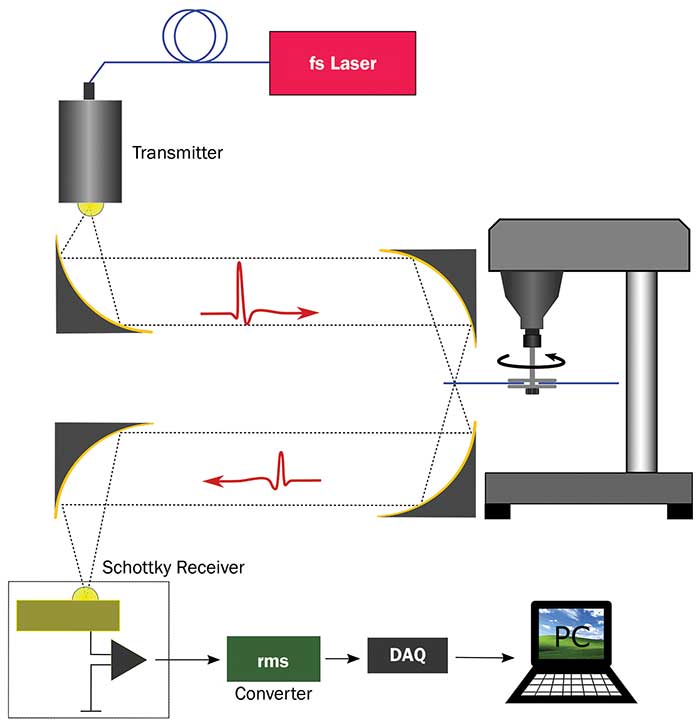
Figure 4. Terahertz setup to analyze folded cardboard boxes. The transmitter converts the output of a femtosecond (fs) laser to terahertz pulses. Parabolic mirrors focus the pulses onto the samples mounted on a fast turntable. The Schottky receiver measures the transmitted intensities, which are further processed in a root mean square (rms) converter and a data acquisition (DAQ) unit.


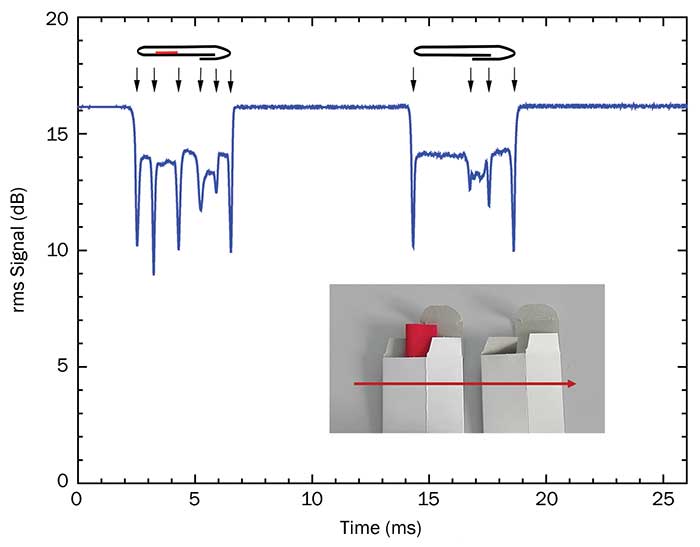
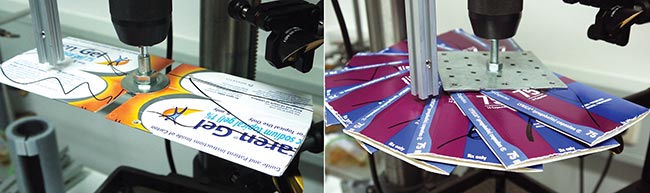
In a feasibility experiment conducted by TOPTICA Photonics, folded boxes were mounted on an industrial drill that simulated a fast conveyor belt. The boxes rotated with a transversal speed of 21 m/s through the focus of the terahertz beam. The dips in the time-dependent signal result from the scattering of the terahertz pulses at the edges of the sample itself and in the paper fold. The presence of a delivery note becomes visible in two additional peaks in the signal. The experiments show that packages with missing delivery notes can still be identified. The method even worked for samples that overlapped in a tile-like manner, with an overlap degree up to 50 to 60 percent (Figures 4, 5). 
erahertz transmission through folded cardboard boxes

Figure 5. Terahertz transmission through folded cardboard boxes with (left) and without (right) a delivery note. In this measurement, the boxes moved at 21 m/s; rms: root mean square.


New procedures can measure the intensity of each and every terahertz pulse. The measurement process can be implemented in a screening system and enable an acquisition speed of 100 million data points per second. Because such large data volumes are not easily processed, it is advantageous to average several thousand measuring points at a time. Even then, the data rate is still considerably higher than earlier terahertz systems and sufficient to deliver a high resolution at even sample speeds well beyond 100 km/h. 
Temporal evolution of the curing process of a transparent two-component adhesive

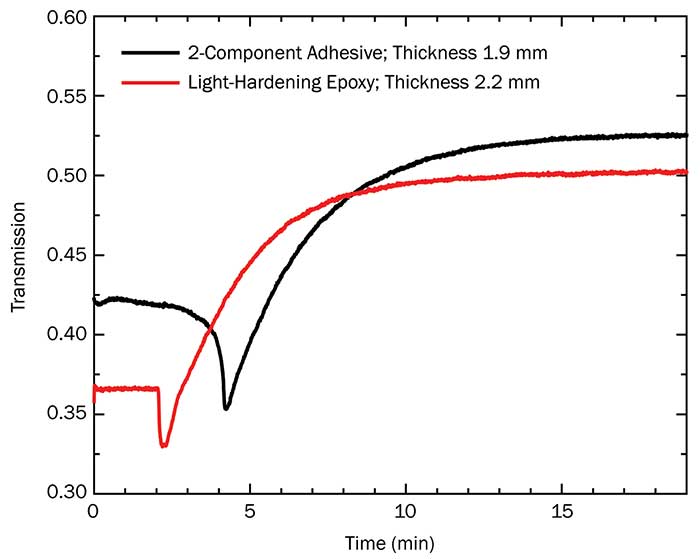
Figure 6. Temporal evolution of the curing process of a transparent two-component adhesive (black curve) and a light-hardening epoxy adhesive (red curve), recorded with a TeraSpeed.


Unlike conventional time-domain spectrometers, more recent screening systems do not use any moving parts and are thus extremely robust, both thermally and mechanically. The data rate can be reduced if slow processes, such as the curing of adhesives (Figure 6), have to be observed. Initial research along these lines has shown that the transmission properties of a two-component adhesive and a light-hardening epoxy adhesive are significantly changed in the curing process. Terahertz measurements thus allow a touch-free control of the tempering procedure and can therefore help to optimize the curing duration and material composition. 

The unique characteristics of terahertz radiation turn it into an effective tool for a variety of applications. 

Looking to the future, and beyond the applications mentioned here, higher carrier frequencies will enable higher data rates in wireless communication. And there has been recent work characterizing pharmaceuticals, both with respect to their structure (coating thickness) and composition. The number of emerging applications — especially in contact-free material and quality testing — is constantly growing. 

Meet the authors 

Anselm Deninger, Ph.D., is product manager and director of terahertz technology at TOPTICA Photonics AG. He received a doctorate in physics from the University of Mainz, having investigated the applications of spin-polarized helium-3 gas to functional magnetic resonance imaging of human lungs; email: anselm.deninger@toptica.com. 

Lisa Gray currently holds an inside sales and marketing position at TOPTICA Photonics. She has a bachelor’s degree in international relations with a minor in business administration from SUNY Geneseo; email: lisa.gray@toptica.com. 

Tim Paasch-Colberg, Ph.D., was marketing director at TOPTICA Photonics AG and responsible for worldwide marketing of TOPTICA’s product lines. His doctorate in physics from the University of Munich focused on charge carrier dynamics in solid-state materials on attosecond timescales; email: tim.paasch-colberg@toptica.com.

Friday, November 3, 2017

Terahertz Window Offers Untapped Potential


Occupying a small slice of the electromagnetic spectrum, THz radiation is suited for medical imaging, security screening and space science. However, despite its vast potential, developers have yet to identify its so-called “killer app.”

MARIE FREEBODY, CONTRIBUTING EDITOR, MARIE.FREEBODY@PHOTONICS.COM

https://www.photonics.com/Article.aspx?AID=62608

Sandwiched between the infrared and microwave parts of the electro-magnetic spectrum lies the terahertz window — a valuable and largely untapped portion of energy that can reveal a huge variety of unknowns, from hidden weapons and suspicious foreign objects to the thickness of paint and quality of medicine. 

Despite its vast potential to expose even more hidden secrets, there is one thing that still eludes terahertz waves — the discovery of the killer application that will see market demand explode and subsequently drive the investment and research that the field so badly needs to progress. 

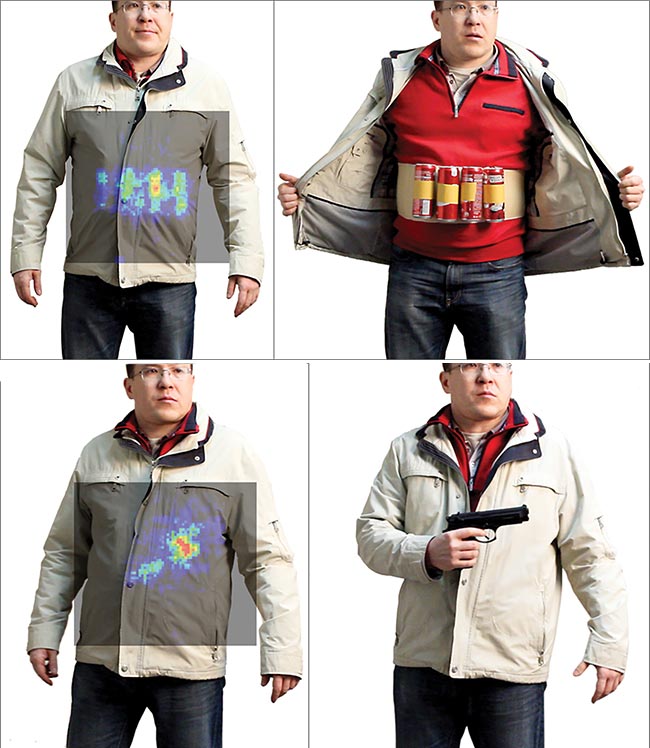
Stand-off terahertz imaging systems are nonionizing, which means that they can be safely used to scan for weapons and more.

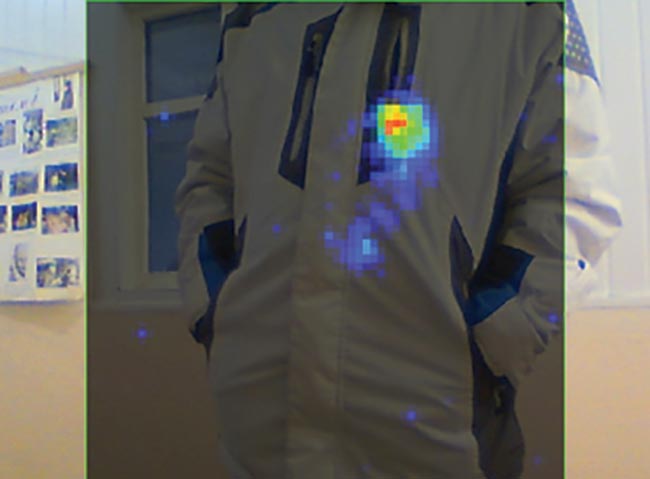
Stand-off terahertz imaging systems are nonionizing, which means that they can be safely used to scan for weapons and more. Courtesy of TeraSense Development Labs.


The challenges facing terahertz developers fall into two main areas. The first, as so often is the case, is economic. The parts that make up a terahertz imaging system are expensive, and until there is a great push to bring the cost of components down, the market will continue to favor existing imaging systems that do almost the same job for a fraction of the price. The second obstacle is technological: Terahertz systems remain uncomfortably slow in attaining meaningful high signal-to-noise ratio. They are also prone to false positives. What’s more, terahertz imaging is intrinsically limited by water absorption in certain bands and is therefore limited by atmospheric attenuation and in vivo biological materials. 

If these challenges could be overcome, the wealth of applications could be tremendous and wide-ranging. Several companies are stepping up to the challenge, dogged in their pursuit of identifying the ultimate application that will reward their efforts. 

Detecting weapons and explosives 

Security has been the most widely publicized terahertz imaging application, and is also the simplest in principle, as it relies on the ability of terahertz waves to penetrate clothing in order to detect hidden metal and other objects. 

With the rising level of violence and terrorism all over the world, companies staked in the security field are now receiving many inquiries for security screening systems similar to those used at airports, but based on THz imaging technology. Unlike x-rays, terahertz waves are absolutely harmless to humans and emit no ionizing radiation. 

One such terahertz body scanner can be found at Munich Airport. Developed by German wireless communication and security firm Rohde and Schwarz GmbH, the scanner can detect objects such as steel weapons, fire arms, bombs, grenades and explosive belts hidden on a person. This opens the door to terahertz scanners being used wherever there may be crowds of people. Besides airport checkpoints, such areas include train stations and subways, secure areas, public places, high-profile events, customs checkpoints, border crossings, and many other fields with high throughput rates where lives might be jeopardized, or where there is a risk of smuggling prohibited objects. 

One of the main advantages of a terahertz body-scanning system is the possibility of distant detection of hidden objects.

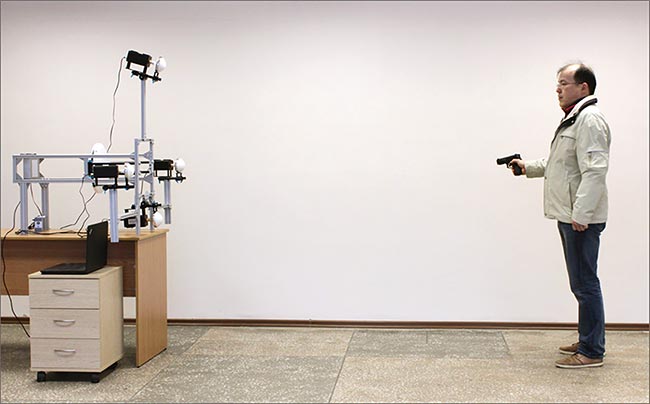
One of the main advantages of a terahertz body-scanning system is the possibility of distant detection of hidden objects. Courtesy of TeraSense Development Labs.


Another firm, TeraSense Group Inc., offers a stand-off body scanner that it claims can detect hidden objects beneath clothes. The body scanner system operates in reflection mode at a distance up to 3 m away from the target human body, with an effective field of view covering an area of approximately 70 × 70 cm, with resolution of 3 cm. The company currently offers two models — one with four terahertz sources and one with six — ranging from $59,500 to $74,500. 

Dmitriy Romanyuk, sales and marketing manager at TeraSense, said that four units have already been sold, three of which were six-THz-source scanners. “From what we know, there are quite a few high-profile customers all over the world who are potentially interested in such systems.” 

The TeraSense body scanner system operates in reflection mode at a distance up to 3 m away from the target (human body).

The TeraSense body scanner system operates in reflection mode at a distance up to 3 m away from the target (human body). Its effective field of view covers an area of approximately 70 × 70 cm on the target. Courtesy of TeraSense Development Labs.


The growing threat of chemical and biological agent use has precipitated the convergence of security applications with biological research. Here, terahertz offers a unique advantage in that it is able to image and also characterize intramolecular vibrations that occur in the terahertz regime. 

Generating an image and performing spectroscopic analysis of samples has been a focus at laser system specialist Toptica Photonics AG. Researchers found that continuous-wave (CW) systems based on photomixing are promising candidates, thanks on one side to their broadband-tuning characteristics, and their ?exibility in the choice of frequency on the other. 

Toptica’s system for frequency-domain terahertz spectroscopy generates a monochromatic terahertz wave by converting the beat signal of two tunable lasers to terahertz light.

Toptica’s system for frequency-domain terahertz spectroscopy generates a monochromatic terahertz wave by converting the beat signal of two tunable lasers to terahertz light. One of the key elements is the so-called photomixer, which is illuminated by the two-colored laser light and, in turn, emits the terahertz wave. A second photomixer is used on the detection side. Courtesy of Toptica.


In a 2016 paper published in IEEE Transactions on Terahertz Science and Technology1, researchers at Toptica combined a photomixer as a CW-terahertz source with a broadband, DC-coupled Schottky receiver. The result was a proof-of-principle that both imaging and high-resolution terahertz spectroscopy could be carried out without the need for any beam-path realignments in between. 

“We envisage that the system can be used for real-time monitoring of foreign bodies in plastics, nappies or cardboard boxes,” said Anselm Deninger, product manager and director of Terahertz Technologies at Toptica. “If a ?xed-frequency inspection reveals the presence of a suspicious object, additional spectral information can be gained — without shifting the sample or the measurement setup.” 

Exploring the capabilities of terahertz imaging.

Exploring the capabilities of terahertz imaging. Folded cardboard boxes were mounted on a turntable in nonoverlapping (left) and shingled (right) arrangements. In each arrangement, a package leaflet was removed from one of the boxes. Courtesy of A. Deninger/Journal of Infrared, Millimeter, and Terahertz Waves.


Quality control 

Quality and safety issues are a big concern, particularly when it comes to pharmaceuticals. One issue that Toptica is looking to address relates to European legislation that dictates all pharmaceuticals must be sold with patient information leaflets enclosed. This requirement means that every folded cardboard box used for packaging pharmaceuticals must be inspected. Traditionally this is carried out by weighing large batches of boxes, either in the production line or in post-production measurements; however, should the scales come up short, there is no way to tell which box is missing its leaflet. Pinpointing the deficient box would save time on the production line, and terahertz is ideal for the job. By combining a high-power photoconductive switch and a fast, AC-coupled Schottky receiver to measure the intensities of individual terahertz pulses at repetition rates of 100 MHz, scientists found that signal patterns of folded cardboard boxes with and without package inserts differed significantly. 

Terahertz imaging is capable of discerning different types of inserts in pharmaceutical packages.

Terahertz imaging is capable of discerning different types of inserts in pharmaceutical packages. Courtesy of A. Deninger/Journal of Infrared, Millimeter, and Terahertz Waves.


“We developed a ‘superfast’ imaging method that is capable of measuring the intensities of individual terahertz pulses,” Deninger said. “Our femtosecond lasers produce 100 million pulses per second, and a new generation of detectors are so sensitive, and at the same time so fast, that they can detect each and every pulse.” 

In other words, an imaging speed of 100 MHz becomes feasible, proving that the approach is suitable for fast and reliable screening of pharmaceutical packages. 

Toptica’s TeraFlash time-domain terahertz platform incorporates photoconductive antennas to translate the pulse train of a femtosecond laser into broadband terahertz radiation.

One antenna generates the terahertz beam and a second one acts as THz receiver. Having fiber-coupled rather than free-space antennas means that the antennas can be positioned in any configuration (transmission, reflection, or even move them around). This system is used for high-bandwidth spectroscopy, and also for the assessment of thin layers. Courtesy of Toptica.


Speedy scanning, which is useful in pharmaceutical quality control applications, lends itself well to any production line. TeraSense created the world’s first sub-THz multipixel imaging camera in 2014 and it remains the company’s flagship product line. It’s designed to provide nondestructive testing and quality control for various industrial applications. Due to its compact size and high-speed capability, the camera is a good option for imaging the contents of sealed pharmaceutical packages or food products without causing damage. 

In the future, the company aims to combine its latest TeraFAST-256-HS high-speed linear camera with a terahertz source that emits up to 1 W of power to increase the number of “transparent materials” at the 100-GHz range. 

TeraView, a spinout of Toshiba and Cambridge University, has teamed up with semiconductor giant Intel to inspect the hundreds of millions of semiconductor chips the company manufactures every year. 

Today’s advanced integrated circuits are getting smaller and more complex. They are susceptible to a variety of faults and quality variations, including solder ball defects that may not be captured by logic or electrical testers — even if there is good electrical continuity present. 

TeraView’s EOTPR (electro-optical terahertz pulsed reflectometer) 5000 is based on time domain reflectometry that can detect minute shifts in impedance changes from weak or marginal interconnects after accelerated life tests or high-temperature cycle tests. 

An emerging application for TeraView is measuring coatings in car paints using its TeraCota system. The terahertz sensor is noncontact and suitable for working on curved surfaces. One of the main advantages over existing methods is it is noncontact, which means that no couplant is needed. The TeraCota system can be applied to flat or curved surfaces and can be operated handheld or fully automated. 

“TeraView has developed a system [that] can determine the individual thickness of multiple paint layers on both metallic and nonmetallic substrates,” said Alessia Portieri, senior scientist at TeraView. “The automotive industry has been very positive on taking on board terahertz alongside their routine measurements.” 

Measuring the stratosphere 

From discovering hard-to-detect faults to analyzing metal to studying climate change, by taking terahertz imaging into space, scientists are taking advantage of the most common form of radiation found in the Universe. 

Spectroscopy in the terahertz regime is ideally suited for investigating the chemical compositions of interstellar medium and planetary atmospheres, including our own stratosphere and mesosphere. By launching imaging systems above our planet’s atmosphere, one of the key issues of water absorption is bypassed. The economic challenge remains, however — not just with the cost of the imager itself, but also the cost of launching it into space. 

Drastic demands are placed on the size, weight and power consumption of potential systems for launch; nevertheless, a few forays into space have been successful. For example, a terahertz payload, known as the Superconducting Submillimeter-Wave Limb-Emission Sounder, was launched to the International Space Station and, although no longer in operation, it provided experts with invaluable data to help evaluate the accuracy of climate models. 

The system was able to provide important insights into the ozone trend, especially chlorine and bromine compounds related to ozone chemistry. By evaluating the recovery and stability of the ozone layer, scientists attempted to shed light on the considerable uncertainties in factors affecting the ozone layer. According to Seongsin “Margaret” Kim, associate professor of electrical and computer engineering at the University of Alabama, terahertz technology has the potential to revolutionize the future and open new opportunities that will benefit society. “Our community needs to be more patient than ever and focus on exciting science that can lead to this revolution coming in the near future,” she said. 

Reference 

1. M. Yahyapour et al. (2016). A flexible phase-insensitive system for broadband CW-terahertz spectroscopy and imaging. IEEE Transactions on Terahertz Science and Technology, Vol. 6, Issue 5.

Wednesday, July 5, 2017

LASER 2017: The progress of terahertz spectroscopy


30 Jun 2017

Panel session reports on the significant advances of real-world applications of terahertz technology.


Practical – and increasingly commercially valuable – applications of terahertz radiation were described in an applications panel at LASER World of Photonics this week. A busy session in Hall B2, chaired by Dr. Thomas Renner, of Toptica Photonics and Prof. Dr. Martin Schell of HHI Fraunhofer Institute for Telecoms, introduced the technology.
Under consideration was its applications in areas as diverse as paper inspection during manufacture; remotely measuring opaque plastic pipe thicknesses; spotting defects in semiconductors; and analyzing the composition of chemical gases.
In most cases the terahertz radiation is generated by either femtosecond, DFB diode or quantum cascade lasers. This panel provided an overview of the established laser and THz antennae technologies, the required measurement technologies and first successful industrial realizations.
Firstly, Prof. Martin Koch of Philipps Universität Marburg, gave a general review of industrial applications of terahertz spectroscopy. He commented, “In the past few years spectroscopy at terahertz frequencies – the range between 0.1 and several THz – has enjoyed increasing interest.
Consequently, a multitude of applications have been developed for THz systems, including medical diagnostics, security applications and the monitoring of industrial production processes. The following talks will present several real-world applications of THz spectroscopy systems and recent progress.”

Inspection of paper and lacquer
Dook van Mechelen of Swiss industrial giant ABB Research told the conference: “The growing maturity of THz technology is paving the road towards industrial applications. Yet the process industry already successfully employs optical sensors and techniques. Therefore, a key question is how THz technology can differentiate itself and create additional value that justifies its current price tag.
“At ABB, we carried out a comprehensive study on a large variety of paper sheets in the industrial environment,” he said adding that in recent years terahertz technology has actually struggled to establish itself in the competitive optical metrology space.
“After a “peak of inflated expectations” as long ago as 2005, terahertz systems had started to enter the “trough of disillusionment.” But there are some grounds for optimism. ABB’s own production tests ranged from toilet tissue to cardboard, via 100 gsm copy paper.
He concluded: “Terahertz technology is definitely ready to be applied. It can do the job cheaper and better. But its feasibility needs to be shown in factories to create a market pull. A first industrial killer app could be a wet paint analyzer, as could be used in the automotive manufacturing industry.”

THz microprobe for non-destructive inspection
Dr. Michael Nagel of Protemics said, “Terahertz radiation has many benefits for different kinds of non-destructive inspection applications. However, a major limitation is its comparatively long wavelengths prohibiting the spatial resolution of micron-scale structures or defects through standard diffraction-limited optics. In his talk he presented a range of sensing applications enabled by photoconductive microprobe emitter and detector components.
“Microprobe devices are now offering highly efficient THz signal transfer to micro- and nano-scale structures, which is a key advantage over diffraction limited standard approaches. Application areas are in the non-destructive inspection of solar cells, IC packages and conductive thin-films as well as THz research related applications.”

Real-time imaging with multi-pixel cameras
Dr Gombo Tsydynzapov of Terasense stood in for colleague Dr. Vlacheslav Muravev. He said: “Real-time THz imaging is the most popular field of terahertz technology that is in the highest demand nowadays. Our multi pixel semiconductor THz cameras are based on two basic parts: an array of THz broadband detectors and IMPATT-diode sources.
“Our particular emphasis is on linear scanning of conveyer production environments and stand-off terahertz security scanner. Both of our solutions have undergone successful tests in security, textile and pharmaceutical industries. But despite the success, early tests have revealed a number of unforeseen limitations, which pose a number of challenges for the terahertz community, such as interference, diffraction and resolution. But on the positive side it works well in a number of situations, the more uniform the subject material the better, basically more R&D is necessary.”

Process and quality control
Dr. Anselm Deninger of Toptica Photonics concluded the panel saying, “As of today, the most likely candidate for a terhertz ‘killer application’ is in industrial process and quality control. Requirements are stringent though: Depending on the application, an ideal system should accomplish hundreds or thousands measurements per second, and it should provide accurate and reproducible results even in a noisy environment.”
He discussed two new technological approaches that address these challenges. The first concept involves two phase-locked ultrafast lasers, where an electronic delay ("Electronically Controlled Optical Sampling", ECOPS) replaces the mechanical delay stage of conventional time-domain terahertz systems. ECOPS systems have proven capable of acquiring more than 1000 thickness measurements per second.
The second technique is still faster and detects the intensities of individual terahertz pulses, at measurement speeds as high as 100 MHz. This concept lends itself to screening of rapidly moving samples. I will present proof-of-principle measurements that demonstrate the capabilities of each method.

Wednesday, February 22, 2017

Contact with Dr. Anselm Deninger head of Terahertz Technologies at TOPTICA and Abstract-Towards Quality Control in Pharmaceutical Packaging: Screening Folded Boxes for Package Inserts


My Note: I received the following email from Dr. Anselm Deninger, who is the Product Manager / Director of Terahertz Technologies at TOPTICA Photonics AG. I have linked the paper Dr. Deninger refers to below. Thank you Anselm, I appreciate hearing from the terahertz community, especially from a world leader in THz, such as yourself on behalf of TOPTICA!


Dear Randy,

A colleague has sent me the link to your blog. I must admit I had not been aware of it, but it is really a wonderful collection of links, clips and posts – great job!

Since the top headline of your blog explicitly mentions “process control”, I have taken the liberty of sending you a recent publication that we wrote in collaboration with scientists of Papiertechnische Stiftung, a German research institute focusing on the properties of paper. This is our first “terahertz application paper”, and if you find it interesting, feel free to include it in your pages. It is an open-access article, so there are no copyright restrictions to worry about.

If there is anything else related to terahertz in general, or the commercialization of the technology in particular, that I can help you with, then please do not hesitate to contact me.

Best regards from cloudy Munich,
Anselm
--
Dr. Anselm Deninger
Product Manager / Director THz Technologies
TOPTICA Photonics AG
Lochhamer Schlag 19
D-82166 Graefelfing/Munich

+49 89 85837-153 (ph)
+49 89 85837-200 (fax)

TOPTICA Photonics AG, Registered Office: 82166 Graefelfing, Germany
Companies' Register: Amtsgericht München, HRB 137368
Executive Directors: Dr. Wilhelm Kaenders, Dr. Thomas Weber
Chairman of the Supervisory Board: Dr. Dieter Schenk
www.toptica.com
--------------------

Towards Quality Control in Pharmaceutical Packaging: Screening Folded Boxes for Package Inserts


S. Brinkmann, N. Vieweg, G. Gärtner, P. Plew, A. Deninger, 

http://link.springer.com/article/10.1007/s10762-016-0345-y

We applied a recently developed, ultrafast terahertz measurement technique to screen folded cardboard boxes for package inserts. The presence or absence of an enclosed leaflet could be detected unambiguously in samples moving at velocities up to 21 m/s and, depending on the sample, up to an area overlap of 50–60%. The simple, robust measurement setup may pave the way to new applications of terahertz technology for quality control in pharmaceutical packaging.

Monday, April 11, 2016

Can higher powers open windows for terahertz security?


Andy Extance investigates the new sources that could broaden adoption of terahertz imaging
As of today, terahertz imaging and sensing is yet to fully live up to the hopes that potential users in security applications might have had for it. The term terahertz became popular among spectroscopists referring to the electromagnetic spectrum between the infrared and microwave in the 1970s. Interest from researchers in using technology producing and detecting such light for identifying hidden threats grew through the 2000s, as better terahertz sources became available. The promise they saw is today being exploited in a few airport scanners – but that’s only a very narrow niche. However, higher-power sources have entered the market; could they drive broader adoption?  
Terahertz’s appeal comes because it interacts with matter differently to other types of light. Whereas infrared, for example, induces molecules to perform bending and stretching motions, terahertz light causes collective motions of groups of polar molecules like water. Consequently, it’s potentially great for detecting what others want to keep from you. Because it’s not absorbed by non-polar materials like cardboard and clothes, terahertz offers similar capabilities for imaging what’s within things to X-rays, but without the health risks. Explosives, chemical or biological weapons do absorb terahertz light, giving unique spectroscopic ‘fingerprints’.  
Yet to be practical, security systems have to be fast, reliable, robust, and reasonably inexpensive. Combining all these requirements has proven ‘difficult to achieve’, explained Anselm Deninger, director for terahertz technologies at Toptica Photonics in Munich, Germany. ‘With most commercial terahertz systems it takes at least a minute to record a high-quality spectrum,’ Deninger said. ‘If you want to scan hundreds of envelopes per hour, this is clearly too slow.’ Cost is also not amenable to wide deployment, he added.
Consequently, the significance of the non-destructive testing market for Toptica’s terahertz systems is greater than the market for security applications. ‘Via time-of-flight techniques, pulsed terahertz systems can quantify the thickness of paint layers, or wall thickness of plastic pipes or bottles,’ Deninger said. ‘This is a much more dynamic field right now. I do believe that the terahertz market will grow. One might debate whether or not the growth will be driven by defence and security – in my view, likely not.’
Toptica produces two complementary terahertz system brands: TeraFlash and TeraScan, with maximum output power of 65µW. TeraFlash is a pulsed system, based on the company’s FemtoFErb, a 1,560 femtosecond pulsed erbium fibre laser. The laser pulse is split in two; one part travels to a semiconductor-based terahertz emitter, creating a terahertz beam that then interacts with a sample before travelling to the detector. The other part serves as a ’readout’ pulse at the detector where it samples the incident terahertz field, much like a sampling oscilloscope does. Deninger noted that Teraflash can offer either very broad bandwidth, covering frequencies as high as 6THz, or speed, recording a complete spectrum in 20ms. ‘Of course, we trade measurement speed for spectral bandwidth – this is true for any terahertz system, but even at maximum speed, we still obtain an impressive signal,’ he said. 
TeraScan combines beams from two distributed feedback (DFB) semiconductor lasers, obtaining continuous wave terahertz light whose frequency is the difference between the two input lasers. Its main advantage is the spectral resolution, distinguishing absorption lines down to single megahertz amid the terahertz range. ‘In both systems, the dynamic range of the terahertz power is very high,’ Deninger said. ‘Thus, you will still see a signal in the case of highly absorbing samples, within physical limits, of course.’
Toptica’s DFB lasers were used in a terahertz system designed to identify toxic chemicals by Goodrich ISR Systems in Danbury, Connecticut. ‘This worked well, but for reasons not disclosed to us, the project was discontinued,’ Deninger commented. Now, his company is taking part in a German consortium – including the city of Mannheim’s fire brigade – looking at trace gas detection. ‘They are keen to identify gases released in an industrial disaster, such as a fire in a factory. This has a direct impact on the protective gear firefighters need. We still need to work out how we best bring gas samples to the spectrometer, but the new TeraScan seems to be a great instrument, owing to its signal quality, spectral resolution, and frequency repeatability. The project has already detected gas on the parts-per-million level.’
The need to bring samples to the spectrometer highlights an inherent challenge facing this technology. ‘Terahertz light is strongly attenuated by water vapour – omnipresent in air – so remote sensing simply does not work: after a few metres, only selected “window frequencies” survive,’ Deninger explained. This is not sufficient for ‘stand-off spectroscopy’ applications detecting threats at a distance, he added. ‘I have talked to people who wanted to detect buried land mines with the help of terahertz light, and I had to tell them terahertz rays will not pass through soil, so this does not work either. Applications that I consider realistic include detecting trace amounts of toxic gases in public places, buildings, or subway stations. Also, the spectroscopic analysis of mail envelopes seems feasible. This does not require extended path lengths, and paper is reasonably transparent, so one might be able to check envelopes for explosives, or illicit drugs inside.’

More power to them

Alan Lee, who co-founded Mountain View, California’s Longwave Photonics in 2010, agreed that security and defence applications using terahertz spectroscopy technology, although interesting and very promising, ‘are still quite limited’. ‘For now, the need for high resolution terahertz spectroscopy is still mainly driven by laboratory and industrial internal R&D,’ he said. ‘However, with the maturation of terahertz technology and with more researchers adopting our high-quality Easy-QCL source, I can see a strong need might emerge in this area.’
Longwave’s semiconductor quantum cascade laser (QCL) is currently a test platform for research and development, enabling applications in the 2 to 5THz frequency range to be explored. These include homing in on the narrow frequency windows where terahertz light does propagate through atmospheric moisture. ‘One large challenge is producing lasers that operate in these windows, which we can do by creating DFB lasers for specific frequencies,’ Lee explained. ‘We’ve been able to develop DFB devices that have milliwatt average power levels with nice beam patterns and single frequency operation. Milliwatt power is also sufficient to use room temperature direct detectors like pyroelectric detectors and microbolometer focal plane arrays for real-time imaging. Otherwise, terahertz sources that produce microwatts of average power must typically use either a more complicated heterodyne detection technique or a high-sensitivity liquid helium cooled detector.’   
However, confining the electrons responsible for emitting the terahertz light in semiconductor QCL structures also requires very low temperatures. ‘To date, the maximum operating temperature of a terahertz QCL is 200K, but they really work best below liquid nitrogen temperatures of 77K,’ Lee explained. Yet Longwave packs its lasers in compact pulse-tube cryocoolers that provide closed-cycle refrigeration, without needing cryogens like liquid nitrogen or even – they claim – maintenance. ‘We’ve made these systems to be flexible so that researchers can exchange laser modules to access different parts of the 2 to 5THz frequency range, or take advantage of DFB or even higher power Fabry-Perot devices,’ Lee added.  
This technology allows spectroscopy at a distance, such as in remote sensing of atmospheric gases and observing emission from molecular gases in astronomy. ‘We recently prepared a device that was made at MIT for use on the STO-2 NASA balloon mission in Antarctica,’ Lee said. The final instrument, assembled by the Netherlands Institute for Space Research (SRON), will use a 4.74THz QCL to provide some of the first observations of emission from neutral oxygen. 
Lee is optimistic that similar capabilities can help in security applications. ‘I would argue that the ultra-high frequency resolution and high power of our terahertz source could lead to an advanced buried explosive detection system,’ he said. ‘Not only could it generate a binary, true or false result, but the ability to do fine spectrum analysis would reveal a chemical fingerprint which is crucial for explosive identification.’

Working on the terahertz image

Higher-power QCLs could also enhance the prospects of replacing X-ray security imaging, according to Pierre Gellie co-founder of Paris, France’s Lytid. Lytid, which was spun out of Paris Diderot University in 2015, also offers a milliwatt-output ‘TeraCascade’ QCL. It emits specifically at 2.5THz, but provides both continuous wave and pulsed operation from the same system. Higher power sources can illuminate more pixels on a detector, Gellie emphasised. ‘That’s very interesting in imaging – you could perform several million measurements per second,’ he said. ‘That could enable terahertz cameras producing several hundred thousand signals at one time and several tens of images per second. Eventually scanners could work quickly.’
Closed-cycle, ‘maintenance-free’ refrigeration is also included in Lytid’s TeraCascade QCL systems. ‘Our market study shows people want a terahertz source with higher power that is very easy,’ Gellie said. ‘We’ve worked on integration and user-friendliness a lot – it’s easier to use than a smartphone. It’s one press on the touch screen, you wait 20 minutes for it to cool down and then you’re ready to go. You have all you need in a single box – a cooler, all the electronics to drive the cooler and the quantum cascade laser. That’s why it’s bulkier than just a diode laser – and also makes the system more expensive. Obviously it has to be as transparent as possible for the end user in any real-world application. This is what we’re aiming for, and what’s missing in other sources on the market.’
Having been established so recently, Lytid is initially targeting the better-developed industrial non-destructive testing market, where it provides real-time terahertz imaging. Currently that’s the greatest interest in TeraCascade from the defence industry, Gellie explained. ‘It’s a tool for thickness measurements, finding faults in very high grade designs in aerospace engines, and also on armoured vehicles. Of course, going towards industrial applications, having a fully integrated system, the most reliable components are a must-have. But they don’t need to worry about the source any more – they can focus on their application.’ TeraCascade won a Prism Award in the Scientific Lasers category at Photonics West 2016, Gellie added.
TeraCascade’s reliability would be well suited to use airport scanners, Gellie suggested – although even at the milliwatt level it doesn’t yet have the necessary power. ‘Airport scanners now use millimetre wave technology that provides low-resolution image patches and can only detect small areas,’ he explained. Consequently, security applications either require manual scanning or systems using emitter and receiver arrays. ‘With terahertz you could have much higher resolution – you could actually see the proper shape of the object,’ Gellie explained. ‘But nowadays it’s difficult to implement; there are few sources, they are not powerful enough and also detectors are not quite sensitive enough. You’re talking about needing 1W of power with actual receiver technology today. If they improve too you might be able to do something with a few tens of milliwatts of power.’
Lytid is working on power improvements, but the need for better detectors highlights the key barrier to broader uptake. ‘For terahertz technology to go mainstream you have to do more on components and the whole system,’ Gellie said. ‘There are no terahertz optical fibres right now, there probably won’t be any time soon. We hope that there are some advances still to be made. ’ Similarly to how Lytid came to commercialise the TeraCascade, he feels that those advances are most likely to involve technology transfer from academic labs. 
Producing systems that operate at other frequencies is another area that Lytid would like to explore. Gellie believes this would take terahertz imaging in a highly desirable direction for security use.  ‘Using different frequencies you can go towards spectroscopic imaging,’ he explained. ‘That would be the holy grail for this application, not just being able to detect what kind of object is hidden, but also the chemical composition, for example finding explosives and drugs. This has been shown in academic publications – it’s still in an infant stage, but it’s very promising. It will come.’ 
Andy Extance is a freelance science writer based in Exeter, UK

Thursday, May 2, 2013

Abstract-Enhancing the stability of a continuous-wave terahertz system by photocurrent normalization

http://www.opticsinfobase.org/josab/abstract.cfm?uri=josab-30-6-1397

In a continuous-wave terahertz system based on photomixing, the measured amplitude of the terahertz signal shows a variability due to drifts of the responsivities of the photomixers and of the optical power illuminating the photomixers. We report a simple method to substantially reduce this variability. By normalizing the amplitude to the DC photocurrents in both the transmitter and receiver photomixers, we achieve a significant increase in stability. If, e.g., the optical power of one laser is reduced by 10%, the normalized signal is expected to change by only 0.3%, i.e., less than the typical uncertainty due to short-term fluctuations. This stabilization can be particularly valuable for terahertz applications in nonideal environmental conditions outside of a temperature-stabilized laboratory.

© 2013 Optical Society of America