Showing posts with label Chinese University of Hong Kong. Show all posts

Thursday, December 3, 2020

Terahertz spectroscopy probes cellular structure of skin


Emma MacPherson: versatile THz technology

https://optics.org/news/11/12/1

University of Warwick and Chinese University of Hong Kong project could assist in skin cancer diagnosis.

Terahertz radiation, falling between the infrared and microwave regions of the spectrum, is attractive for in vivo applications due to its non-invasive and non-ionizing nature.

The limited penetration depths of THz radiation is thought to make it particularly suitable for analysis of the skin, diagnosing burns, scars and cancers.

However the complicated nature of living systems has to date presented a challenge, preventing current THz platforms from obtaining the accurate reflections from target tissues needed to build up images of the skin.

A project at the University of Warwick and the Chinese University of Hong Kong (CUHK) has now developed a THz platform intended to significantly enhance the characterization capabilities of THz spectroscopy, and published its study in Advanced Photonics Research.

The breakthrough involves a novel ellipsometry technique, providing mutliple complementary sets of spectral ratios and significantly boosting the performance of the technique.

A basic ellipsometry approach involves calculating the refractive index of target tissues measured in two directions at right angles to each other. The difference between these refractive indices is termed birefringence, and this is the first time that the THz birefringence of human skin has been measured in vivo according to the project. These properties can provide valuable information on how much water is in the skin and enable the skin thickness to be calculated.

"We wanted to show that we could do in vivo ellipsometry measurements in human skin and calculate the properties of skin accurately," said project leader Emma Pickwell-MacPherson of CUHK's terahertz research group.

"In ordinary terahertz reflection imaging, you have thickness and refractive index combined as one parameter. By taking measurements at multiple angles you can separate the two."

Tailored medicine from THz spectroscopy

The project's experimental platform employed a double-prism architecture mounted on a motorized stage, to provide two alternative optical paths and effectively allow four complementary sets of spectral ratios to be collected from the target.

After initial trials on a model of skin and its outer layer, or stratum corneum (SC), the project applied its platform to the forearms of five human volunteers, and found that the properties of the SC components and the epidermis could be computationally extracted from the spectral data using an algorithm.

The THz dispersion and birefringence sensitivity parameters are effectively probes for the level of hydration and the cellular inhomogeneity in the skin, according to the project, producing results in good agreement with microscope images and the observed biological processes taking place in the SC layer.

A THz platform capable of quantitatively assessing the condition of skin could be useful in clinical scenarios for the monitoring of skin cancer, or to assess the effectiveness of medications and moisturizers. The inherent sensitivity to water molecules could also allow the technique to detect areas of skin where the water circulation is different from the surrounding areas, potentially an early sign of problems.

"If this works well you could go into a clinic, put your arm on a scanner, your occlusion curve would be plotted and a suitable product for your skin could be recommended," commented Emma Pickwell-MacPherson. "We could get more tailored medicine and develop products for different skin responses. It could really fit in with the current focus on tailored medicine.”

Thursday, November 29, 2018

Varying graphene’s conductivity modulates THz wave


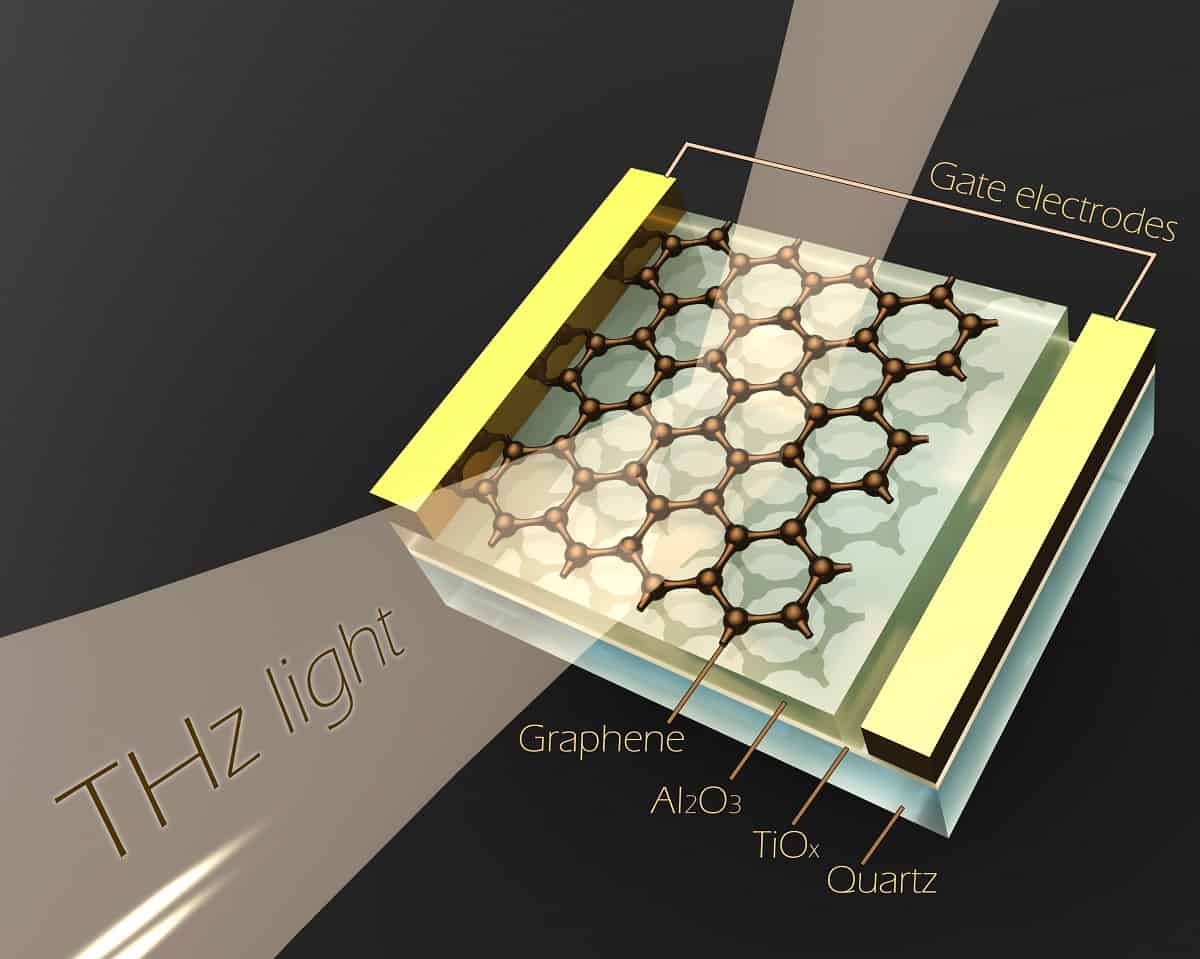
     Illustration of the device structure and its interaction with terahertz light . Credit: Xuequan
Lauren Barr 

https://physicsworld.com/a/varying-graphenes-conductivity-modulates-thz-wave/
Compared with other regions of the electromagnetic spectrum terahertz (THz), the frequency range between the infrared and the microwave, has been relatively neglected. A group from the Chinese University of Hong Kong and Warwick University have recently shown that broadband, large and fast modulation of THz beams is in fact possible, and can even be achieved with one very neat device.
Much effort has been spent designing cameras and spectrometers that operate at THz frequencies. They have already proved useful in airport security scanners, and for identifying underlying layers of old paintings.
One important component of these pieces of equipment are modulators, which control the amplitude or phase of a THz beam. These must operate quickly, consume little energy, give consistent modulation over a large frequency range, and produce large changes in the intensity or phase of a THz beam. Approaches so far include metamaterials, semiconductors and liquid crystal devices, none of which meet all the necessary requirements.

In comes Mr. Brewster…

In 1815 David Brewster published a paper describing the angle of incidence required to achieve zero reflection from a transparent body. Now over two hundred years later a team of scientists led by Jianbin Xu and Emma Pickwell-MacPherson have applied this knowledge, along with some more recent technological advances, to create a record-breaking THz modulator.
Pickwell-MacPherson commented, “Our first step was to demonstrate that broadband THz modulation can be achieved with a much lower change in the conductivity by employing  total internal reflection (TIR) geometry rather than transmission geometry (read more about it in Advanced Optical Materials). This has blossomed into the realization of several new device designs, with this latest one exploiting the Brewster angle.”
The device consists of a single stack of graphene, aluminium oxide (Al2O3) and titanium oxide (TiO­­x) on a quartz substrate. A p-polarized THz beam is reflected from the stack, and when Brewster’s angle is reached the reflection goes to zero. The addition of a layer of graphene here allows for an extra element of tunability. When a voltage is applied across the graphene between two gold contacts, the conductivity changes. This alters the Brewster angle for the stack, so for a given angle of incidence the reflected THz may be “switched on or off” by controlling the voltage.
R

Choose your mode of operation

Shining the p-polarized THz beam onto the device at an angle of 65°, and altering the voltage across the graphene from -12V to +14V, you can modulate the amplitude of the THz by between 99.3% and 99.9% across the entire frequency range of 0.5–1.6 THz. This range is limited by the experimental constraints; in theory even larger bandwidths could be achieved.
But that’s not the only option they have. The researchers took advantage of the fact that at angles greater than the Brewster angle, the reflected beam undergoes a 180° phase change. A THz beam incident at an angle of 68° will experience a phase change of at least 140° across the same frequency range when the voltage is changed from -12V to +16V. Across this range of voltages the Brewster angle varies between 72° and 64°.
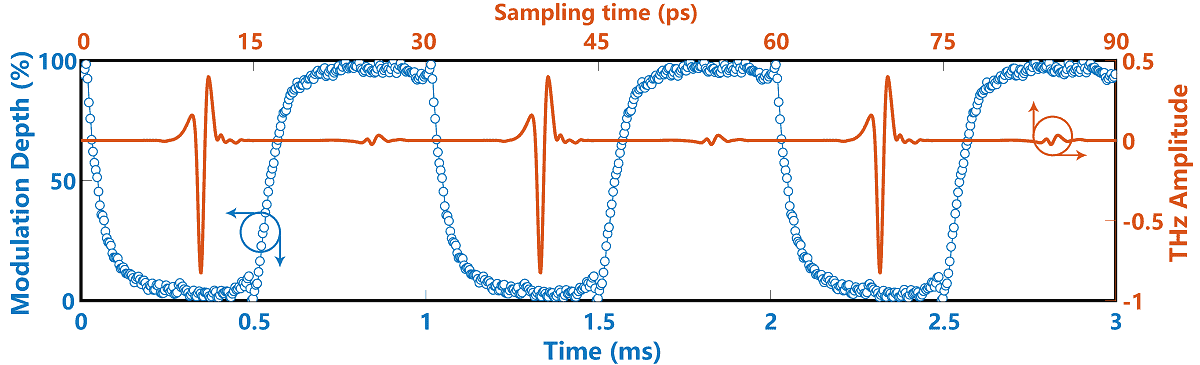
Modulated terahertz time-domain waveform (red) and the modulation depth response (blue) to a 1 kHz square-wave electrical signal. Credit: Chen Xuequan.

The need for speed

The rise time of the modulation is around 1ms, so modulation frequencies of 1 kHz are easily achieved. However, if the modulation depth can be compromised, frequencies of up to 10 kHz can also be reached. Although other solid-state THz modulators operate at significantly higher frequencies of around 2.4 MHz, all is not lost as some small tweaks can improve the modulation frequency of this device. Currently it is limited by the resistance and capacitance of the layers between the gold contacts. By reducing the size to around 1 mm and replacing the TiOx with another layer of graphene, the modulation can reach speeds comparable to other devices.
Xu, who is Director of Materials Science and Technology Research Centre, the Chinese University of Hong Kong, explained that, “the additional benefit of this device is that it can be retrofitted into existing commercially available THz spectrometers.” This graphene-controlled Brewster angle THz modulator truly propels us into the future of THz technologies in real-life applications.

Friday, August 18, 2017

New Terahertz Imaging Approach Could Speed Up Skin Cancer Detection


To enable high resolution terahertz imaging, the researchers used a digital micromirrordevice to project laser light onto a silicon wafer in a specific pattern. When a terahertz beam passes through the wafer, a computer can reconstruct an image of the object based on the pattern of terahertz light detected. The inset shows an optical image of the test target (gold pinwheel) on a 6-mm thick silicon wafer. Credit: Rayko Stantchev, University of Exeter

Researchers show that subwavelength terahertz imaging works with methods that accelerate imaging speed

http://www.businesswire.com/news/home/20170817005602/en/New-Terahertz-Imaging-Approach-Speed-Skin-Cancer

WASHINGTON--()--Researchers have developed a new terahertz imaging approach that, for the first time, can acquire micron-scale resolution images while retaining computational approaches designed to speed up image acquisition. This combination could allow terahertz imaging to be useful for detecting early-stage skin cancer without requiring a tissue biopsy from the patient.

Terahertz wavelengths fall between microwaves and infrared light on the electromagnetic spectrum. Light in this region is ideal for biological applications because, unlike x-rays, it doesn’t carry enough energy to harm tissue. Other research has shown that skin cancer cells absorb terahertz light more strongly than healthy cells, demonstrating that terahertz imaging can be useful for distinguishing between cancerous and healthy tissue.
“Skin cancer can already be detected using terahertz light, but because of the low resolution of current imaging approaches, the cancer can only be seen after it has grown quite large,” said the research team’s leader, Rayko Stantchev of the University of Exeter, UK. “Ideally, we want to detect the cancer early, when it is still small. We hope that high-resolution terahertz images, combined with the ability to take an image quickly, could eventually lead to a device that could detect cancer in the doctor’s office.”
In Optica, The Optical Society's journal for high impact research, the researchers showed that their near-field approach to terahertz imaging can achieve a spatial resolution of about nine microns and was compatible with compressed sensing and adaptive imaging algorithms that allow three times faster image acquisition than conventional technologies.
In addition to its practical benefits for medical imaging, the research also represents a new way of accomplishing high resolution terahertz imaging. In conventional imaging, spatial resolution is limited by the diffraction limit, which is determined by the wavelength of light used. Although most imaging techniques detect scattered light at some distance from the object being imaged, the researchers overcame the diffraction limit by using a unique setup to measure close, or near-field, interactions of terahertz waves with the object being imaged. Their approach produced a resolution about 1/45 of the wavelength used for imaging.
“This is the first experimental demonstration, for any spectral region, showing that compressed sensing and adaptive imaging can be performed at resolutions much smaller than the wavelength of light used for imaging,” said Stantchev. “Showing that this is physically possible will allow engineers and scientists to start to think about the full potential of this approach.”
Subwavelength terahertz imaging
The primary innovation that made the new approach possible was a digital micromirror device (DMD), an array of tiny mirrors that can each be controlled by a computer. The researchers use the DMD to project a pattern of 800nm light onto a silicon wafer, which makes the wafer opaque to terahertz light in areas where the 800nm light hits the silicon. This means that when a terahertz beam passes though the wafer, it creates a patterned terahertz beam on the other side of the wafer that can then interact with an object being imaged. Because the pattern created by the DMD is known, a computer can reconstruct an image of the object based on the detected terahertz light.
Because near-field terahertz imaging approaches are typically plagued by slow acquisition speeds, the researchers designed their approach to be compatible with compressed sensing and adaptive sampling algorithms that increase the rate of imaging. These algorithms work similarly to image compression, which reduces the size of an image by getting rid of any data not needed to visually perceive an image. Compressed sensing and adaptive imaging algorithms take this a step farther by ignoring the unnecessary data to begin with, speeding up imaging by measuring only the vital components of the image.
“We used these algorithms to determine which regions of the wafer are transparent and which regions are not transparent, essentially creating pixels,” said Stantchev. “Because we were using a single-pixel terahertz detector, normally each pixel would acquire one measurement. However, by creating many transparent pixels in one measurement, an image can be acquired more quickly by taking fewer measurements than the number of pixels.”
The researchers used their setup to image a variety of objects and showed that the method could distinguish arms of a metallic cartwheel that were spaced about nine microns apart.
Moving towards practicality
“For our current setup, we have to use a very intense laser to make the silicon wafers opaque,” said Stantchev. “This laser is very big and expensive, so to make this approach practical we needed to figure out how to do it using a much cheaper and smaller laser.”
Stantchev is now working with researchers in the Chinese University of Hong Kong who have created a different optical setup that might be able to make the silicon wafers opaque using a less powerful laser. The researchers are now working together to see if this approach might make it possible to acquire subwavelength terahertz images using a laser that cost around $200 instead of the almost $400,000 laser used for the work reported in the Optica paper.
“This is one step toward making the technique more compatible with biological applications,” said Stantchev. “Eventually, we envision a device that could be used in the doctor’s office that would quickly reveal if skin cancer is present.”
Paper: R. I. Stantchev, D. B. Phillips, P. Hobson, S. M. Hornett, M. J. Padgett, E. Hendry, “Compressed sensing with near-field THz radiation,” Optica, Volume 4 Issue 8, 989-992 (2017).
About Optica
Optica is an open-access, online-only journal dedicated to the rapid dissemination of high-impact peer-reviewed research across the entire spectrum of optics and photonics. Published monthly by The Optical Society (OSA), Optica provides a forum for pioneering research to be swiftly accessed by the international community, whether that research is theoretical or experimental, fundamental or applied. Optica maintains a distinguished editorial board of more than 40 associate editors from around the world and is overseen by Editor-in-Chief Alex Gaeta, Columbia University, USA. For more information, visit Optica.