Showing posts with label terahertz plasmonic devices. Show all posts

Monday, July 9, 2018

Abstract-Color‐Sensitive Ultrafast Optical Modulation and Switching of Terahertz Plasmonic Devices


Abhishek Kumar,   Yogesh Kumar,  Srivastava  Manukumara,  Manjappa, Ranjan Singh

https://onlinelibrary.wiley.com/doi/abs/10.1002/adom.201800030

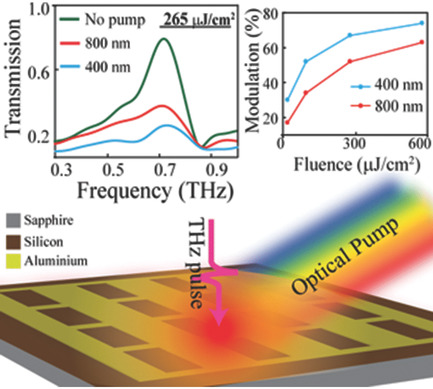
2D micro‐nanostructured metal films with hole arrays show promising features such as the extraordinary transmission of light. Such systems are interesting in the field of subwavelength photonics and nonlinear optics due to their high field confinement in addition to their inherent spectral scalability and frequency selective response. Several active schemes to control the extraordinary transmission are recently demonstrated. However, these dynamic devices do not reveal any obvious color‐dependent modulation of the resonant transmission behavior. Here, color‐sensitive ultrafast modulation of extraordinary resonant transmission of terahertz (THz) waves through 2D metallic hole arrays is demonstrated. Pumping the silicon beneath the metallic array with light of different colors and identical fluences exhibit significantly different ultrafast switching dynamics and modulation. The color‐dependent sensitivity and control of THz waves at an ultrafast timescale provide an extra degree of freedom that opens up new opportunities for future applications in active subwavelength optics, optoelectronics, and all‐optical switching of THz photonic devices.

Sunday, January 7, 2018

Abstract-An Electrically Tunable Terahertz Plasmonic Device Based on Shape Memory Alloys and Liquid Metals


Hui Zhou, Ting Zhang, Sivaraman Guruswamy, Ajay Nahata,

http://onlinelibrary.wiley.com/doi/10.1002/adom.201700684/full

An electrically tunable terahertz (THz) plasmonic device is designed and fabricated using liquid metals (eutectic gallium indium) and shape memory alloy wires (Flexinol). The liquid metal is injected into the voids of a poly(dimethyl) siloxane microfluidic mold forming a periodic array of subwavelength apertures, while the wires are inserted into the elastomer below the metal plane. When a DC voltage is applied to the wires, they contract via Joule heating, reducing the aperture periodicity and blueshifting the transmission resonances of the device. When the voltage is removed, the wires cool and elongate back to their original length, allowing the transmission spectrum to return to its original state. The magnitude of this change depends upon the applied voltage. The device is shown to thermally cycle between the relaxed state and the fully contracted state reproducibly over at least 500 thermal cycles. The asymmetric geometry of the device and the contraction process yield transmission properties that are unexpected: two closely spaced resonances, where both resonances correspond to the same scattering indices, and an increase in the transmission amplitude of the lowest order resonance upon contraction. Numerical simulations are used to understand these features.

Saturday, December 9, 2017

Abstract-Study of terahertz spoof surface plasmons on subwavelength gratings with dielectric substance in grooves

V.V.Bulgakova, V.V.Gerasimov, B.G.Goldenberg, A.G.Lemzyakov, A.M.Malkin, 

http://www.sciencedirect.com/science/article/pii/S1877705817341711

Terahertz (THz) plasmonic devises based on periodical corrugated structures are promising for sensing applications in biology and medicine but have not been developed so far because spoof surface plasmons (SSPs) on such structures were studied insufficiently in the THz spectral range. In the paper, the propagation of THz SSPs along one-dimensional subwavelength rectangular plane gratings with a dielectric substance in the grooves was studied and optimal parameters of gratings (period, aspect ratio and groove depth) for sensing of dielectric were found. First grating samples were made and tested using the THz radiation of the Novosibirsk free electron laser.