A new type of graphene metasurface containing moiré patterns that
can be made using cost-effective and scalable nanosphere lithography has been
developed by researchers at the University
of Texas at Austin

When
two pieces of fine mesh are placed one on top of the other and then rotated,
new, more complicated patterns appear. As you keep on twisting, the patterns
change like in a kaleidoscope and so-called moiré patterns form. Such patterns
have been recently observed in scanning tunnelling microscope (STM) images of
stacked layers of graphene (a sheet of carbon just one atom thick) with the
twists causing dramatic changes in the material’s electronic properties.
Graphene
also has extraordinary optical properties thanks to the fact that it supports
strong surface plasmon polaritons. A polariton is a particle-like entity (or
quasiparticle) that can be used to describe how light interacts with
semiconductors and other materials that have been made to resonate at certain
frequencies. It has two different components: an electron-hole pair (or
exciton) and a photon, which is emitted when the electron and hole recombine.
When a photon is emitted, it is immediately reabsorbed to reform an exciton, so
the cycle is repeated. This continuous exchange, or coupling, of energy between
photons and excitons can be described in terms of polariton states.
Tunable plasmonic resonance bands
Polaritons
will play an important role in future photonics devices that exploit light
instead of electricity to process information. Such devices will be much faster
and use less energy than their electronic counterparts and the strong coupling
of polaritons will be crucial for the success of this new photonics.
“Graphene metasurfaces show
plasmonic resonance bands that can be tuned from the mid-infrared to the
terahertz regimes,” explains Maruthi Nagavalli Yogeesh, who is a member of Deji Akinwande’s team in Texas
Multiband surfaces are better
The
problem is that current graphene plasmonic metasurfaces are usually single band
and it would better to be able to make multiband surfaces for more advanced
applications such as single-molecule detection, surveillance and communication.
Now,
the Austin
Obtaining various moiré patterns
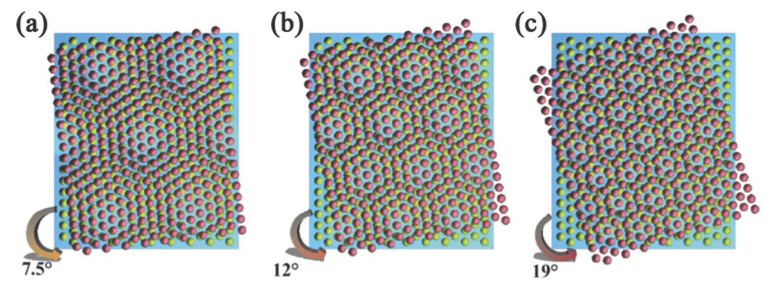
“In this work, we patterned
graphene grown by chemical vapour deposition into moiré metasurfaces by
combining moiré nanosphere lithography (MNSL) and oxygen reactive ion etching
(RIE),” explains Zilong Wu,
a member of Yuebing Zheng’s
team in Texas
An
additional RIE step creates voids between closely packed nanospheres and etches
away graphene that has been exposed to the plasma. “After removing the residual
nanospheres, graphene sheets with moiré patterns are then left on the
substrates,” adds Wu.
Towards protein biosensors
“By varying the relative
rotational angle between the top and bottom monolayers of PS nanospheres during
MNSL, we are able to significantly change the size and shape of the graphene
nanostructures in the metasurfaces. This means that we can tune the multiband
resonance peaks in the material from the infrared to the terahertz.” team
member Wei Li tellsnanotechweb.org.
The team, reporting its work in Advanced Optical MaterialsDOI: 10.1002/adom.201600242,
says that it is now working on making protein biosensors from the graphene
metasurface. “We also hope to integrate it with THz photodetectors,” says
Zheng.
About the author
Belle Dumé is contributing
editor at nanotechweb.org