Showing posts with label Weilong Li. Show all posts

Wednesday, December 14, 2016

Abstract-Angular dependent anisotropic terahertz response of vertically aligned multi-walled carbon nanotube arrays with spatial dispersion


http://www.nature.com/articles/srep38515

Spatial dispersion effect of aligned carbon nanotubes (CNTs) in the terahertz (THz) region has significance for both theoretical and applied consideration due to the unique intrinsically anisotropic physical properties of CNTs. Herein, we report the angular dependent reflection of p-polarized THz wave from vertically aligned multi-walled CNT arrays in both experiment and theory. The spectra indicate that the reflection depends on the film thickness of vertically aligned CNTs, the incident angle, and the frequency. The calculation model is based on the spatial dispersion effect of aligned CNTs and performed with effective impedance method and the Maxwell-Garnett approximation. The results fit well with the experiment when the thickness of CNT film is thin, which reveals a coherent superposition mechanism of the CNT surface reflection and CNTs/Si interface reflection. For thick CNT films, the CNTs/Si interface response determines the reflection at small incident angles, while the CNTs surface effect dominates at large incident angles. This work investigates the spatial dispersion effect of vertically aligned CNT arrays in the THz region, and paves a way for potential anisotropic THz applications based on CNTs with oblique incidence requirements.

Tuesday, March 10, 2015

Abstract-Anisotropic terahertz response of stretch-aligned composite films based on carbon nanotube-SiC hybrid structures


Ruili Wu,   Weilong Li,   Yun Wan,   Zhaoyu Ren,   Xin Long Xu and  Yixuan Zhou  
RSC Adv., 2015, Accepted Manuscript

DOI: 10.1039/C4RA14871A
Received 19 Nov 2014, Accepted 09 Mar 2015
First published online 10 Mar 2015

http://pubs.rsc.org/en/content/articlelanding/2015/ra/c4ra14871a#!divAbstract

Well-organized CNT-SiC hybrid structures were prepared by floating catalytic chemical vapor deposition (CCVD) process. The aligned CNTs-based composite materials were also fabricated by simply stretching. Gelatin and CNT-SiC hybrid structures were taken as the matrix and fillers, respectively. The alignment of CNT-SiC hybrids and anisotropic properties of the composite materials were discussed by the detection of THz time-domain spectroscopy technology. The results indicated that the anisotropic properties of CNT-SiC hybrids based composite films are better than the case of pure MWCNTs. The unique structure of hybrids not only largely favors the dispersion of CNTs in polymer matrix, but also favors the alignment of CNTs in the composites by stretching. The CNTs-based composite films with further improving the anisotropy are highly desirable for various modern applications in the electrical and optical industry (such as the polarizer).

Saturday, January 17, 2015

Abstract-Solution-processable reduced graphene oxide films as broadband terahertz wave impedance matching layers


J. Mater. Chem. C, 2015, Accepted Manuscript
http://pubs.rsc.org/en/content/articlelanding/2015/tc/c4tc02930e#!divAbstract
DOI: 10.1039/C4TC02930E


The potential of solution-processable reduced graphene oxide (rGO) films as wave impedance matching layers has been examined in a broad terahertz (THz) spectral bandwidth. The THz sheet conductivities of rGO fims measured by THz time-domain spectroscopy were observed to be tunable and sensitive to the film thicknesses and reduction degrees, which can be efficiently controlled by our solution-processable fabrication method. Remarkable broadband impedance matching was achieved with suitable rGO film, showing as the suppression of the internal reflected THz pulses from the substrate in the spectra. The underlying mechanisms have been revealed in both experiment and theory. This work paves the way for developing rGO-based broadband and large-scale anti-reflection layers for THz components.

Tuesday, July 1, 2014

Abstract-Improving Terahertz Sheet Conductivity of Graphene Films Synthesized by Atmospheric Pressure Chemical Vapor Deposition with Acetylene


Mei Qi †, Yixuan Zhou †, Fangrong Hu ‡, Xinlong Xu *†, Weilong Li †, Anran Li †, Jintao Bai †, andZhaoyu Ren *†
† State Key Lab Incubation Base of Photoelectric Technology and Functional Materials, International Collaborative Center on Photoelectric Technology and Nano Functional Materials, Institute of Photonics & Photon-Technology, Northwest University, Xi’an 710069, China
‡ School of Electronic Engineering and Automation,Guilin University of Electronic Technology, Guilin 541004, China
J. Phys. Chem. C, Article ASAP
DOI: 10.1021/jp502260k
Publication Date (Web): June 17, 2014
Copyright © 2014 American Chemical Society
*Tel.: +86-29-88303336. Fax: +86-29-88303336. E-mail: xlxuphy@nwu.edu.cn., *Tel.: +86-29-88303336. Fax:+86-29-88303336. E-mail: rzy@nwu.edu.cn.

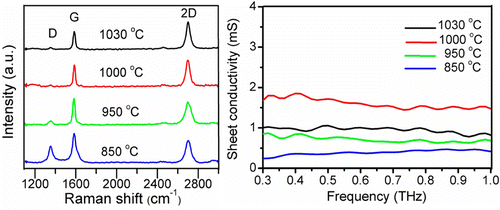
Graphene has shown great potential for terahertz (THz) applications in recent years. THz sheet conductivity of graphene is essential to assess the high performance of THz devices such as modulators based on graphene. In this work, THz sheet conductivity of graphene grown with different temperatures, along with the effects of chemical doping by HNO3, were studied in detail. Graphene films were synthesized on Cu surface by atmospheric pressure chemical vapor deposition with C2H2. Different samples with growth temperature from 850 to 1030 °C were characterized by Raman spectroscopy, transmission electron microscope, and UV–vis spectroscopy. THz time-domain spectroscopy was used to study the THz sheet conductivity of the samples before and after HNO3 doping. The results show that graphene grown at 1000 °C has the highest THz sheet conductivity. As compared to the sample grown at 850 °C, the value enhances 600%. In addition, after HNO3 doping, the THz sheet conductivity of the sample grown at 1000 °C becomes 2.42 mS, which enhances 44%. These indicate that both the optimization of the growth temperature and chemical doping can improve the THz sheet conductivity of graphene significantly. Combining with the characterization of the material, we have attributed the effect of the growth temperature to the influence of carrier momentum scattering time in graphene, and the chemical doping to the influence of the carrier concentration in graphene. This work advances the understanding of improving THz sheet conductivity by in situ growth and postgrowth and paves the way for efficient THz components with graphene.

Tuesday, June 17, 2014

Abstract-Improving Terahertz Sheet Conductivity of Graphene Films Synthesized by Atmospheric Pressure Chemical Vapor Deposition with Acetylene


J. Phys. Chem. C, Just Accepted Manuscript
DOI: 10.1021/jp502260k
Publication Date (Web): June 17, 2014
Copyright © 2014 American Chemical Society
http://pubs.acs.org/doi/abs/10.1021/jp502260k
Graphene has shown great potential for terahertz (THz) applications in recent years. THz sheet conductivity of graphene is essential to assess the high performance of THz devices such as modulators based on graphene. In this work, THz sheet conductivity of graphene grown with different temperatures, along with the effects of chemical doping by HNO3, were studied in detail. Graphene films were synthesized on Cu surface by atmospheric pressure chemical vapor deposition with C2H2. Different samples with growth temperature from 850 to 1030 oC were characterized by Raman spectroscopy, transmission electron microscope, and UV-Vis spectroscopy. THz time-domain spectroscopy was used to study the THz sheet conductivity of the samples before and after HNO3 doping. The results show that graphene grown at 1000 oC has the highest THz sheet conductivity. Compared with the sample grown at 850 oC, the value enhances 600%. In addition, after HNO3 doping, the THz sheet conductivity of the sample grown at 1000 oC becomes 2.42 mS, which enhances 44%. These indicate that both the optimization of the growth temperature and chemical doping can improve the THz sheet conductivity of graphene significantly. Combining with the characterization of the material, we have attributed the effect of the growth temperature to the influence of carrier momentum scattering time in graphene, and the chemical doping to influence of the carrier concentration in graphene. This work advances the understanding of improving THz sheet conductivity by in-situ growth and post-growth and paves the way for efficient THz components with graphene.