Showing posts with label Max Born Institute. Show all posts

Thursday, March 4, 2021

Terahertz waves from electrons oscillating in liquid water


MAX BORN INSTITUTE FOR NONLINEAR OPTICS AND SHORT PULSE SPECTROSCOPY (MBI)

Cartoon of an oscillating polaron in liquid water: (a) Schematic network of hydrogen-bonded water molecules of neat water (red: oxygen atoms, green: hydrogen atoms). (b) Electron solvated in water (yellow-red cloud). The electron attracts the hydrogen atoms of water molecules, thereby polarizing its environment of water molecules and generating a self-consistent potential trap for the electron. The electron solvated this way represents an elementary quantum system (c) A possible elementary excitation is a combined motion of the electron and the water shell, a so-called polaron. The polaron can be connected with an oscillation of the size of the quantum system (panels (b) and (c)), changing the strength of the overall electric polarization originating from the water molecules. (d) The oscillating electric polarization emits an electric field E_osc(τ) which is plotted as a function of time τ and represents the quantity observed experimentally.

https://www.eurekalert.org/pub_releases/2021-03/mbif-twf030421.php

Ionization of water molecules by light generates free electrons in liquid water. After generation, the so-called solvated electron is formed, a localized electron surrounded by a shell of water molecules. In the ultrafast localization process, the electron and its water shell display strong oscillations, giving rise to terahertz emission for tens of picoseconds.

Ionization of atoms and molecules by light is a basic physical process generating a negatively charged free electron and a positively charged parent ion. If one ionizes liquid water, the free electron undergoes a sequence of ultrafast processes by which it loses energy and eventually localizes at a new site in the liquid, surrounded by a water shell [Fig. 1]. The localization process includes a reorientation of water molecules at the new site, a so-called solvation process, in order to minimize the electric interaction energy between the electron and the water dipole moments. The localized electron obeys the laws of quantum mechanics and displays discrete energy levels. Electron localization occurs in the subpicosecond time range (1 ps = 10^-12 s = a millionth of a millionth of a second) and is followed by dissipation of excess energy into the liquid.

Researchers at the Max-Born-Institute have now observed radiation in the terahertz range (1 THz = 10^12 Hz = 10^12 oscillations per second) which is initiated during the electron localization process. As they report in the recent issue of Physical Review Letters, Vol. 126, 097401 (2021), the THz emission can persist for up to 40 ps, i.e., much longer than the localization process itself. It displays a frequency between 0.2 and 1.5 THz, depending on the electron concentration in the liquid.

The emitted THz waves originate from oscillations of the solvated electrons and their water shells. The oscillation frequency is determined by the local electric field the liquid environment exerts on this quantum system. Adding hydrated electrons to the liquid changes the local field and, thus, induces a change of oscillation frequency with electron concentration. Most surprising is the comparably weak damping of the oscillations which points to a weak interaction with the fluctuating larger environment in the liquid and a longitudinal character of the underlying electron and water motions.

The new experimental results are accounted for by a theoretical model based on a polaron picture as explained in Fig. 1. The polaron is an excitation which includes coupled motions of the electron and the water shell at low frequency. Due to such internal oscillations of charge, the hydrated electron radiates a THz wave. The weak damping of this wave allows for a manipulation of the emission, e.g., by interaction of the hydrated electron with a sequence of ultrashort light pulses.

Tuesday, January 15, 2019

5000 times faster than a computer - interatomic light rectifier generates directed electric currents


https://www.nanowerk.com/nanotechnology-news2/newsid=51873.php

(Nanowerk News) Solar cells convert the energy of light into an electric direct current (DC) which is fed into an electric supply grid. Key steps are the separation of charges after light absorption and their transport to the contacts of the device.
The electric currents are carried by negative (electrons) and positive charge carriers (holes) performing so called intraband motions in various electronic bands of the semiconductor. From a physics point of view, the following questions are essential: what is the smallest unit in a crystal which can provide a photo-induced direct current (DC)? Up to which maximum frequency can one generate such currents? Which mechanisms at the atomic scale are responsible for such charge transport?
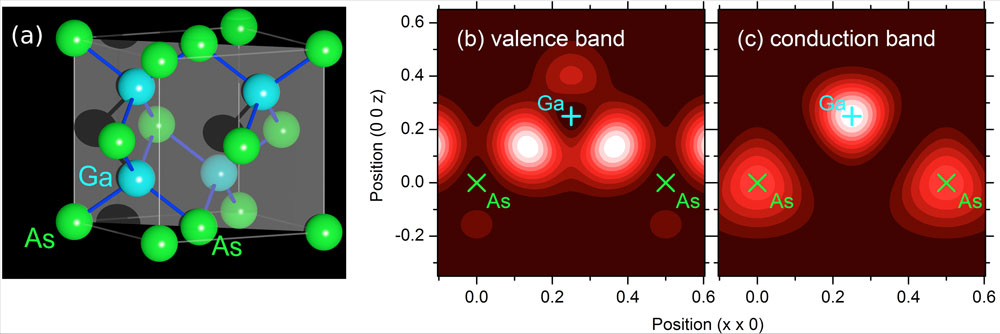
The smallest unit of a crystal is the so-called unit cell, a well-defined arrangement of atoms determined by chemical bonds. The unit cell of the prototype semiconductor GaAs is shown in Figure 1a and represents an arrangement of Ga and As atoms without a center of inversion.
In the ground state of the crystal represented by the electronic valence band, the valence electrons are concentrated on the bonds between the Ga and the As atoms (Figure 1b). Upon absorption of near-infrared or visible light, an electron is promoted from the valence band to the next higher band, the conduction band.
Resonant second-order nonlinear terahertz response of gallium arsenide
Fig.1 : (a) Unit cell of the semiconductor gallium arsenide (GaAs). Chemical bonds (blue) connect every Ga atom to four neighboring As atoms and vice versa. Valence electron density in the grey plane of (a) in the (b) ground state (the electrons are in the valence band) and in the (c) excited state (electrons are in the conduction band). Apart from the valence electrons shown, there are tightly bound electrons near the nuclei. (Image: MBI Berlin) 
In the new state, the electron charge is shifted towards the Ga atoms (Figure 1b). This charge transfer corresponds to a local electric current, the interband or shift current, which is fundamentally different from the electron motions in intraband currents. Until recently, there has been a controversial debate among theoreticians whether the experimentally observed photo-induced currents are due to intraband or interband motions.
Researchers at the Max Born Institute in Berlin, Germany, have investigated optically induced shift currents in the semiconductor gallium arsenide (GaAs) for the first time on ultrafast time scales down to 50 femtoseconds (1 fs = 10-15 seconds).
They report their results in the current issue of the journal Physical Review Letters ("Resonant second-order nonlinear terahertz response of gallium arsenide").
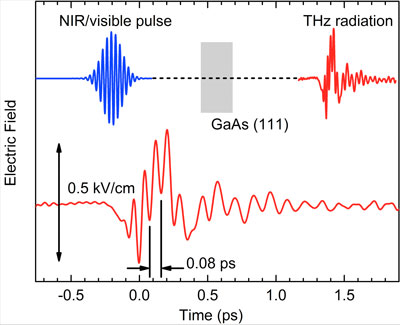
Using ultrashort, intense light pulses from the near infrared (λ = 900 nm) to the visible (λ = 650 nm, orange color), they generated shift currents in GaAs which oscillate and, thus, emit terahertz radiation with a bandwidth up to 20 THz (Figure 2). The properties of these currents and the underlying electron motions are fully reflected in the emitted THz waves which are detected in amplitude and phase.
Experimental concept of Resonant second-order nonlinear terahertz response of gallium arsenide
Fig. 2: The experimental concept is shown in the top. A short pulse in the near-infrared or visible spectral range is sent onto a thin GaAs layer. The electric field of the emitted THz radiation is measured as a function of time (1 ps = 10-12 s). An example of such a THz waveform is shown below. It contains oscillations with a period of 0.08 ps corresponding to a frequency of 12000 GHz=12 THz. (Image: MBI Berlin)
The THz radiation shows that the ultrashort current bursts of rectified light contain frequencies which are 5000 times higher than the highest clock rate of modern computer technology.
The properties of the observed shift currents definitely exclude an intraband motion of electrons or holes. In contrast, model calculations based on the interband transfer of electrons in a pseudo-potential band structure reproduce the experimental results and show that a real-space transfer of electrons over the distance on the order of a bond length represents the key mechanism.
This process is operative within each unit cell of the crystal, i.e., on a sub-nanometer length scale, and causes the rectification of the optical field. The effect can be exploited at even higher frequencies, offering novel interesting applications in high frequency electronics.

Tuesday, July 17, 2018

What happens when we heat the atomic lattice of a magnet with terahertz bursts all of a sudden?

https://www.nanowerk.com/nanotechnology-news2/newsid=50687.php
(Nanowerk News) Magnets have fascinated humans for several thousand years and enabled the age of digital data storage. They occur in various flavors. Ferrimagnets form the largest class of magnets and consist of two types of atoms. Similar to a compass needle, each atom exhibits a little magnetic moment, also called spin, which arises from the rotation of the atom's electrons about their own axes.
In a ferrimagnet, the magnetic moments point in opposite directions for the two types of atoms (see panel A). Thus, the total magnetization is the sum of all magnetic moments of type 1 (M1), blue arrows) and type 2 (M2), green arrows). Due to the opposite direction, the magnitude of the total magnetization is M1-M2.
When an insulating ferrimagnet is heated, the heat is first deposited in the atomic lattice which causes the atoms to move randomly around their cold positions. Finally, part of the heat also causes random rotation (precession) of the spins around their cold direction.
Thus, magnetic order gets lost; the total magnetization (M1-M2) decreases and eventually vanishes if the temperature of the ferrimagnet exceeds a critical temperature, the so-called Curie temperature. Although this process is of fundamental importance, its dynamics are not well understood.
Even for the ferrimagnet yttrium iron garnet (YIG), one of the most intensely researched ferrimagnets, it is unknown how long it takes until the heated atomic lattice and the cold magnetic spins reach equilibrium with each other. Previous estimates of this time scale differ from each other by a factor of up to one million.

Fig. 1 (A-C): Heating a magnet without changing its magnetization. (A) A ferrimagnet consists of two spin sorts of opposite orientation (green and blue arrows). In the experiment, the atomic lattice of the ferrimagnet is heated by an extremely short terahertz laser pulse. This situation is analogous to heating the air (=atomic lattice) inside an oven that contains a pot with water (=spins). (B) Heat is transferred into the spin system and decreases the magnetization of each spin type by exactly the same amount. This process arises because spin is transferred from the blue to the green spin sort. Thus, the magnet is heated without changing its total magnetization! In the pot analogy, heat is transferred from the air outside the pot to the water inside. While the amount of water in the pot has not changed, an overpressure has built up. (C) Finally, the hot spins release their overpressure to the atomic lattice, thereby reducing the total magnetization. In the analogy, water overpressure is released through little leaks in the pot lid. (Image: Fritz Haber Institute)
A team of scientists from Berlin (Collaborative Research Center / Transregio 227 Ultrafast Spin Dynamics, Fritz Haber Institute and Max Born Institute), Dresden (Helmholtz Center), Uppsala (Sweden), St. Petersburg (Russia), and Sendai (Japan) have now revealed the elementary steps of this process (Science Advances"Dissecting spin-phonon equilibration in ferrimagnetic insulators by ultrafast lattice excitation").
"To instantaneously and exclusively heat up the atomic lattice of a YIG film, we use a very specific and novel kind of stimulus: ultrashort bursts of laser light at terahertz frequencies. With a subsequently arriving visible laser pulse, we can then step-by-step trace the evolution of the initially cold magnetic spins. Essentially, we record a stop-motion movie of how the magnetization evolves," says Sebastian Maehrlein, who conducted the experiments.
His colleague Ilie Radu summarizes: "Our observations are striking. We found that sudden heating of the atomic lattice reduces the magnetic order of the ferrimagnet on two distinct time scales: an incredibly fast scale of only 1 ps and a 100,000 times slower scale of 100 ns."
These two time scales can be understood in analogy to water in a closed pot that is put into a hot oven. The hot air of the oven corresponds to the hot atomic lattice whereas the magnetic spins correspond to the water inside the pot (see panel A). Once the atomic lattice is heated by the terahertz laser burst, the enhanced random oscillations of the atoms lead to a transfer of magnetic order from spin type 1 to spin type 2.
Therefore, both the magnetic moments M1 (blue arrows in panel B) and M2 (green arrows) are reduced by exactly the same amount (red arrows). This process evolves on the fast time scale, and the atomic spins are forced to heat up while leaving the total magnetization M1-M2unchanged, just like water in a closed pot that has to keep its volume.
We know, however, that a heated ferrimagnet not only aims at reducing M1 and M2, but also its total magnetization M1-M2. To do so, part of the spin must be released to the atomic lattice.
This situation is again completely analogous to the hot water in a closed pot: the pressure inside the pot increases but is slowly released to the outside through little leaks in the lid (see panel C). This leakage of angular momentum to the atomic lattice is exactly what happens in the ferrimagnet through weak couplings between spins and lattice.
"We now have a clear picture of how the hot atomic lattice and the cold magnetic spins of a ferrimagnetic insulator equilibrate with each other." says Ilie Radu.
The international team of researchers discovered that energy transfer proceeds very quickly and leads to a novel state of matter in which the spins are hot but have not yet reduced their total magnetic moment. This "spin overpressure" is released through much slower processes that permit leakage of angular momentum to the lattice.
"Our results are also relevant for applications in data storage." Sebastian Maehrlein adds. “The reason is simple. Whenever we want to switch the value of a bit between 0 to 1 in a magnetic storage medium, angular momentum and energy have to finally be transferred between atomic lattice and spins."

Thursday, September 14, 2017

Max Born Institute- Aspirin tablets help unravel basic physics


https://www.mbi-berlin.de/en/current/index.html#2017_09_01

Aspirin in form of small crystallites provides new insight into delicate motions of electrons and atomic nuclei. Set into molecular vibration by strong ultrashort far-infrared (terahertz) pulses, the nuclei oscillate much faster than for weak excitation. They gradually return to their intrinsic oscillation frequency, in parallel to the picosecond decay of electronic motions. An analysis of the terahertz waves radiated from the moving particles by in-depth theory reveals the strongly coupled character of electron and nuclear dynamics characteristic for a large class of molecular materials.
Based on its physiological activity, aspirin has found widespread pharmaceutical application in different medical areas. Looking at an individual aspirin molecule from the physics perspective, one can distinguish two types of motions: (i) molecular vibrations, i.e., oscillatory motions of the atomic nuclei in a wide frequency range, among them, e.g., the hindered rotation of the methyl group (Movie 1) at a frequency of 6 terahertz (THz) (1 THz = 1,000,000,000,000 oscillation cycles per second) and (ii) oscillatory motions of electrons in the molecule around 1000 THz (Movie 2), as induced, e.g., by ultraviolet light. While the different motions are only weakly coupled in a single aspirin molecule, they develop a very strong electric interaction in a dense molecular packaging such as in the aspirin tablets from the pharmacy. As a result, the character of particular vibrations, the so-called soft modes, changes and their oscillation frequency is substantially reduced (Movie 3). This complex coupling scheme and the resulting molecular dynamics are important for how aspirin and other molecules respond to an external stimulus. So far, this problem has remained unresolved.

In the current issue of Physical Review Letters, researchers from the Max Born Institute in Berlin and the University of Luxembourg combine top-notch experimental and theoretical methods to unravel the basic properties of soft modes. In the experiments, a sequence of two phase-locked THz pulses interacts with a 700-μm thick tablet of polycrystalline aspirin. The electric field radiated by the moving atoms serves as a probe for mapping the soft-mode oscillations in real time. Two-dimensional scans in which the time delay between the two THz pulses is varied, display a strong nonlinearity of the soft-mode response in aspirin crystals. This nonlinearity is dominated by a pronounced transient shift of the soft mode to higher frequencies (Fig. 1). The response displays a non-instantaneous character with picosecond decay times originating from the generated electric polarization of the crystallites. During the polarization decay, the soft-mode frequency returns gradually to the value it had before excitation.

The theoretical analysis shows that strong electric polarizations in the ensemble of aspirin molecules give the soft mode a hybrid character, combining nuclear and electronic degrees of freedom via dipole-dipole coupling. In the unexcited aspirin crystallites, this correlation between electrons and nuclei determines the soft-mode frequency. Strong THz excitation induces a break-up of the correlations, resulting in a transient blue-shift of the soft modes and, via the comparably slow decay (decoherence) of the polarization, a non-instantaneous response. The scenario discovered here is relevant for a large class of molecular materials, in particular for those with applications in ferroelectrics.

Movie 1: A single aspirin molecule in vacuum showing hindered rotations of the methyl group. Grey balls: carbon atoms, red balls: oxygen atoms, and white balls: hydrogen atoms. The vibrating methyl group consists of 1 carbon atom and 3 hydrogen atoms.

Movie 2: A single aspirin molecule in vacuum showing collective oscillations of the π electrons in the benzene ring. The latter is represented by the hexagon of carbon atoms. The oscillating yellow cloud represents the π electrons in the benzene ring.

Movie 3: Atomic motions of the soft mode in an aspirin crystal. In contrast to a single aspririn molecule in vacuum shown in movies 1 and 2 the hindered rotations of the methyl group are strongly coupled to the collective oscillations of the π electrons in the benzene ring.

Original publication: Physical Review Letters 119, 097404 (2017)
Strong Local-Field Enhancement of the Nonlinear Soft-Mode Response in a Molecular Crystal
Giulia Folpini, Klaus Reimann, Michael Woerner, Thomas Elsaesser, Johannes Hoja, and Alexandre Tkatchenko 
Contact
Dr. Michael Woerner Tel. 030 6392 1470
Giulia Folpini Tel. 030 6392 1474
Prof. Dr. Klaus Reimann Tel. 030 6392 1476
Prof. Dr. Thomas Elsaesser Tel. 030 6392 1400

Tuesday, May 10, 2016

Quantum Swing: a pendulum that moves forward and backwards at the same time


Fig. 1: Experimental data: (a) Two-dimensional (2D) scan of the sum of the electric fields E(?,t) of the three driving THz pulses A, B, and C as a function of the coherence time ? and the real time t. The contour plot is colored red for positive electric fields and blue for negative fields. (b) 2D scan of electric field ENL(?,t) nonlinearly emitted by the two-phonon coherence in InSb. The orange dashed line indicates the center of pulse A. (c) Electric field transient ENL(0,t) for the coherence time ?=0.
Credit: Image courtesy of Forschungsverbund Berlin e.V. (FVB)
Two-quantum oscillations of atoms in a semiconductor crystal are excited by ultrashort terahertz pulses. The terahertz waves radiated from the moving atoms are analyzed by a novel time-resolving method and demonstrate the non-classical character of large-amplitude atomic motions.
The classical pendulum of a clock swings forth and back with a well-defined elongation and velocity at any instant in time. During this motion, the total energy is constant and depends on the initial elongation which can be chosen arbitrarily. Oscillators in the quantum world of atoms and molecules behave quite differently: their energy has discrete values corresponding to different quantum states. The location of the atom in a single quantum state of the oscillator is described by a time-independent wavefunction, meaning that there are no oscillations.
Oscillations in the quantum world require a superposition of different quantum states, a so-called coherence or wavepacket. The superposition of two quantum states, a one-phonon coherence, results in an atomic motion close to the classical pendulum. Much more interesting are two-phonon coherences, a genuinely non-classical excitation for which the atom is at two different positions simultaneously. Its velocity is nonclassical, meaning that the atom moves at the same time both to the right and to the left as shown in the movie. Such motions exist for very short times only as the well-defined superposition of quantum states decays by so-called decoherence within a few picoseconds (1 picosecond = 10-12 s). Two-phonon coherences are highly relevant in the new research area of quantum phononics where tailored atomic motions such as squeezed and/or entangled phonons are investigated.
In a recent issue of Physical Review Letters, researchers from the Max Born Institute in Berlin apply a novel method of two-dimensional terahertz (2D-THz) spectroscopy for generating and analyzing non-classical two-phonon coherences with huge spatial amplitudes. In their experiments, a sequence of three phase-locked THz pulses interacts with a 70-μm thick crystal of the semiconductor InSb and the electric field radiated by the moving atoms serves as a probe for mapping the phonons in real-time. Two-dimensional scans in which the time delay between the three THz pulses is varied, display strong two-phonon signals and reveal their temporal signature [Fig. 1]. A detailed theoretical analysis shows that multiple nonlinear interactions of all three THz pulses with the InSb crystal generate strong two-phonon excitations.
This novel experimental scheme allows for the first time to kick off and detect large amplitude two-quantum coherences of lattice vibrations in a crystal. All experimental observations are in excellent agreement with theoretical calculations. This new type of 2D THz spectroscopy paves the way towards generating, analyzing, and manipulating other low-energy excitations in solids such as magnons and transitions between ground and excited states of excitons and impurities with multiple-pulse sequences.
Movie: Visualization of nonclassical quantum coherences in matter. The two parabolas (black curves) show the potential energy surfaces of harmonic oscillators representing the oscillations of atoms in a crystalline solid around their equilibrium positions, i.e., the so called phonons. Blue curves: probability of presence of atoms at different spatial positions in thermal equilibrium. The quantum mechanical uncertainty principle demands a finite width of such distribution functions. Red curves: time-dependent probability distributions of coherent oscillating states in matter. One-phonon coherence (left panel): the quantum mechanical motion of atoms resembles the classical motion of a pendulum (cyan ball). The latter moves during the oscillation either from left to right or vice versa. Two-phonon coherence (right panel): quantum mechanics allows also for kicking off a nonclassical state with the quantum-mechanical property that the atom can be at two positions simultaneously. The velocity of the atoms behaves also nonclassical, i.e., the atom moves at the same time both to the right and to the left. In the case of a perfect harmonic oscillator the currents of the two parts of the atom exactly cancel each other. Thus, a small anharmonicity is necessary to observe the emission of a coherent electric field transient as shown in Fig. 1(c).

Story Source:
The above post is reprinted from materials provided byForschungsverbund Berlin e.V. (FVB)Note: Materials may be edited for content and length.

Journal Reference:
  1. Carmine Somma, Giulia Folpini, Klaus Reimann, Michael Woerner, Thomas Elsaesser. Two-Phonon Quantum Coherences in Indium Antimonide Studied by Nonlinear Two-Dimensional Terahertz SpectroscopyPhysical Review Letters, 2016; 116 (17) DOI:10.1103/PhysRevLett.116.177401

Tuesday, April 15, 2014

AC/DC for terahertz waves - rectification with picosecond clock rates


MBI – 15.04.2014:

AC/DC for terahertz waves - rectification with picosecond clock rates

Researchers at the Max-Born-Institute in Berlin, Germany discover an ultrafast rectifier for terahertz radiation. In the unit cells of a lithium niobate crystal alternating currents (AC) with a frequency 1000 times higher than that of modern computer systems are transformed into a direct current (DC), thereby generating simultaneously a series of overtones of the terahertz radiation.
When the guitarist Angus Young of the Australian hard rock band AC/DC touches the strings of his electric guitar, a strongly distorted sound rings out from the loudspeaker. The origin of the electronically generated overtones is the rectifying effect in the electronic tubes of the guitar amplifier. In the simplest case an (A)lternating (C)urrent generates a (D)irect (C)urrent, an effect which finds its application in telecommunications at much higher radio or mobile phone frequencies. From a physics point of view the highly interesting question arises: up to which cut-off frequencies can one generate directed currents (DC) and which microscopic mechanisms underlie them?
For the generation of a direct current out of alternating currents the material used must feature a preferred direction. This condition is fulfilled by ferroelectric crystals, in which the spatial separation of positively and negatively charged ions is connected to a static electric polarization. Most ferroelectrics are electric insulators, i.e., low electric fields cannot cause any detectable electric currents in the material. A drastic change of this behavior is observed if one applies for a short period an extremely high electric field in the range of several 100.000 volts per centimeter. At such field strengths, bound electrons, the so called valence electrons can be freed for a short period by means of the quantum mechanical tunneling process leading in turn to a current through the crystal.
Now, researchers at the Max-Born-Institute in Berlin, Germany investigated the properties of such a current for the first time and report their results in the current issue of the journal Physical Review Letters 112.146602 (2014)). Using ultrashort, intense terahertz pulses (1 Terahertz = 1012 Hz, period of a field oscillation 1 picosecond=10-12 seconds) they applied an AC field to a thin lithium niobate (LiNbO3) crystal which causes an electric current in the material. The properties of this current were studied in detail by measuring and analyzing the electric field radiated by the accelerated electrons. Besides an oscillating current with the frequency of the applied terahertz field (2 THz) and several overtones of the latter, the researchers observed the signature of a directed current (DC) along the c-axis the preferred direction of the ferroelectric LiNbO3 crystal.
The rectified current along the ferroelectric c-axis has its origin in the interplay of quantum mechanical tunneling of electrons between the valence and several conduction bands of the LiNbO3 crystal and the deceleration of electrons by friction processes. The tunneling process generates free electrons which in absence of friction would spatially oscillate in time with the applied terahertz field. The friction destroys this oscillatory motion, a mechanism called decoherence. Due to the asymmetry of the tunneling barrier along the ferroelectric c-axis decoherence results in a spatially asymmetric transport, i.e., the tunneling barrier lets pass more electrons from right to left than from left to right. This mechanism is operative within each unit cell of the crystal, i.e., on a sub-nanometer length scale, and causes the rectification of the terahertz field. The effect can be exploited at even higher frequencies, offering novel interesting applications in high frequency electronics.
Fig. 1: Experiment: The high electric field of the intense terahertz pulse accelerates electrons in a lithium niobate LiNbO3 crystal. The hexagonal unit cell contains lithium atoms (green spheres), niobium atoms (blue spheres), and oxygen atoms (red spheres) the latter being arranged on the corners of a unit cell. The crystal lacks inversion symmetry and, thus, shows a ferroelectric polarization along the c-axis.

Fig. 2: During transport along the c-axis, electrons see alternating different distances between lithium and niobium atoms. Moreover, the niobium atoms are not in the center of the oxygen octahedrons. Such geometry leads to asymmetric barriers the electrons have to pass by quantum mechanical tunneling when moving along the c-axis. The electrons are driven through the barriers by the high terahertz AC field. The barrier asymmetry together with decoherence/friction processes result in a spatially asymmetric transport, i.e., the rectification to a DC current.
AC/DC for terahertz waves Fig. 2


Fig. 2 | Fig.: MBI

Moviehttp://www.mbi-berlin.de/en/current/index.html


Original article

C. Somma, K. Reimann, C. Flytzanis, T. Elsaesser, und M. Woerner: High-Field Terahertz Bulk Photovoltaic Effect in Lithium Niobate
Physical Review Letters 112.146602 (2014)

Contact

Max-Born-Institut für Nichtlineare Optik und Kurzzeitspektroskopie (MBI)
Dr. Michael Wörner, woerner@mbi-berlin.de, Tel.: 0049 30 6392 1470
Carmine Somma, somma@mbi-berlin.de, Tel.: 0049 30 6392 1474
Prof. Dr. Thomas Elsässer, elsaesser@mbi-berlin.de, Tel.: 0049 30 6392 1400