Showing posts with label Louvre. Show all posts

Sunday, December 29, 2013

A Roman fresco discovered under a XIX century painting


Terahertz analysis unveiled a hidden image that was never discovered before with other imaging technologies
http://www.digitalmeetsculture.net/article/a-roman-fresco-discovered-under-a-xix-century-painting/

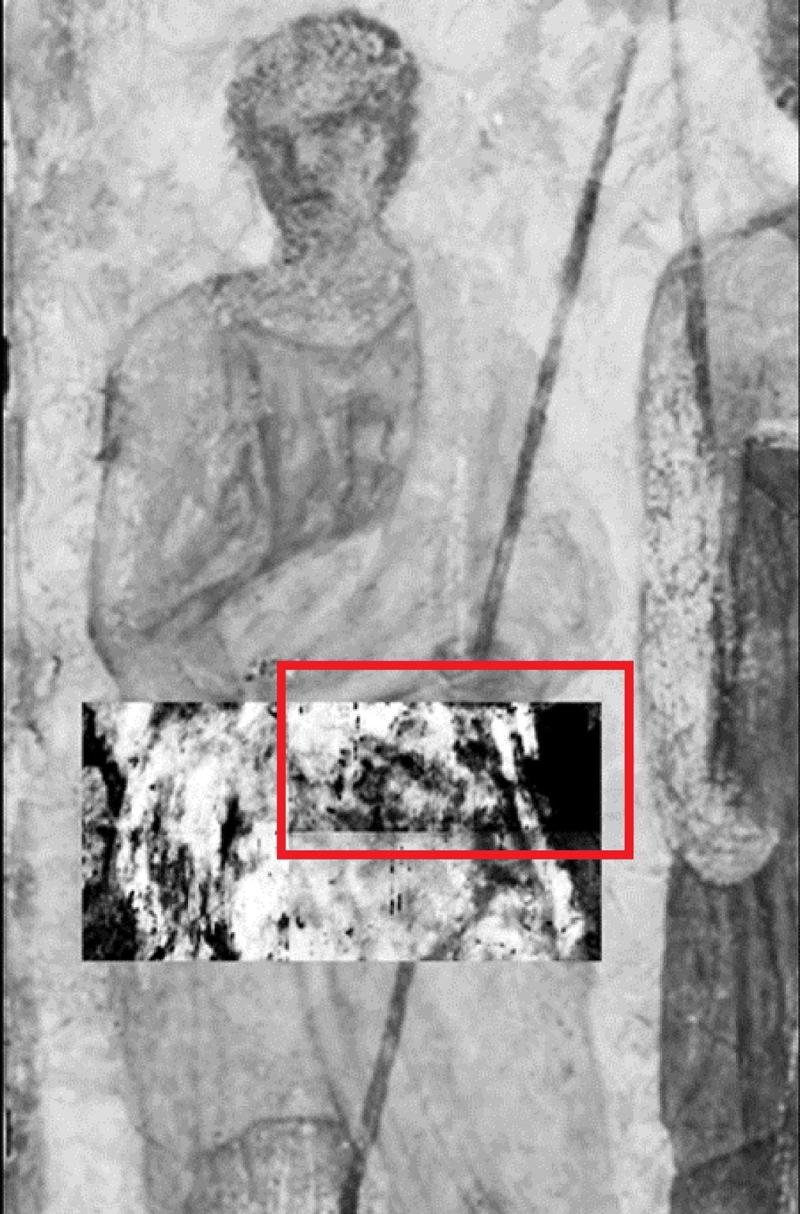
The terahertz technology, also used in airport security scanners, has detectedthe face of an ancient Roman man hidden below the surface of a wall painting in the Louvre Museum in Paris. The nineteenth-century fresco under examination was Trois homes armés de lances, in the Giampietro Campana collection (an Italian art collector in the 1800s who sometimes restored damaged parts in the artworks, or reworked the original), and the analysis with terahertz technology unveiled an authentic Roman fresco that lies under it, which scientists and art historians believe may be thousands of years old. Art historians believe that Trois homes armés de lances was painted after the ancient fresco was removed from its original wall in Italy and entered Campana’s collection.
130410154622-large
It is a well-known habit that in the past artists sometimes re-used canvases or covered old paintings with new works, in order to avoid the expense of buying a new canvas or to enhance colors and shapes in a prior composition. J. Bianca Jackson, Ph.D. now at the University of Rochester, who reported on the project, explained how the staff tried with terahertz technology analysis when suspicions that a hidden image might lie beneath Campana’s brushstrokes came out.
“We were amazed, and we were delighted,” said Jackson. “We could not believe our eyes as the image materialized on the screen. Underneath the top painting of the folds of a man’s tunic, we saw an eye, a nose and then a mouth appear. We were seeing what likely was part of an ancient Roman fresco, thousands of years old.”
“Terahertz technology has been in use for some time, especially in quality control in the pharmaceutical industry to assure the integrity of pills and capsules, in biomedical imaging and even in homeland security with those whole-body scanners that see beneath clothing at airport security check points,”said Jackson, “But its use in examining artifacts and artworks is relatively new.”
This research was funded by the EC project CHARISMA and in part byAHRC/EPSRC Science and Heritage Programme; while the research on the possibilities offerd by the use of terahertz technology for heritage investigation is on-going, as witnessed by the recently launched project INSIDDE.
“No previous imaging technique, including almost half a dozen commonly used to detect hidden images below paintings, forged signatures of artists and other information not visible on the surface has revealed a lost image in this fresco,”Jackson said. “This opens to door to wider use of the technology in the world of art, and we also used the method to study a Russian religious icon and the walls of a mud hut in one of humanity’s first settlements in what was ancient Turkey.”
Source: American Chemical Society (ACS) (2013, April 10). Ancient Roman man hidden beneath famouspaintingattheLouvre. ScienceDaily.Retrieved –http://www.sciencedaily.com/releases/2013/04/130410154622.htm

Wednesday, April 10, 2013

Revealing hidden artwork with airport security full-body-scanner technology


http://phys.org/news/2013-04-revealing-hidden-artwork-airport-full-body-scanner.html

In the latest achievement in efforts to see what may lie underneath the surface of great works of art, scientists today described the first use of an imaging technology like that used in airport whole-body security scanners to detect the face of an ancient Roman man hidden below the surface of a wall painting in the Louvre Museum in Paris.

They described unveiling the image, which scientists and art historians say may be thousands of years old, during the 245th National Meeting & Exposition of the American Chemical Society.


 J. Bianca Jackson, Ph.D., who reported on the project, explained that it involved a fresco, which is a mural or painting done on a wall after application of fresh plaster. In a fresco, the artist's paint seeps into the wet plaster and sets as the plaster dries. The painting becomes part of the wall. The earliest known frescoes date to about 1500 B.C. and were found on the island of Crete in Greece.

 "No previous imaging technique, including almost half a dozen commonly used to detect hidden images below paintings, forged signatures of artists and other information not visible on the surface has revealed a lost image in this fresco," Jackson said. "This opens to door to wider use of the technology in the world of art, and we also used the method to study a Russian religious icon and the walls of a mud hut in one of humanity's first settlements in what was ancient Turkey." 

The technology is a new addition to the palette that art conservators and scientists use to see below the surface and detect changes, including fake signatures and other alterations in a painting. Termed terahertz spectroscopy, it uses beams of electromagnetic radiation that lie between microwaves, like those used in kitchen ovens, and the infrared rays used in TV remote controls. This radiation is relatively weak, does not damage paintings and does not involve exposure to harmful radiation. 

"Terahertz technology has been in use for some time, especially in quality control in the pharmaceutical industry to assure the integrity of pills and capsules, in biomedical imaging and even in homeland security with those whole-body scanners that see beneath clothing at airport security check points," said Jackson, who is now with the University of Rochester. "But its use in examining artifacts and artworks is relatively new." 

Artists, including some of the great masters, sometimes re-used canvases, wiping out the initial image or covered old paintings with new works. They often did this in order to avoid the expense of buying a new canvas or to enhance colors and shapes in a prior composition. Frescoes likewise got a refresh, especially when the originals faded, owners tired of the image on the wall or property changed hands.

The scientists turned to terahertz technology when suspicions surfaced that a hidden image might lie beneath the brushstrokes of a precious 19th century fresco, Trois hommes armés de lances, in the Louvre's Campana collection. Giampietro Campana was an Italian art collector in the 1800s whose treasures are now on display in museums around the world. When Campana acquired a work of art, he sometimes restored damaged parts or reworked the original. Art historians believe that Campana painted Trois hommes armés de lances after the fresco was removed from its original wall in Italy and entered his collection.

 Jackson said that Campana's painting in itself is valuable, and the terahertz revelations may have added value by showing that an authentic Roman fresco lies under it. 

To search for a hidden image, Jackson and colleagues, including Gerard Mourou, Ph.D., of Ècole Polytechnique, and , Ph.D., of the Centre de Recherche et de Restauration des Musées de France, and Vincent Detalle, of the Laboratoire Recherche des Monuments Historiques, probed it with terahertz technology. The process is slow, requiring a few hours to analyze a section the size of a sheet of paper.

 "We were amazed, and we were delighted," said Jackson. "We could not believe our eyes as the image materialized on the screen. Underneath the top painting of the folds of a man's tunic, we saw an eye, a nose and then a mouth appear. We were seeing what likely was part of an ancient Roman fresco, thousands of years old."

 Who is the man in the fresco? An imperial Roman senator? A patrician? A plebian? A great orator? A ruler who changed the course of history? Or just a wealthy, egotistical landowner who wanted to admire his image on the wall? 

Jackson is leaving those questions to art historians. The team already has moved ahead and used terahertz technology to study a Russian religious icon and the walls of a mud hut in one of the earliest known human settlements in what now is the country of Turkey.

 More information: Abstract

 Terahertz pulse imaging and spectroscopy is emerging as a tool of high potential for the nondestructive investigation of historical artworks, architecture and archaeological objects for the purpose of research and conservation. We studied a section of the fresco Trois hommes armés de lances from the Louvre's Campana collection using time-domain terahertz imaging. The top painting is 19th C, while the support is composed of wall sections recovered from Roman ruins. No previous technique, including X-ray radiography, XRF, infrared photography, infrared reflectometry and UV florescence, has produced an image of a lost fresco beneath the painting. A composite of the photograph of the section and the composite terahertz image reveals a face hidden beneath the 1st man's drape. Other examples of this application will also be presented, including a Russian icon, a wall painting from the Riga Dom cathedral and a Neolithic site from Catalhoyuk Turkey

My note: see related earlier story-http://terahertztechnology.blogspot.com/2010/08/advanced-photonix-sells-t-4000-to.html

Thursday, August 12, 2010

Advanced photonix sells T-4000 to the C2RMF at the Louvre

Current logo for the C2RMF.Image via Wikipedia
Advanced Photonix, Inc. Announces T-Ray® 4000 Sale to Center for Research and Restoration of the Museums of France
ANN ARBOR, Mich., Aug. 12 /PRNewswire-FirstCall/ -- Advanced Photonix today announced that the Center for Research and Restoration of the Museums of France (C2RMF), located at the Louvre Palace has purchased a T-Ray 4000®, as its instrument of choice for performing investigations into art conservation and restoration using terahertz technology. The system, which will be located in the most prestigious art restoration research center in France, will be available to researchers from across France and the European Union and will be shipped during the current quarter.
This purchase is the next step in a dynamic relationship between the C2RMF and Advanced Photonix (API) that has existed since 2007. During this time, the T-Ray® 4000 has been used for such varied purposes as investigation of ancient pigment spectroscopy, identifying paintings under plaster, examining the contents of burial urns, reading a papyrus scroll without opening it, and dating a wood panel by its growth rings. These investigations have occurred at Advanced Photonix headquarters in Ann Arbor, at the C2RMF in Paris, onsite at a chapel in Vif outside Grenoble, and at the Egyptian collection of the University of Chicago. The unique information that can be obtained using this equipment, and its ability to be easily transported to remote locations, make it an invaluable tool in the preservation and restoration of cultural heritage artifacts.
"We are excited to be working with the top researchers at the C2RMF and continuing to develop the art restoration and conservation market. It is a confirmation of the versatility of our 4th generation terahertz system, the T-Ray® 4000, to address a number of market opportunities from research to industrial applications. The fact that it was chosen for this active research center above all other options, speak volumes to the flexibility and performance of our system," said Richard Kurtz, CEO of API.
The T-Ray 4000® produces ultrashort pulses of terahertz that allow a variety of unique and novel applications to be investigated. The system's patented fiber coupling permits automated or manual positioning of the sensor heads. This permits the imaging of any size objects in place, thereby eliminating the need to fit the object into a specialized sample chamber. The excellent signal to noise ratio of the T-Ray® platform allows even thick samples to be scanned effectively.
The Centre for Research and Restoration of the Museums of France is the national research centre in France responsible for the documentation, conservation and restoration of the items held in the collections of more than 1,200 museums across France. C2RMF also carries out extensive scientific studies and data recording for these collections, and is active both nationally and internationally in the field of cultural heritage conservation and analysis. The C2RMF is involved in the development of technologies and scientific procedures employed in the preservation of art works and artifacts, both on its own and in partnership with other museums and research institutions across the globe.
About Advanced Photonix, Inc.
Advanced Photonix, Inc. (R) (NYSE Amex: API) is a leading supplier with a broad offering of optoelectronic products to a global customer base. We provide optoelectronic solutions, high-speed optical receivers and terahertz instrumentation for telecom, homeland security, military, medical and industrial markets. With our patented technology and state-of-the-art manufacturing we offer industry leading performance, exceptional quality, and high value added products to our OEM customer base. For more information visit us on the web at www.advancedphotonix.com.
Enhanced by Zemanta