A repository & source of cutting edge news about emerging terahertz technology, it's commercialization & innovations in THz devices, quality & process control, medical diagnostics, security, astronomy, communications, applications in graphene, metamaterials, CMOS, compressive sensing, 3d printing, and the Internet of Nanothings. NOTHING POSTED IS INVESTMENT ADVICE! REPOSTED COPYRIGHT IS FOR EDUCATIONAL USE.
The origin of the water spin isomers observed under various physico-chemical conditions is of great interest, including that of H2O molecules in the gas phase. Here, terahertz time-domain spectroscopy (THz-TDS) was used to study the humidity-dependent ortho-to-para (O/P) ratio of water vapor at room temperature. The relative contents of para and ortho molecules were obtained by fitting the absorption lines of water vapor showing the relationship between the spin isomer contents and humidity. Larger O/P ratios with values of 3.2 were observed at lower humidity (<20%) due to the stronger attractive forces of para molecules. The concentration of the ortho isomers then began to decrease at higher humidity (>20%) due to the preferential formation of dimers and clusters at increasing concentrations. Thus, the ratio gradually decreased with increasing humidity.
In terms of the evaluation of the diffusion-controlled adsorption and diffused rate, a mathematical model was built on the basis of the double-exponential kinetics model and terahertz amplitude in this letter. The double-exponential-THz model described the two-step mechanism controlled by diffusion. A rapid step involves external and internal diffusion, followed by a slow step controlled by intraparticle diffusion. The concentration gradient of the molecules promoted the organic molecules rapidly diffusing to the external surface of adsorbent. The solute molecules then transferred across the liquid film. Intraparticle diffusion began and was determined by the molecular sizes, as well as affinities between organics and activated carbon.
Water content in crude oil is closely related to the prediction of water level of oil well, the evaluation of oil reservoir exploitation and the recovery and development of mining scheme. Therefore, the accurate measurement of water content is significant not only for forecasting the exploiting capacity of an oil field before mining and estimating working status, but also for grading and evaluating oil products.
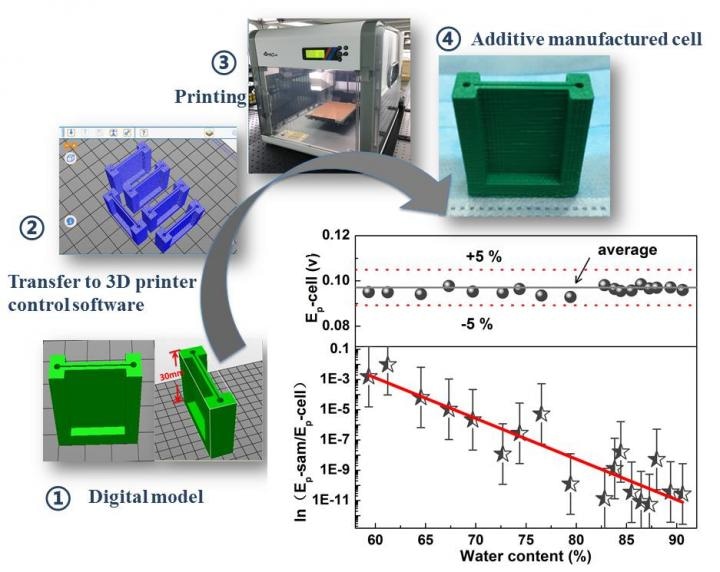
Producing sample pool using AM technology and the relationship between water content and THz parameters. (Credit: Science China Press)
In order to optimize the production and confirm the security, simple and secure methods have been proposed for detecting the water content in crude oil. Terahertz (THz) radiation is a newly-developed, non-contact and secure method, and can be absorbed by organics and water molecules in different degrees, which has been used to evaluate the quality of oil and oil products.
In the article, coauthored with LiMei Guan, HongLei Zhan, XinYang Miao, Jing Zhu, Kun Zhao, water content in oil-water mixtures from 1.8%-90.6% was measured by using special designed samplers for high-water-content oil which are manufactured by additive manufacturing system. These researchers stated: "water content of oil-water mixtures with high water content is quantitatively characterized by the combination of THz spectroscopy and 3D-printing technology".
The study was published in the journal Science China Physics, Mechanics & Astronomy. The strong absorption of water in the THz range leads to a decrease in SNR (signal-to-noiseratio), applying the additive manufactured samplers, the problem that signals usually affected by the significant signal attenuation can be resolved.
Detailed analysis shows the relationships among THz parameters such as signal peak, time delay, and refractive index as well as absorption coefficient and water content in crude oil. Therefore, these THz parameters can be used to continuously monitor the moisture content.
In summary, the combination of THz spectroscopy and AM technique can be applied in oil characterization, even when the oilfield enters the high-water-bearing period. This combination could be a promising selection for measuring water content of fluid with good accuracy, which in turn could open up a new area of research.