New theoretical study shows how to use Terahertz light to peep in the secrets of two-dimensional superconductors
https://scitechdaily.com/controlling-two-dimensional-superconductors-with-terahertz-light/
A researcher at the Center for Theoretical Physics of Complex Systems, within the Institute for Basic Science (IBS, South Korea), Professor Ivan Savenko, has reported a conceptually new method to study the properties of superconductors using optical tools. The theory was published in Physical Review Letters and co-authored by Doctor Vadim Kovalev, physicist at the A.V. Rzhanov Institute of Semiconductor Physics (Russia).
Below some temperature, the resistivity of a material can disappear, and thus, superconducting properties emerge. These are usually extremely low temperatures, between -200°C and -272°C, where commonly unbound electrons suddenly change their behavior and pair up, forming Cooper pairs. This transition manifests itself with supercurrents, which can circulate in the material forever without losses.

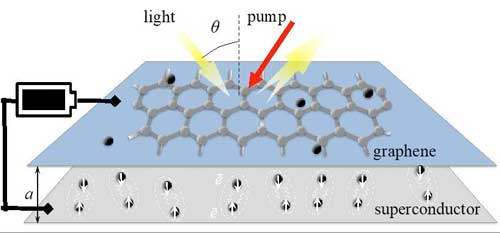
Graphic of the system: a two-dimensional superconductor close to its critical temperature. The system is exposed to electromagnetic field (orange arrow) with THz frequency. Stripes of metals as a grating (not shown) are required for the excitation of plasmons, a special type of excitations of unbound electrons in the superconductor. Thus, unbound electrons act as mediators: they interact with each other, with light (as plasmons), and with the Cooper pairs, depicted as dashed red circles. Credit: IBS
However, superconducting properties can appear slightly above the critical temperature. In this so-called fluctuating regime, Cooper pairs start to appear and disappear, drastically altering the electric conductivity and other properties of the superconductor. More than fifty years ago, Aslamazov and Larkin developed a theory which says that the conductivity of fluctuating superconductors is mediated by both unbound electrons and Cooper pairs. However, fluctuating superconductivity is such a challenging research topic that it continues to be investigated. In this new study, the researchers suggest a way to monitor these electron transport phenomena with optical spectroscopy, an experimentally available optical platform.
“While the resistivity-based and magnetic methods to monitor superconductors are well established, it is very hard to “marry” light and superconductivity,” explains Savenko. “This is a hot research field where we can expect new discoveries in fundamental science and innovative applications.”
Superconductivity and light are two seemingly unrelated phenomena. Usually, superconductors are not very sensitive to external light: they can only weakly interact with it, and rather serve as mirrors. This study, instead, shows that light at terahertz (THz) frequencies, which lie between the radio and infrared domains, could be used to optically explore the properties of superconductors.
The researchers modelled the optical and electrical responses of a 2D fluctuating semiconducting layer exposed to THz waves. Approaching the critical temperature, the emerging Cooper pairs cause significant changes in electric conductivity and light absorption by the system. The unbound electrons act as mediators, interacting with both Cooper pairs and light.
“The design we developed is very simple. Therefore, we believe that our discovery can be applicable to multiple cases,” says Savenko. “We expect that the corresponding experiment will be conducted in the near future. It should show either the modification of the electric current, or the alteration of the reflected or transmitted light spectrum, depending on the density of the Cooper pairs.”
Reference: “Proposal for Plasmon Spectroscopy of Fluctuations in Low-Dimensional Superconductors” by V. M. Kovalev and I. G. Savenko, 18 May 2020, Physical Review Letters.
DOI: 10.1103/PhysRevLett.124.207002
DOI: 10.1103/PhysRevLett.124.207002