Showing posts with label Hamid Rajabalipanah. Show all posts

Monday, June 29, 2020

Abstract-A theoretical investigation on reciprocity-inspired wide-angle spectrally-selective THz absorbers augmented by anisotropic metamaterials


Mansoureh Mohammadi, Hamid Rajabalipanah,  Ali Abdolali,
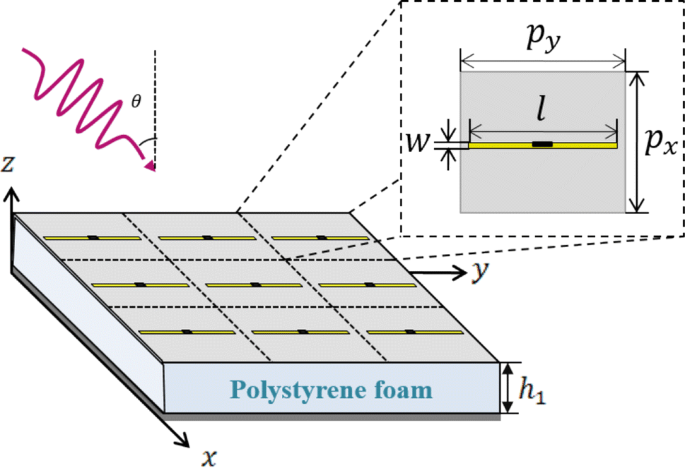
figure1
https://www.nature.com/articles/s41598-020-67399-3

In this paper, a theoretical framework relying on the reciprocity theorem is proposed to accurately design a spectrally-selective THz superstrate-loaded metamaterial absorber (SLMA) exhibiting wide-angle feature. By leveraging high-order Floquet harmonics in a generalized transmission line model characterizing the conventional metamaterial absorbers (MAs), it is demonstrated that MAs suffer from impedance mismatch, especially at near grazing angles. From an impedance matching viewpoint, this major challenge is tackled in this paper via two different designs, exploiting a magneto-electric anisotropic Huygens' metamaterial and a multilayer dielectric structure at a certain distance over the MA plane. The numerical results corroborate well the theoretical predictions, elucidating that the proposed SLMA significantly broadens the angular performance of the MA up to near grazing angles (about 80°), where high absorptivity is still achieved in both principal planes. The deteriorating effect of diffraction modes has been comprehensively analyzed. In comparison to the previous wide-angle MA reports based on intricate particle geometries and brute-force optimizations, the proposed design features a straightforward semi-analytical algorithm, which can also be re-developed for microwave, mid-infrared, and optical frequency bands and for any type of MA element. The proposed SLMA would be very promising for various wavelength-selective applications such as sensors and imaging.

Thursday, February 8, 2018

Abstract-Multilayer graphene-based metasurfaces: robust design method for extremely broadband, wide-angle, and polarization-insensitive terahertz absorbers


Mahdi Rahmanzadeh, Hamid Rajabalipanah, and Ali Abdolali

https://www.osapublishing.org/ao/abstract.cfm?uri=ao-57-4-959

In this study, by using an equivalent circuit method, a polarization-insensitive terahertz (THz) absorber based on multilayer graphene-based metasurfaces (MGBMs) is systematically designed, providing an extremely broad absorption bandwidth (BW). The proposed absorber is a compact, three-layer structure, comprising square-, cross-, and circular-shaped graphene metasurfaces embedded between three separator dielectrics. The equivalent-conductivity method serves as a parameter retrieval technique to characterize the graphene metasurfaces as the components of the proposed circuit model. Good agreement is observed between the full-wave simulations and the equivalent-circuit predictions. The optimum MGBM absorber exhibits >90% absorbance in an extremely broad frequency band of 0.55–3.12 THz (BW=140%). The results indicate a significant BW enhancement compared with both the previous metal- and graphene-based THz absorbers, highlighting the capability of the designed MGBM absorber. To clarify the physical mechanism of absorption, the surface current and the electric-field distributions, as well as the power loss density of each graphene metasurface, are monitored and discussed. The MGBM functionality is evaluated under a wide range of incident wave angles to prove that the proposed absorber is omnidirectional and polarization-insensitive. These superior performances guarantee the applicability of the MGBM structure as an ultra-broadband absorber for various THz applications.
© 2018 Optical Society of America