Showing posts with label Guocui Wang. Show all posts

Saturday, January 25, 2020

Abstract-Gate-controlled terahertz focusing based on graphene-loaded metasurface


Naeem Ullah, Weiguang Liu, Guocui Wang, Zongyuan Wang, Ata Ur Rahman Khalid, Bin Hu, Juan Liu, and Yan Zhang
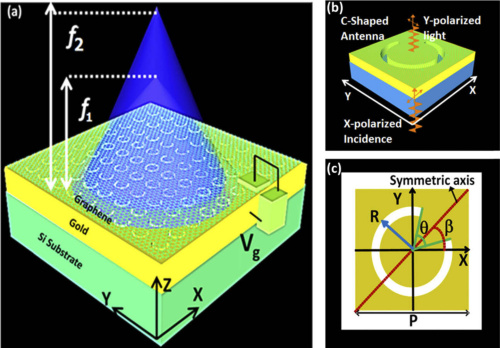
 (a) Schematic of the designed graphene-loaded metalens. A gate voltage Vg is applied to tune the chemical potential of graphene. (b) One unit-cell of the structure under the illumination of a linearly x-polarized THz wave. The transmitted y-polarized wave is dependent on both the C-shaped aperture and the graphene chemical potential. (c) 2-D illustration of a basic unit-cell, where P = 100µm, w = 10µm. The symmetric axis has an angle of β=45° to the x-axis.
https://www.osapublishing.org/oe/abstract.cfm?uri=oe-28-3-2789

Metasurfaces have proven their great application potentials in terahertz (THz) wave modulations. However, realizing an active metasurface retaining lensing functionality in the THz frequency regime is still highly desired. Here a metalens, featuring electrically tunable focal length, based on propagation phase delay, is proposed and demonstrated experimentally. To have full control over the designed lens functionality, a gold thin film etched with a C-shaped aperture antenna array covered by monolayer graphene is used. By applying a bias voltage to the graphene, the phase control of the antenna array is changed, and thus the focus of the linearly polarized THz beam can be flexibly tuned from 7.13mm to 8.25mm. The proposed approach has a promising perspective for a variety of applications in communication, reconfigurable flat optics and real-time imaging in THz regime.
© 2020 Optical Society of America under the terms of the OSA Open Access Publishing Agreement

Thursday, October 4, 2018

Abstract-Ultraviolet light-induced terahertz modulation based on indium oxide thin film


Hongyu Ji, Bo Zhang, Wei Wang, Guocui Wang, Longfeng Lv, and Jingling Shen

https://www.osapublishing.org/abstract.cfm?uri=isuptw-2018-WI19&origin=search


An active ultraviolet light-induced terahertz modulation based on indium oxide thin film was investigated in which exhibit a large absorption modulation of ~50% when illuminated by a low intensity UV laser (11 mW/cm2). The interaction between indium oxide and the metamaterial structure was investigated due to the large enhancement of photo carriers in UV-induced in indium oxide film. We can realize the absorption peak shifts of 37 GHz by changing the UV excited light intensity.
© 2018 The Author(s)

Thursday, May 24, 2018

Abstract-Optically tunable terahertz-band interference fringes shift


Dandan Liu, Bo Zhang, Wei Wang, Hongyu Ji, Guocui Wang, Jingling Shen

https://www.sciencedirect.com/science/article/abs/pii/S0030401818303602


Optically tunable terahertz (THz)-band interference fringes shift in a polymer/silicon structure was investigated. We report an interference phenomenon formed by partial-through measurements and shift of periodic peaks in a terahertz time-domain spectroscopy system. When the terahertz beam passes through the sample edge, equally-spaced interference fringes are obtained in the frequency domain, and the interference fringes can be varied using an external continuous wave laser. This work offers the ability to observe THz-band interference fringes in the frequency domain; these interference fringes change with variations in the applied excitation light intensity

Monday, January 9, 2017

Abstract-Monolayer graphene based organic optical terahertz modulator


Guocui Wang, Bo Zhang, Hongyu Ji,   Xin Liu, Ting He, Longfeng Lv, Yanbing Hou,  Jingling Shen,

http://aip.scitation.org/doi/full/10.1063/1.4973816

We investigate a high-efficiency broadband terahertz wave modulator with structures made from the conjugated polymer [2-methoxy-5-(2′-ethylhexyloxy)-1, 4-phenylennevinylene], graphene, and Si, irradiated with an external excitation laser. We demonstrate a strategy that can alleviate the tradeoff between the requirements of modulation depth and modulation speed in polymer/silicon terahertz wave modulators. Using terahertz time-domain and continuous-wave systems, we measured both the terahertz transmission modulation properties and the time responses of the modulator structures. The conjugated polymer/graphene/silicon structure achieved a high modulation factor of 93% for transmission as well as improved the modulation speed of the devices based on polymer/silicon. The high modulation efficiency of the polymer/graphene/silicon structure was induced by the enhancement in carrier density and the extremely high carrier mobility of graphene, respectively.