Showing posts with label Francesco P. Mezzapesa. Show all posts

Monday, December 7, 2020

Abstract-Terahertz Frequency Combs Exploiting an On-Chip, Solution-Processed, Graphene-Quantum Cascade Laser Coupled-Cavity


Francesco P. Mezzapesa,  Katia Garrasi, Johannes Schmidt, Luca Salemi, Valentino Pistore, Lianhe Li, A. Giles Davies, Edmund H. Linfield, Michael Riesch, Christian Jirauschek, Tian Carey, Felice Torrisi, Andrea C. Ferrari,  Miriam S. Vitiello

https://pubs.acs.org/doi/10.1021/acsphotonics.0c01523#

The ability to engineer quantum-cascade-lasers (QCLs) with ultrabroad gain spectra, and with a full compensation of the group velocity dispersion, at terahertz (THz) frequencies, is key for devising monolithic and miniaturized optical frequency-comb-synthesizers (FCSs) in the far-infrared. In THz QCLs four-wave mixing, driven by intrinsic third-order susceptibility of the intersubband gain medium, self-locks the optical modes in phase, allowing stable comb operation, albeit over a restricted dynamic range (∼20% of the laser operational range). Here, we engineer miniaturized THz FCSs, comprising a heterogeneous THz QCL, integrated with a tightly coupled, on-chip, solution-processed, graphene saturable-absorber reflector that preserves phase-coherence between lasing modes, even when four-wave mixing no longer provides dispersion compensation. This enables a high-power (8 mW) FCS with over 90 optical modes, through 55% of the laser operational range. We also achieve stable injection-locking, paving the way to a number of key applications, including high-precision tunable broadband-spectroscopy and quantum-metrology.

Friday, August 28, 2020

Music goes terahertz: Scientists achieve breakthrough for pulsed terahertz lasers


https://www.nanowerk.com/nanotechnology-news2/newsid=56003.php
(Nanowerk News) An international research team from Germany, Italy, and the UK has developed a key photonics component for the intriguing terahertz spectral range. By mixing electronic resonances in semiconductor nanostructures with the photon field of microresonators, they designed a stained mirror that bleaches more easily than ever and could make terahertz lasers ultrafast.
The results are published in Nature Communications ("Ultrafast terahertz saturable absorbers using tailored intersubband polaritons").
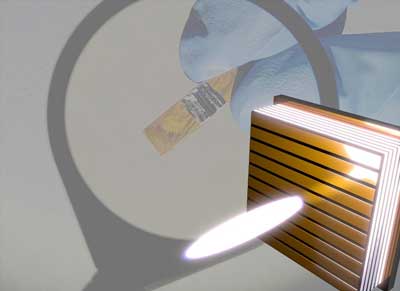
A strong light pulse (white) can turn the saturable absorber (gold grating) into a nearly perfect mirror
A strong light pulse (white) can turn the saturable absorber (gold grating) into a nearly perfect mirror. Background photo: magnified view of a quantum cascade laser (center part of the silver area). (Image: Juergen Raab, Universität Regensburg)
Terahertz radiation – often dubbed T-rays – marks one of the last frontiers in photonics. Located in the spectral gap between microwave electronics and infrared optics, T-rays offer enormous application potential, but they have been expensive to generate. First broadly available terahertz applications range from body scanners at airports and rapid gas sensing to ultrafast communication.
Many more ideas could hit the market if ultrashort pulses could be directly generated in so-called quantum cascade lasers, special types of electrically driven, compact terahertz lasers. These sources typically operate in continuous wave mode, but it has been widely predicted that they might change into pulsed operation if a key photonics element was incorporated into the laser – a so-called saturable absorber.
A saturable absorber works like a foggy mirror that transiently turns clear if the incident light becomes too bright. If all the power inside a laser concentrates in a short pulse it would easily saturate the absorber and suffer less loss than a continuous wave beam.
Such elements are readily available in optics, whereas in the terahertz domain they have only existed for impracticably intense radiation, not achievable with quantum cascade lasers.
A European consortium formed by the research groups of Miriam S. Vitiello, Pisa, Edmund Linfield, Leeds, and Rupert Huber, University of Regensburg, have now joined forces to develop a new class of saturable absorbers operating at much lower saturation intensities.
Their novel idea is inspired by a strategy well-known in music: resonators. Where does a Steinway piano get its unique sound from? The secret is less in the strings than in the resonating body. This is where the exact sound is defined and its dynamical response to a forte keystroke.
“We essentially transfer this idea into terahertz optics”, says Jürgen Raab, lead author of the manuscript.
Miriam Vitiello’s group designed a microstructured assembly of a gold mirror and a gold grating that jointly work like a resonating body for terahertz radiation. These resonances can be coupled strongly with electrons that can hop between two quantum states defined by an atomically precise sequence of semiconducting nanostructures, designed and grown in the group of Edmund Linfield.
The pivot: The strong coupling between the electrons and the terahertz microcavity results in an excitation that is half electron, half terahertz photon. This situation not only shapes the “tone” of the resonance, but it also dramatically changes the way the system reacts to a “forte keystroke”, corresponding to an intense terahertz pulse.
The group put the new terahertz Steinway to its ultimate test. In a specially designed setup in Regensburg, they focused an ultrashort terahertz pulse onto the saturable absorber and developed an extreme slow-motion camera to follow its saturation dynamics on the femtosecond time scale – the millionth part of a billionth of a second.
The amazing result: The absorber was not only much easier to saturate than the electronic transition alone, by approximately an order of magnitude. It also saturates faster than a single oscillation cycle of the terahertz pulse, and the “tone” of the resonator morphs so well during the saturation process that essentially no absorption remains while the intense THz pulse is applied. These are the best possible genes of saturable absorbers.
Miriam Vitiello is convinced: “Now we have all components at hand to build ultrafast terahertz quantum cascade lasers with saturable absorbers”.
Such a source could dramatically extend the scope of terahertz photonics. Surpassing the frequency of modern computers by a staggering factor of 1000, ultrashort terahertz pulses could form the backbone of revolutionary next-generation telecommunication links. Compact quantum cascade lasers, emitting ultrashort T-rays, may allow also boost chemical analytics and enable an enormous variety of applications in diagnostics and medicine. With the current results, an important milestone towards these bold goals has been reached.

Thursday, August 27, 2020

Abstract-Ultrafast terahertz saturable absorbers using tailored intersubband polaritons


Jürgen Raab, Francesco P. Mezzapesa, Leonardo Viti, Nils Dessmann, Laura K. Diebel, Lianhe Li, A. Giles Davies, Edmund H. Linfield, Christoph Lange, Rupert Huber, Miriam S. Vitiello,

         Polaritonic saturable absorber structure.
https://www.nature.com/articles/s41467-020-18004-8

Semiconductor heterostructures have enabled a great variety of applications ranging from GHz electronics to photonic quantum devices. While nonlinearities play a central role for cutting-edge functionality, they require strong field amplitudes owing to the weak light-matter coupling of electronic resonances of naturally occurring materials. Here, we ultrastrongly couple intersubband transitions of semiconductor quantum wells to the photonic mode of a metallic cavity in order to custom-tailor the population and polarization dynamics of intersubband cavity polaritons in the saturation regime. Two-dimensional THz spectroscopy reveals strong subcycle nonlinearities including six-wave mixing and a collapse of light-matter coupling within 900 fs. This collapse bleaches the absorption, at a peak intensity one order of magnitude lower than previous all-integrated approaches and well achievable by state-of-the-art QCLs, as demonstrated by a saturation of the structure under cw-excitation. We complement our data by a quantitative theory. Our results highlight a path towards passively mode-locked QCLs based on polaritonic saturable absorbers in a monolithic single-chip design.

Saturday, February 9, 2019

Abstract-High dynamic range, heterogeneous, terahertz quantum cascade lasers featuring thermally-tunable frequency comb operation over a broad current range


We report on the engineering of broadband quantum cascade lasers (QCLs) emitting at Terahertz (THz) frequencies, which exploit a heterogeneous active region scheme and have a current density dynamic range (Jdr) of 3.2, significantly larger than the state of the art, over a 1.3 THz bandwidth. We demonstrate that the devised broadband lasers operate as THz optical frequency comb synthesizers in continuous wave, with a maximum optical output power of 4 mW (0.73 mW in the comb regime). Measurement of the intermode beatnote map reveals a clear dispersion-compensated frequency comb regime extending over a continuous 106 mA current range (current density dynamic range of 1.24), significantly larger than the state of the art reported under similar geometries, with a corresponding emission bandwidth of 1.05 THz ans a stable and narrow (4.15 KHz) beatnote detected with a signal-to-noise ratio of 34 dB. Analysis of the electrical and thermal beatnote tuning reveals a current-tuning coefficient ranging between 5 MHz/mA and 2.1 MHz/mA and a temperature-tuning coefficient of -4 MHz/K. The ability to tune the THz QCL combs over their full dynamic range by temperature and current paves the way for their use as powerful spectroscopy tool that can provide broad frequency coverage combined with high precision spectral accuracy.