Showing posts with label DESY. Show all posts

Saturday, March 21, 2020

Tiny double terahertz accelerator recycles energy

Proof of concept for cascaded terahertz accelerator using long pulses. The mini-accelerator uses terahertz radiation that can be recycled for a second stage of acceleration. Credit: DESY, Science Communication Lab
by 
https://phys.org/news/2020-03-tiny-recycles-energy.html

A team of DESY scientists has built a miniature double particle accelerator that can recycle some of the laser energy fed into the system to boost the energy of the accelerated electrons a second time. The device uses narrowband terahertz radiation which lies between infrared and radio frequencies in the electromagnetic spectrum, and a single accelerating tube is just 1.5 centimetres long and 0.79 millimetres in diameter. Dongfang Zhang and his colleagues from the Center for Free-Electron laser Science (CFEL) at DESY present their experimental accelerator in the journal Physical Review X.

The miniature size of the device is possible due to the short wavelength of  radiation. "Terahertz-based accelerators have emerged as promising candidates for next-generation compact electron sources," explains Franz Kärtner, Lead Scientist at DESY and head of the CFEL group that built the device. Scientists have successfully experimented with terahertz accelerators before, which could enable applications where large particle accelerators are just not feasible or necessary. "However, the technique is still in an early stage, and the performance of experimental terahertz accelerators has been limited by the relatively short section of interaction between the  and the electrons," says Kärtner.
For the new device, the team used a longer  comprising many cycles of terahertz waves. This multicycle pulse significantly extends the interaction section with the particles. "We feed the multicycle terahertz pulse into a waveguide that is lined with a dielectric material", says Zhang. Within the waveguide, the pulse's speed is reduced. A bunch of electrons is shot into the central part of the waveguide just in time to travel along with the pulse. "This scheme increases the interaction region between the terahertz pulse and the electron bunch to the centimetre range—compared to a few millimetres in earlier experiments," reports Zhang.
The device did not produce a large acceleration in the lab. However, the team could prove the concept by showing that the electrons gain energy in the waveguide. "It is a proof of concept. The electrons' energy increased from 55 to about 56.5 kilo electron volts," says Zhang. "A stronger acceleration can be achieved by using a stronger laser to generate the terahertz pulses."
The set-up is mainly designed for the non-relativistic regime, meaning the electrons have speeds that are not so close to the speed of light. Interestingly, this regime enables a recycling of the terahertz pulse for a second stage of acceleration. "Once the terahertz pulse leaves the waveguide and enters the vacuum, its speed is reset to the speed of light," explains Zhang. "This means, the pulse overtakes the slower electron bunch in a couple of centimetres. We placed a second waveguide at just the right distance that the electrons enter it together with the terahertz pulse which is again slowed down by the waveguide. In this way, we generate a second interaction section, boosting the electrons' energies further."
In the lab experiment, only a small fraction of the terahertz pulse could be recycled this way. But the experiment shows that recycling is possible in principle, and Zhang is confident that the recycled fraction can be substantially increased. Nicholas Mattlis, senior scientist and the team leader of the project in the CFEL group, emphasises: "Our cascading scheme will greatly lower the demand on the required laser system for electron acceleration in the non-relativistic regime, opening new possibilities for the design of terahertz-based accelerators."

Friday, July 12, 2019

Experimental mini-accelerator achieves record energy


The two-stage miniature accelerator is operated with terahertz radiation (shown here in red). In a first step (left) the electron bunches (shown in blue) are compressed, in a second step (right) they are accelerated. The two individual elements are each about two centimeters wide. Credit: DESY, Gesine Born
https://phys.org/news/2019-07-experimental-mini-accelerator-energy.html\

Scientists at DESY have achieved a new world record for an experimental type of miniature particle accelerator: For the first time, a terahertz powered accelerator more than doubled the energy of the injected electrons. At the same time, the setup significantly improved the electron beam quality compared to earlier experiments with the technique, as Dongfang Zhang and his colleagues from the Center for Free-Electron Laser Science (CFEL) at DESY report in the journal Optica. "We have achieved the best beam parameters yet for terahertz accelerators," said Zhang.
"This result represents a critical step forward for the practical implementation of terahertz-powered accelerators," emphasized Franz Kärtner, who heads the ultrafast optics and X-rays group at DESY. Terahertz radiation lies between infrared and microwave frequencies in the electromagnetic spectrum and promises a new generation of compact particle accelerators. "The wavelength of terahertz radiation is about a hundred times shorter than the  currently used to accelerate particles," explained Kärtner. "This means that the components of the  can also be built to be around a hundred times smaller." The terahertz approach promises lab-sized accelerators that will enable completely new applications for instance as compact X-ray sources for materials science and maybe even for medical imaging. The technology is currently under development.
Since terahertz waves oscillate so fast, every component and every step has to be precisely synchronized. "For instance, to achieve the best  gain, the electrons have to hit the terahertz field exactly during its accelerating half cycle," explained Zhang. In accelerators, particles usually do not fly in a continuous , but are packed in bunches. Because of the fast-changing field, in terahertz accelerators these bunches have to be very short to ensure even acceleration conditions along the bunch.
"In previous experiments the electron bunches were too long", said Zhang. "Since the terahertz field oscillates so quickly, some of the electrons in the bunch were accelerated, while others were even slowed down. So, in total there was just a moderate average energy gain, and, what is more important, a wide energy spread, resulting in what we call poor beam quality." To make things worse, this effect strongly increased the emittance, a measure for how well a particle beam is bundled transversally. The tighter, the better—the smaller the emittance.
To improve the beam quality, Zhang and his colleagues built a two-step accelerator from a multi-purpose device they had developed earlier: The Segmented Terahertz Electron Accelerator and Manipulator (STEAM) can compress, focus, accelerate and analyze electron bunches with terahertz radiation. The researchers combined two STEAM devices in line. They first compressed the incoming electron bunches from about 0.3 millimetres in length to just 0.1 millimetres. With the second STEAM device, they accelerated the compressed bunches. "This scheme requires control on the level of quadrillionths of a second, which we achieved," said Zhang "This led to a fourfold reduction of the energy spread and improved the emittance sixfold, yielding the best beam parameters of a terahertz accelerator so far."
The net energy gain of the electrons that were injected with an energy of 55 kiloelectron volts (keV) was 70 keV. "This is the first energy boost greater than 100 percent in a terahertz powered accelerator," emphasised Zhang. The coupled device produced an accelerating field with a peak strength of 200 million Volts per metre (MV/m) - close to state-of-the-art strongest conventional accelerators. For practical applications this still has to be significantly improved. "Our work shows that even a more than three times stronger compression of the electron bunches is possible. Together with a higher terahertz energy, acceleration gradients in the regime of gigavolts per metre seem feasible," summarized Zhang. "The  concept thus appears increasingly promising as a realistic option for the design of compact electron accelerators."

Friday, June 14, 2019

Laser trick produces high-energy terahertz pulses


From the color difference of two slightly delayed laser flashes (left) a non-linear crystal generates an energetic terahertz pulse (right).CREDIT DESY, Lucid Berlin
https://www.eurekalert.org/pub_releases/2019-06/ded-ltp061319.php

A team of scientists from DESY and the University of Hamburg has achieved an important milestone in the quest for a new type of compact particle accelerator. Using ultra-powerful pulses of laser light, they were able to produce particularly high-energy flashes of radiation in the terahertz range having a sharply defined wavelength (colour). Terahertz radiation is to open the way for a new generation of compact particle accelerators that will find room on a lab bench. The team headed by Andreas Maier and Franz Kärtner from the Hamburg Center for Free-Electron Laser Science (CFEL) is presenting its findings in the journal Nature Communications. CFEL is jointly run by DESY, the University of Hamburg and the Max Planck Society.
The terahertz range of electromagnetic radiation lies between the infrared and microwave frequencies. Air travellers may be familiar with terahertz radiation from the full-body scanners used by airport security to search for objects hidden beneath a person's garments. However, radiation in this frequency range might also be used to build compact particle accelerators. "The wavelength of terahertz radiation is about a thousand times shorter than the radio waves that are currently used to accelerate particles," says Kärtner, who is a lead scientist at DESY. "This means that the components of the accelerator can also be built to be around a thousand times smaller." The generation of high-energy terahertz pulses is therefore also an important step for the AXSIS (frontiers in Attosecond X-ray Science: Imaging and Spectroscopy) project at CFEL, funded by the European Research Council (ERC), which aims to open up completely new applications with compact terahertz particle accelerators.
However, chivvying along an appreciable number of particles calls for powerful pulses of terahertz radiation having a sharply defined wavelength. This is precisely what the team has now managed to create. "In order to generate terahertz pulses, we fire two powerful pulses of laser light into a so-called non-linear crystal, with a minimal time delay between the two," explains Maier from the University of Hamburg. The two laser pulses have a kind of colour gradient, meaning that the colour at the front of the pulse is different from that at the back. The slight time shift between the two pulses therefore leads to a slight difference in colour. "This difference lies precisely in the terahertz range," says Maier. "The crystal converts the difference in colour into a terahertz pulse."
The method requires the two laser pulses to be precisely synchronised. The scientists achieve this by splitting a single pulse into two parts and sending one of them on a short detour so that it is slightly delayed before the two pulses are eventually superimposed again. However, the colour gradient along the pulses is not constant, in other words the colour does not change uniformly along the length of the pulse. Instead, the colour changes slowly at first, and then more and more quickly, producing a curved outline. As a result, the colour difference between the two staggered pulses is not constant. The difference is only appropriate for producing terahertz radiation over a narrow stretch of the pulse.
"That was a big obstacle towards creating high-energy terahertz pulses," as Maier reports. "Because straightening the colour gradient of the pulses, which would have been the obvious solution, is not easy to do in practice." It was co-author Nicholas Matlis who came up with the crucial idea: he suggested that the colour profile of just one of the two partial pulses should be stretched slightly along the time axis. While this still does not alter the degree with which the colour changes along the pulse, the colour difference with respect to the other partial pulse now remains constant at all times. "The changes that need to be made to one of the pulses are minimal and surprisingly easy to achieve: all that was necessary was to insert a short length of a special glass into the beam," reports Maier. "All of a sudden, the terahertz signal became stronger by a factor of 13." In addition, the scientists used a particularly large non-linear crystal to produce the terahertz radiation, specially made for them by the Japanese Institute for Molecular Science in Okazaki.
"By combining these two measures, we were able to produce terahertz pulses with an energy of 0.6 millijoules, which is a record for this technique and more than ten times higher than any terahertz pulse of sharply defined wavelength that has previously been generated by optical means," says Kärtner. "Our work demonstrates that it is possible to produce sufficiently powerful terahertz pulses with sharply defined wavelengths in order to operate compact particle accelerators."
###
DESY is one of the world's leading particle accelerator centres. Researchers use the large?scale facilities at DESY to explore the microcosm in all its variety - ranging from the interaction of tiny elementary particles to the behaviour of innovative nanomaterials and the vital processes that take place between biomolecules to the great mysteries of the universe. The accelerators and detectors that DESY develops and builds at its locations in Hamburg and Zeuthen are unique research tools. DESY is a member of the Helmholtz Association, and receives its funding from the German Federal Ministry of Education and Research (BMBF) (90 per cent) and the German federal states of Hamburg and Brandenburg (10 per cent).
Reference:

Spectral Phase Control of Interfering Chirped Pulses for High-Energy Narrowband Terahertz Generation; Spencer W. Jolly, Nicholas H. Matlis, Frederike Ahr, Vincent Leroux, Timo Eichner, Anne-Laure Calendron, Hideki Ishizuki, Takunori Taira, Franz X. Kärtner, and Andreas R. Maier; Nature Communications, 2019; DOI: 10.1038/s41467-019-10657-4

Thursday, May 17, 2018

X-ray scientists create tiny, super-thin sheets of flowing water that shimmer like soap bubbles


A series of movies shows how increasing flows of gas that shape a stream of liquid affects the formation of liquid sheets and their soap-bubble-like sheen. Credit: SLAC National Accelerator Laboratory

by Glennda Chui,

 https://phys.org/news/2018-04-x-ray-scientists-tiny-super-thin-sheets.html#jCp

Water is an essential ingredient for life as we know it, making up more than half of the adult human body and up to 90 percent of some other living things. But scientists trying to examine tiny biological samples with certain wavelengths of light haven't been able to observe them in their natural, watery environments because the water absorbs too much of the light.
Now there's a way around that problem: A team led by scientists at the Department of Energy's SLAC National Accelerator Laboratory turned tiny liquid jets that carry samples into the path of an X-ray beam into thin, free-flowing sheets, 100 times thinner than any produced before. They're so thin that X-rays pass through them unhindered, so images of the samples they carry come out clear.
The new method opens new windows on critical processes in chemistry, physics and biology, including the nature of  itself, the researchers said in an April 10 report in Nature Communications.
The method was developed at SLAC's X-ray free-electron laser, the Linac Coherent Light Source (LCLS), but they said it can also work in experiments with , tabletop lasers and electron beams.
"This opens up possibilities in a lot of fields," said SLAC staff scientist Jake Koralek, who led the research with Daniel DePonte, leader of the LCLS Sample Environment Department.
"Until now, we haven't been able to examine samples suspended in water with two types of  – infrared and 'soft', lower-energy X-rays – that are important for making images and using spectroscopy to study basic processes in physics, chemistry and biology, including the physics of water," Koralek said.
"The new nozzle we developed, which can create flowing sheets of liquid just 100  thick that persist for days in a vacuum, solves that problem. The sheets can even be used to image samples with electron beams that resolve even smaller details."
Shaping Liquid with Gas
The nozzle is a tiny glass chip with three microscopic channels. A stream of liquid flows through the middle channel, shaped by flows of gas coming in from the channels on either side. This particular nozzle was made with photolithography, a technique used


These images show the formation of tiny sheets of liquid shaped by jets of gas from a nozzle developed at SLAC. Top: As the gas flow increases, the liquid sheets become bigger. Bottom: The nozzle produces a series of liquid sheets; the one closest to the nozzle is the widest and thinnest. Each sheet is perpendicular to the previous one, so we are seeing the second and fourth sheets from the side. Credit: SLAC National Accelerator Laboratory


As the scientists turn up the speed of the gas flow, the liquid stream spreads into a series of sheets whose width and thickness can be precisely controlled. The sheet closest to the nozzle is the widest and thinnest; the farther they get from the nozzle, the narrower and thicker the sheets become until they finally merge into a cylindrical stream.

The sheets shimmer like soap bubbles in a variety of colors, the result of light reflecting off both the front and back surfaces of the sheet. And just as the contour lines on a topographic map mark differences in elevation, the hue and spacing of a sheet's ever-changing bands of color indicate how thick it is and how much the thickness changes from one point to another.

"It's a very flexible and reliable design for creating both ultrathin and slightly thicker liquid sheets, which can be desirable for some applications" said Linda Young, a distinguished fellow at DOE's Argonne National Laboratory and professor at the University of Chicago who was not involved in the study.
She said she will be using the nozzle to make slightly thicker sheets of water for an LCLS study of how water molecules behave after one of their electrons has been ripped away. These ionized water molecules persist for only a few hundred femtoseconds, or millions of a billionth of a second, and "the X-rays provide a completely new and clean wayto monitor their electronic response in their natural environment, so that's why we're excited about it," Young said.
A new way to study extreme forms of water
The liquid sheets have already been used in experiments that explore the properties of water in extreme environments like those on giant planets, said co-author Siegfried Glenzer, a SLAC professor and head of the lab's High Energy Density Science Division.
Those experiments were performed with the FLASH free-electron laser at Germany's Deutsches Elektronen-Synchrotron (DESY). Researchers used X-ray pulses to heat the liquid sheets to thousands of degrees to simulate the extremely warm, dense form of water present in giant planets like Jupiter. Then they measured the reflectivity and conductivity of the super-hot water with optical laser pulses in the instant before the water vaporized. These measurements could only be made on a flat  of water.
"There are many mysteries in those big planets and they're important for understanding the evolution of our planetary system as well as others," Glenzer said. "This is a beautiful tool for studying water itself, and in the future we will also study other materials that we can mix into it."
The team measured the thickness of the sheets with a beam of infrared light at the Advanced Light Source at the DOE's Lawrence Berkeley National Laboratory, and also demonstrated that the sheets could be used for infrared spectroscopy, where light absorbed by a material reveals its chemical makeup.

Thursday, April 5, 2018

Scientists create 'Swiss army knife' for electron beams


The mini accelerator STEAM (centre) is driven by Terahertz radiation (yellow, coming from both sides). It can accelerator, compress, focus and analyze the incident electron bunches (blue).

Pocket accelerator combines four functions in one device
DEUTSCHES ELEKTRONEN-SYNCHROTRON DESY
https://www.eurekalert.org/pub_releases/2018-04/ded-sc040318.php

DESY scientists have created a miniature particle accelerator for electrons that can perform four different functions at the push of a button. The experimental device is driven by a Terahertz radiation source and can accelerate, compress, focus and analyse electron bunches in a beam. Its active structures measure just a few millimetres across. The developers from the Center for Free-Electron Laser Science (CFEL) present their "Segmented Terahertz Electron Accelerator and Manipulator" (STEAM) in the journal Nature Photonics. Terahertz radiation is located between microwaves and the infrared in the electromagnetic spectrum.
One of the central features of the device is its perfect timing with the electron beam. The scientists achieve this by using the same laser pulse to generate an electron bunch and to drive the device. "To do this, we take an infrared laser pulse and split it up," explains first author Dongfang Zhang from the group of Franz Kärtner at CFEL. "Both parts are fed into nonlinear crystals that change the laser wavelength: For the generation of an electron bunch the wavelength is shifted into the ultraviolet and directed onto a photocathode where it releases a bunch of electrons. For STEAM the wavelength is shifted into the Terahertz regime. The relative timing of the two parts of the original laser pulse only depends on the length of the path they take and can be controlled very precisely."
This way, the scientists can control with ultra-high precision, what part of the Terahertz wave an electron bunch hits when it enters the device. Depending on the arrival time of the electron bunch, STEAM performs its different functions. "For instance, a bunch that hits the negative part of the Terahertz electric field is accelerated," explains Zhang. "Other parts of the wave lead to focusing or defocusing of the bunch or to a compression by a factor of ten or so." While compression means the electron bunch gets shorter in the direction of flight, focusing means it shrinks perpendicular to the direction of flight.
Additionally, STEAM allows to perform an analysis of the structure of the electron bunch along its path of flight. For this technique, called streaking, the incoming electron bunch is deflected sideways in such a way that it becomes smeared out perpendicular to the direction of flight. When this smeared out bunch hits a detector, it produces a profile of the bunch along its path of flight. Streaking is regularly used to analyse the bunch structures in particle accelerators. "STEAM is a kind of Swiss army knife for electron beams," says Zhang. To perform multiple functions, like compression and focusing, several units of the device can be combined.
Using Terahertz radiation also allows for the compact size of the STEAM device. "Terahertz radiation typically has a hundred times shorter wavelengths than the radio frequency radiation used in today's big particle accelerators. Therefore, all the structures in the device can shrink accordingly," explains Kärtner, who is lead scientist at DESY and professor at Universität Hamburg. Measuring just about two centimetres on the largest side, STEAM easily fits into a matchbox. "And that's just the size of the housing. The active structures are on a millimetre scale," adds Zhang.
The technology is still at an experimental stage. The developers see STEAM as a first step on the road to a future generation of compact, Terahertz driven particle accelerators. These could enable new applications and complement today's accelerators. Also, the pocket manipulator can already be utilised today: accelerator groups around the world are already considering it for bunch characterisation, as Kärtner points out: "STEAM can be used for future table-top accelerators, but its various functions are also interesting for existing machines."
###
DESY is one of the world's leading particle accelerator centres. Researchers use the large scale facilities at DESY to explore the microcosm in all its variety - ranging from the interaction of tiny elementary particles to the behaviour of innovative nanomaterials and the vital processes that take place between biomolecules to the great mysteries of the universe. The accelerators and detectors that DESY develops and builds at its locations in Hamburg and Zeuthen are unique research tools. DESY is a member of the Helmholtz Association, and receives its funding from the German Federal Ministry of Education and Research (BMBF) (90 per cent) and the German federal states of Hamburg and Brandenburg (10 per cent).
Reference
Segmented Terahertz Electron Accelerator and Manipulator (STEAM); Dongfang Zhang, Arya Fallahi, Michael Hemmer, Xiaojun Wu, Moein Fakhari, Yi Hua, Huseyin Cankaya, Anne-Laure Calendron, Luis E. Zapata, Nicholas H. Matlis and Franz X. Kärtner; Nature Photonics, 2018; DOI: 10.1038/s41566-018-0138-z

Wednesday, July 5, 2017

Spin currents switch at terahertz frequencies


Spintronics can lead to extremely fast, energy-efficient electronic circuits
http://www.desy.de/news/news_search/index_eng.html?openDirectAnchor=1247
The technology of spintronics is based on the intrinsic spin of electrons. In the medium term, it is set to replace electronics as the basis for technical devices. DESY scientist Lars Bocklage has discovered a new way of producing ultrafast spin currents. His calculations, which have now been published in the Physical Review Letters, suggest that the spin current can operate at terahertz frequencies – a thousand times faster than the speeds achievable at the moment.

Download [542KB, 2400 x 1200]
Such conventional electronics could be replaced by spintronics in the long term.
Spin is a quantum mechanical property of the electron and a measure of its intrinsic angular momentum. Like the electrical charge of an electron in electronics, its spin can also be used to process or store information. This field of research is known as spintronics, in analogy to electronics. Spintronic devices are already being used today for the read heads of hard disks and for magnetoresistive sensors. However, spinelectronics is a pure nanotechnology, because spin currents only travel extremely short distances before losing the information they carry. Nevertheless, spintronics could one day replace electronics altogether and process signals not only extremely quickly but also very energy-efficiently. This is because, in contrast to electronics, no electrons have to flow as a current in spintronics, producing waste heat and thereby consuming energy.
Like electrical currents, spin currents can be created by fluctuating magnetic fields. A spin current can also be “pumped” from a magnetic material into a neighbouring non-magnetic material; the spin current then also exists inside the other material for some distance. The effect is particularly pronounced when the magnetic material is excited by an external magnetic field at its resonant frequency. This typically lies around a few gigahertz, the frequency at which modern-day mobile communication devices or computer processors are operated. A gigahertz (GHz) corresponds to one billion oscillations per second, a terahertz (THz) is a thousand times faster, i.e. one trillion oscillations per second.

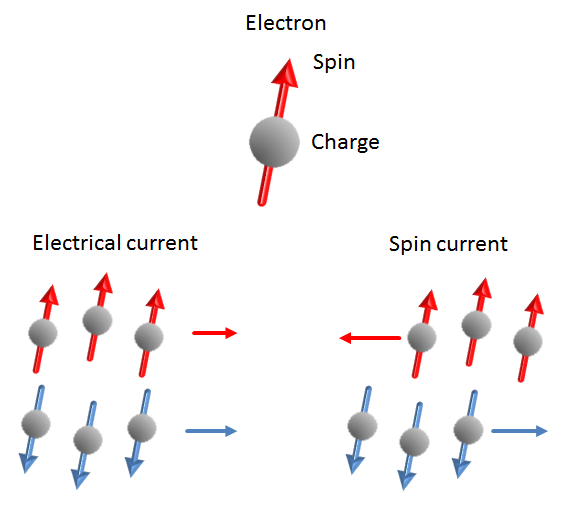
An electron carries a negative charge and a spin (upper picture). The spin can point in two different direction either up (red) or down (blue). Electrical currents transport charges (lower left). The spin directions cancel each other and only charges are transported by the electrical current. Spin currents transport spins. For a spin current (lower right) the electrons with different spin directions move in different directions. The charges cancel and only spins are transported. (picture: L. Bocklage).
Bocklage’s calculations show that ultrafast spin currents can be produced at one thousand times higher frequencies than has hitherto be possible. Surprisingly, the spin current does not drop to zero, even when the excitation is not driven at the resonant frequency. “The rapid temporal fluctuation in the magnetisation compensates for the decrease in the amplitude of the magnetisation,” explains Bocklage. “This leads to a sustained spin current at very high frequencies, which stabilises at around ten percent of the resonant frequency current. By exciting it using terahertz radiation, as is now used by full-body scanners at airports and for which intense sources are currently being developed in modern-day laser research, the THz spin current can be even greater.” Another advantage is that the terahertz spin current oscillates in unison with the magnetic field that stimulates the magnetisation. This means that the spin current can be fully controlled externally via the THz magnetic field.