Showing posts with label Advanced Photon Source. Show all posts

Friday, August 17, 2018

A Designed Material Untangles Long-Standing Puzzle

https://als.lbl.gov/a-designed-material-untangles-long-standing-puzzle/

SCIENTIFIC ACHIEVEMENT

The origin of the metal-to-insulator transition in a key material system was revealed by nanostructures designed to decouple simultaneous phase transitions.

SIGNIFICANCE AND IMPACT

This approach could lead to new materials with emergent physics and unique electronic properties, supporting broader research efforts to revolutionize modern electronics.
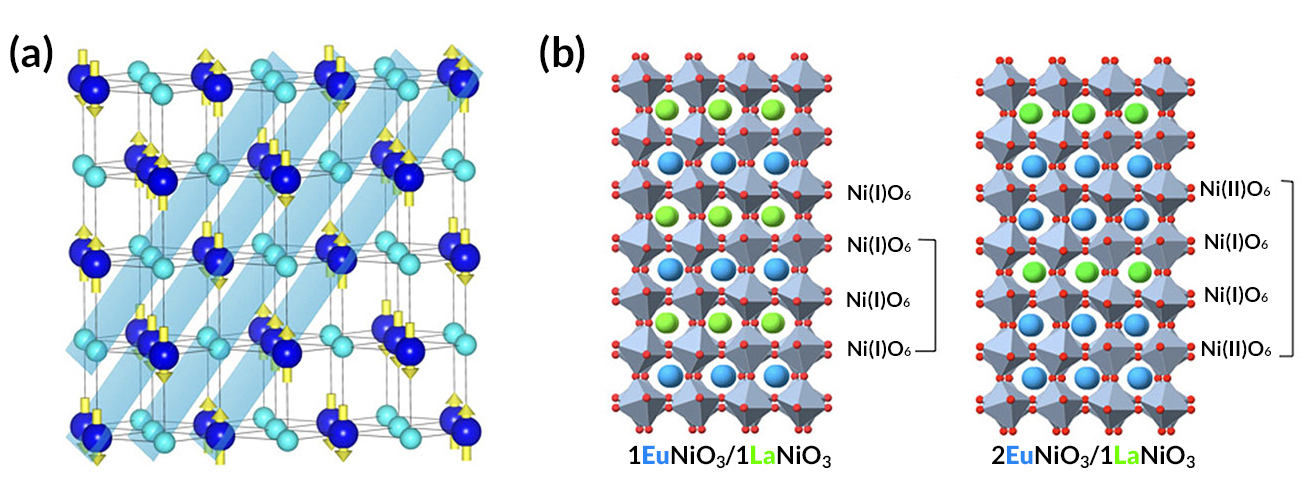
(a) Rare-earth (RE) nickelates (RENiO3) host multiple types of entangled orderings. This illustration depicts a magnetic ordering (spin directions indicated by yellow arrows) and a charge ordering (a checkerboard of two nickel oxidation states, indicated by sphere size and color) in bulk RENiO3 (RE and O atoms omitted for clarity). (b) To selectively suppress the charge-ordering transition, two different RENiO3 materials—EuNiO3 (ENO) and LaNiO3 (LNO)—were combined. The structure on the left, with one ENO layer per LNO layer, supports charge ordering, while the structure on the right, with two ENO layers per LNO layer, does not.

Emergent phenomena

When atoms or molecules assemble to form bulk matter, new properties (such as conductivity and ferromagnetism) that didn’t exist in the constituent parts can emerge from the whole. Similarly, stacking atomically thin layers into nanostructures (heterostructures) can give rise to a rich variety of emergent phases not found in bulk materials.
Materials that exhibit emergent phenomena (“quantum materials”) often feature multiple phases with simultaneous phase transitions. A great deal of effort is currently being expended to disentangle such transitions, to discover what drives them and to ultimately harness them in new materials with desired functionalities. Most of these efforts have relied on external perturbations (light, pressure, etc.) to decouple the transitions. In this work, researchers found a way to do this intrinsically, through layer-by-layer design of stacking sequences with mismatched periodicities.

An archetype of complexity

Rare-earth (RE) nickelates (RENiO3) are prototypical hosts of intertwined phase transitions. They include a metal-to-insulator transition (MIT) and transitions involving antiferromagnetic order and charge order. Charge ordering occurs when a pattern is formed (e.g. stripes or checkerboard) by nickel ions with different oxidation states (differences in the number of local electrons).
Earlier work on the origins of the MIT in such materials had given conflicting results. In this work, researchers attempted to clarify the picture by engineering materials to selectively supress the charge-ordering transition. They combined two different RENiO3 thin-film materials—EuNiO3 (ENO) and LaNiO3 (LNO)—in such a way that the periodicity of the designed structure did not match the periodicity required for stabilizing the charge ordering—a difficult technical challenge requiring subsequent laboratory and synchrotron-based characterization to demonstrate that the proper RE-site ordering was achieved with minimal intermixing.

Resonant soft x-ray diffraction at the ALS
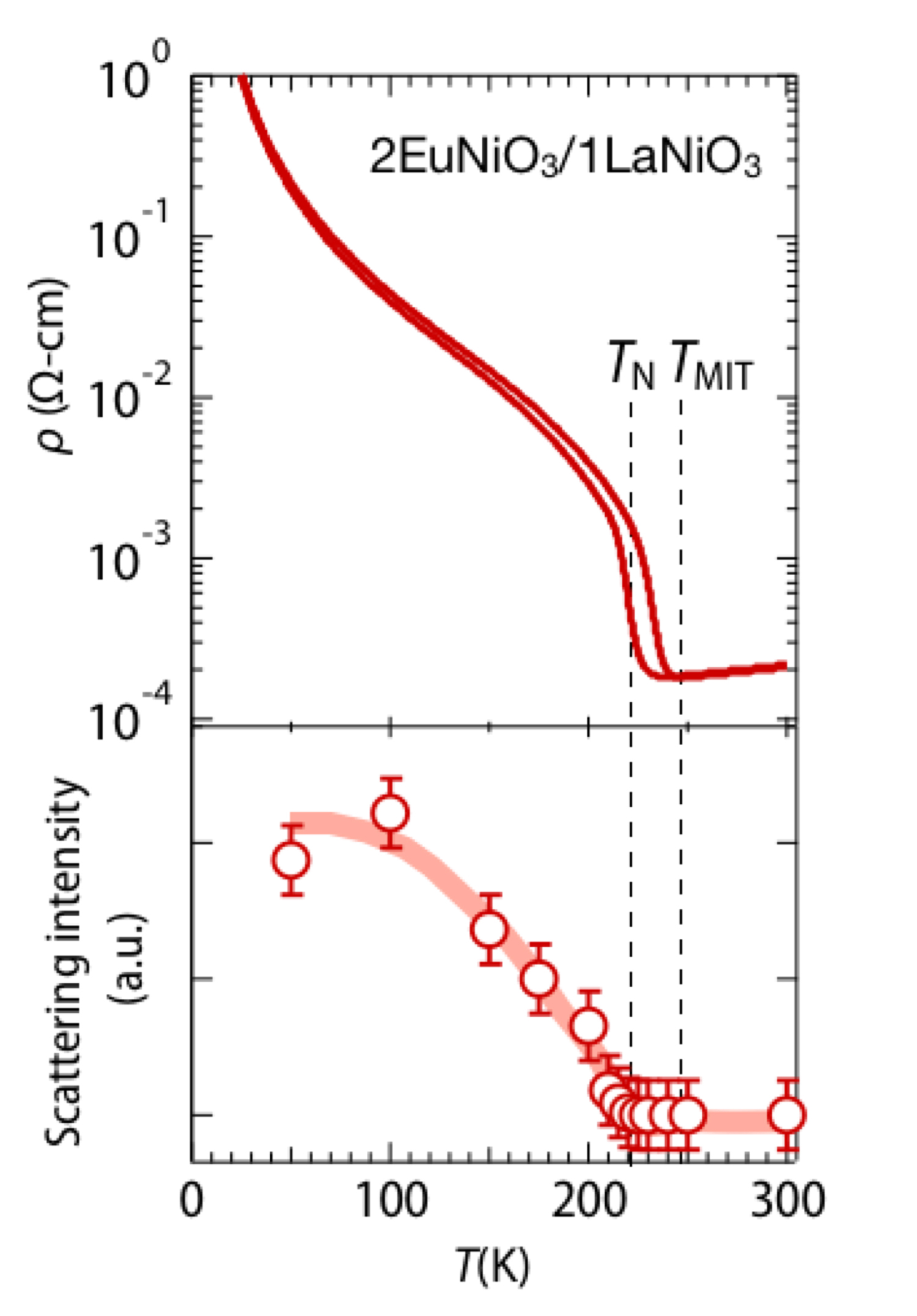
Top: Temperature dependence of resistivity in the mismatched heterostructure. Bottom: Temperature dependence of RSXD peak intensity corresponding to magnetic ordering. There is a finite separation between the metal-to-insulator transition temperature (TMIT) and the magnetic transition (Néel) temperature (TN).
The specific nature of the magnetic ordering and the corresponding transition temperature were revealed by resonant soft x-ray diffraction (RSXD) experiments at ALS Beamline 4.0.2. RSXD probes the periodic order of electronic and magnetic states in a material by diffracting x-rays into patterns characteristic of the electronic order.
The Beamline 4.0.2 scattering endstation is uniquely optimized for RSXD experiments on correlated oxides covering a wide range of scattering geometries and sample temperatures. Moreover, the beamline provides circular as well as variable linear polarization in the important transition-metal L3,2 edges as well as the oxygen K edge, allowing the team to disentangle multiple order parameters.
The ALS experiments showed that, in the heterostructure with mismatched periods, separation between the magnetic-ordering transition temperature and the metal-to-insulator transition temperature was achieved. In addition, experiments performed at the Advanced Photon Source revealed that the charge ordering was indeed suppressed in the mismatched sample. Taken together, the results emphasize that neither magnetic ordering nor charge ordering are necessary for the metal-to-insulator transition, pointing to one particular mechanism (known as the site-selective Mott transition) as being operative.
The researchers expect that this ability to effectively decouple simultaneous ordering phenomena in quantum materials with a simple stacking recipe will spur more discoveries on the nature of entangled orderings and could, in the long term, lead to unique functionalites and emergent physics not seen in bulk systems.

Contacts: Srimanta Middey and Derek Meyers
Researchers: S. Middey (Indian Institute of Science, India); D. Meyers (Brookhaven National Laboratory); M. Kareev, Y. Cao, X. Liu, and J. Chakhalian (Rutgers University); P. Shafer (ALS); and J.W. Freeland, J.-W. Kim, and P.J. Ryan (Argonne National Laboratory).
Funding: Gordon and Betty Moore Foundation; Indian Institute of Science; and U.S. Department of Energy, Office of Science, Basic Energy Sciences Program (DOE BES). Operation of the ALS is supported by DOE BES.
Publication: S. Middey, D. Meyers, M. Kareev, Y. Cao, X. Liu, P. Shafer, J.W. Freeland, J.-W. Kim, P.J. Ryan, and J. Chakhalian, “Disentangled Cooperative Orderings in Artificial Rare-Earth Nickelates,” Phys. Rev. Lett. 120, 156801 (2018), doi:10.1103/PhysRevLett.120.156801.

Saturday, March 9, 2013

Semi-OT The electronic origin of photoinduced strain


http://phys.org/news/2013-02-electronic-photoinduced-strain.html#jCp

(Phys.org)—Multiferroics are in a class of materials that exhibits more than one ferroic order simultaneously. One of the prototypical multiferroics is BiFeO3, an important material because it is one of a few materials that exhibit both ferroelectricity and magnetism at room temperature. The interaction of BiFeO3 with light has attracted great attention because optical control of either magnetism, ferroelectricity, or both has implications for future electronic devices.

The origin of a large photoexcited structural change in BiFeO3 was not well understood because of the lack of direct experimental evidence, preventing a rational design for future optomechanical and optoelectrical applications using ferroelectric and multiferroic materials. 

Now, a team of researchers led by Argonne scientists at the Advanced Photon Source (APS) and Center for Nanoscale Materials (CNM), along with colleagues from the University of Wisconsin-Madison, Cornell University, Northwestern University, Sandia National Laboratories, and Kavli Institute at Cornell for Nanoscale Science, has revealed the electronic origin of the interaction between optical light using a nanometer-thick layer of BFO at the atomic level and ultrafast time scales. Their work was recently published in Physical Review Letters. 

Under illumination with light, these multiferroic respond by creating a large electric current, termed a photocurrent, and can also change their atomic structure, both of which are potentially useful in applications.

 "One of the central problems is how the physical processes associated with the absorption of light in multiferroics leads to these potentially useful properties," said Paul Evans, an article co-author and professor at the University of Wisconsin-Madison. 

Utilizing state-of-art tools readily available at Argonne, a new approach was employed to study what happens after BiFeO3 is excited by an intense pulse of light. Structural studies were conducted using the X-ray Science Division (XSD) 7-ID-C ultrafast x-ray diffraction beamline at the APS. These structural results were compared with the electronic response measured at the ultrafast spectroscopy lab led by Richard Schaller at the CNM.

 "The large, optically induced strain decays within several billionths of a second, which turned out to be the same rate as the excited electrons return to their initial state," said Haidan Wen, the lead author of the paper and an assistant physicist with XSD. This key insight showed that the structural rearrangements after optical excitation were largely driven by electronic processes.

 Faster data storage devices with lower power consumption can result from optical control of electronic and structural properties. This understanding of how that light can induce simultaneous structural and electronic effects now enables optical control of ferroelectric and multiferroic materials without requiring electrical contacts. 

According to John Freeland, a co-author and a physicist in XSD, "The large optically induced strain opens a new route for ultrafast strain engineering of multifunctional complex oxides and new opportunities for manipulation of magnetism for spintronic applications." 

The researchers also believe that the technique can be applied to many other complex material systems and can be helped dramatically by the APS Upgrade. The development over the next five years of a short-pulse x-ray source at the APS will shorten the x-ray pulse by about a factor of 50.

 "Then we will see more detail of the electrons and atoms in action, and probe physics that is out of reach now, especially these occurring in the material right after the excitation by the laser pulse," said Yuelin Li, an XSD physicist and the paper's corresponding author. 

More information: Wen, H. et al. Electronic Origin of Ultrafast Photoinduced Strain in BiFeO3, Phys. Rev. Lett. 110, 037601 (2013). DOI: 10.1103/PhysRevLett.110.037601

Wednesday, February 13, 2013

Ultrafast X-ray spectroscopy as a probe of nonequilibrium dynamics in ruthenium complexes


My Note: This article is slightly off-topic.
http://phys.org/news/2013-02-ultrafast-x-ray-spectroscopy-probe-nonequilibrium.html#jCp
(Phys.org)—Exciting the atoms or molecules of a substance via the use of visible light, or photoexcitation, can play a significant role in a range of energy-conversion processes, such as natural photosynthesis (oxygen from water) and manmade solar cells (electricity from sunlight). But a better understanding of the photoexcitation process is necessary in order to fully exploit this potential resource. Researchers from Argonne National Laboratory and Northern Illinois University have shown that the ultrafast x-ray spectroscopy technique employed at a high-brightness x-ray light source such as the Argonne Advanced Photon Source can produce valuable new information about the physics underlying photoexcitation.
The beginning of the 21st century has seen an exciting increase in our ability to control materials at the quantum level, which could have an enormous impact on a wide array of critical technologies. Many phenomena related to quantum control, such as catalysis, photochemistry, photosynthesis, photoinduced effects, and device physics require an understanding of the nonequilibrium dynamics underlying these physical processes. In order to characterize the dynamics in quantum systems, scientists are developing an extensive suite of experimental tools that have a goal of measuring the response of the structural and electronic properties of a material to an external stimulus, often an optical or terahertz pulse.


 Typical examples of photoinduced phenomena are insulator-to-metal transitions, magnetization and demagnetization, spin-crossover transitions, and melting of charge and orbital order. The typical timescale of the dynamics is of the order of picoseconds (1/1,000,000,000,000 of a second) down to femtoseconds (1/1,000,000,000,000,000 of a second). 

Spin crossover is an intriguing phenomenon that has puzzled many for several decades. Depending on the ligands surrounding the transition metal ion, the spin configuration of the ion can change. For small couplings, the Coulomb interactions on the transition metal will create a local spin moment. For large couplings, the magnetic moment is quenched by the ligand fields. 

In a wide variety of transition-metal (such as iron) complexes, laser excitation creates a photoinduced excited state that decays on the order of tens to hundreds of femtoseconds into a state with a different spin and a significant change in transition metal-ligand distance. These metastable states can have lifetimes ranging from nanoseconds to days. An explanation for the ultrafast photo-excited electron dynamics in low-spin divalent ruthenium organic complexes was recently the cover article in Chemical Physics. The authors, Jun Chang, Arthur Fedro, and Michel van Veenendaal are scientists working in the Theory and Software Group in the Argonne X-ray Science Division at the U.S. Department of Energy Office of Science Advanced Photon Source and the Department of Physics at Northern Illinois University (NIU). google_protectAndRun("render_ads.js::google_render_ad", google_handleError, google_render_ad)

The experimentally-observed singlet-to-triplet decay in the metal-to-ligand charge-transfer (MLCT) states contradicts the expectation that the system should oscillate between the singlet and triplet states in the presence of a large spin-orbit coupling and the absence of a significance change in metal-ligand bond length. This dilemma is solved with a novel quantum decay mechanism that causes a singlet-to-triplet decay in about 300 fs. The decay is mediated by the triplet metal-centered state (MC) state even though there is no direct coupling between the singlet MLCT and triplet MC states. The coupling to the vibronic degrees of freedom causes dephasing effects in the wavefunction, which are crucial to making the decay process irreversible. 

These changes also have a large impact on x-ray spectroscopy. Dynamic x-ray absorption spectra were calculated for the first several hundreds of femtoseconds. Dramatic changes in the spectral line shape are observed that can be directly related to nonequililibrium dynamics. The calculations show a transient crystal-field collapse, dynamic broadenings, and changes in the branching ratio. The authors demonstrate that ultrafast x-ray spectroscopy is a suitable probe to deliver detailed new insights or discriminate between competing physical scenarios. "The calculation clearly show that x-ray spectroscopy can be a valuable tool in unraveling the nonequilibrium decay paths that we want to study with, for example, femtosecond pulses at x-ray free-electron lasers, and picosecond pulses at conventional synchrotrons, such as the Advanced Photon Source," said the APS Theory and Software Group Leader and NIU Presidential Research Professor Michel van Veenendaal.

 More information: Chang, J. et al. Ultrafast X-ray spectroscopy as a probe of nonequilibrium dynamics in ruthenium complexes, Chem. Phys. 407, 65 (2012). www.sciencedirect.com/science/article/pii/S030101041200328X