Showing posts with label A. Gopal. Show all posts

Sunday, December 1, 2019

Abstract-Spatiotemporal visualization of the terahertz emission during high-power laser-matter interaction


A. Gopal, A. Woldegeorgis, S. Herzer, and M. Almassarani

Figure

https://journals.aps.org/pre/abstract/10.1103/PhysRevE.100.053203

Single-cycle pulses with multimillion volts per centimeter field strengths and spectra in the terahertz (THz) band have attracted great interest due to their ability to coherently manipulate molecular orientations and electron spins resonantly and nonresonantly. The tremendous progress made in the development of compact and powerful terahertz sources have identified intense laser-thin foil interaction as a potential candidate for high-power broadband terahertz radiation. They are micrometers in size and deliver radially polarized terahertz pulses with millijoule energy and gigawatt peak power. Although several works have been carried out to investigate the terahertz generation process, their origin and angular distribution are still debated. We present here an indisputable study on their spatiotemporal characteristics and elaborate the underlying physical processes via recording the three-dimensional beam profile along with transient dynamics. These results are substructured with the quantitative visualization of the charge particle spectra.
  • Figure
  • Figure
  • Figure
  • Figure

Tuesday, November 5, 2019

Abstract-Modeling terahertz emission from the target rear side during intense laser-solid interactions


A. Woldegeorgis, S. Herzer, M. Almassarani, S. Marathapalli, and A. Gopal

https://journals.aps.org/pre/accepted/b207eNd9R751152c60cb192029efcb45add52c9d0

Relativistic laser-solid target interaction is a powerful source of terahertz radiation where broadband terahertz radiation is emitted from the front and rear surfaces of the target. Even though several experimental works have reported the generation of sub-picosecond duration gigawatt (GW) peak power terahertz pulses from the target rear surface, the underlying physical process behind their origin is still a question at large. Here we discuss a numerical model which can accurately reproduce several aspects of the experimental results. The model is based on the charged particle dynamics at the target rear surface and the evolution of the charge separation field. We identify the major contributors which are responsible for broadband terahertz emission from the rear surface of the target.

Tuesday, December 18, 2018

Abstract-Investigating the influence of incident laser wavelength and polarization on particle acceleration and terahertz generation


A. H. Woldegeorgis, B. Beleites, F. Ronneberger, R. Grosse, and A. Gopal
Figure


The interaction of a high-power laser pulse with a thin foil can generate energetic, broadband terahertz radiation. Here, we report an experimental investigation on the influence of incident laser polarization and wavelength on the terahertz emission and maximum proton energy from the target rear surface. For similar incident laser intensities, the characteristics of the particle beams and the terahertz radiation show a wavelength dependence. The results fit well with the established scaling laws for the terahertz yield and the maximum proton energy as a function of the incident laser irradiance (Iλ2).
  • Figure
  • Figure
  • Figure
  • Figure

Tuesday, May 8, 2018

Abstract-THz Induced Nonlinear Effects in Materials at Intensities above 26 GW/cm2


A. Woldegeorgis, T. Kurihara, B. Beleites, J. Bossert, R. Grosse, G. G. Paulus, F. Ronneberger, A. Gopal

https://link.springer.com/article/10.1007%2Fs10762-018-0493-3

Nonlinear refractive index and absorption coefficient are measured for common semiconductor material such as silicon and organic molecule such as lactose in the terahertz (THz) spectral regime extending from 0.1 to 3 THz. Terahertz pulses with field strengths in excess of 4.4 MV/cm have been employed. Transmittance and the transmitted spectrum were measured with Z-scan and single shot noncollinear electro-optic pump-probe techniques. The THz-induced change in the refractive index (Δn) shows frequency-dependence and a maximum change of  0.128 at 1.37 THz in lactose and up to + 0.169 at 0.15 THz in silicon was measured for a peak incident THz intensity of 26 GW/cm2. Furthermore, the refractive index variation shows a quadratic dependence on the incident THz field, implying the dominance of third-order nonlinearity.

Tuesday, September 17, 2013

Powering Up Terahertz Sources

My Note: I just saw this on THz Science and Technology network, via Lakeshore Cryotronics blog.
http://thznetwork.net/index.php/archives/1799


Image courtesy of Amrutha Gopal/Friedrich Schiller University Jena
Published Article:
Observation of Gigawatt-Class THz Pulses from a Compact Laser-Driven Particle Accelerator
A. Gopal, S. Herzer, A. Schmidt, P. Singh, A. Reinhard, W. Ziegler, D. Brömmel, A. Karmakar, P. Gibbon, U. Dillner, T. May, H-G. Meyer, and G. G. Paulus
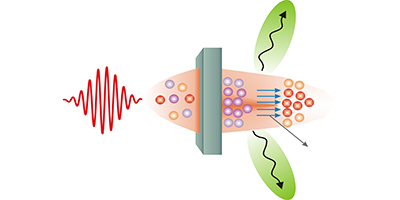
Terahertz (THz) radiation—the band of frequencies falling between the microwave and visible range—can pass through materials that block light and couple to important rotational, vibrational, or electronic degrees of freedom of solids and molecules. Many applications could take advantage of these properties, from wireless communications to imaging of biomolecules or semiconductor wafers. But a key stumbling block for THz technologies is the development of sufficiently powerful sources. Now, as reported in Physical Review Letters, Amrutha Gopal at the Friedrich Schiller University Jena, Germany, and co-workers have demonstrated a laser-based source that emits short THz pulses with the highest peak power ever recorded in a laboratory.
Presently, the most powerful THz sources are at expensive, large-scale accelerator facilities, which generate THz radiation by bending a beam of relativistic electrons with a magnet. Gopal et al.’s solution instead exploits a high-power laser available at the Friedrich Schiller University Jena. The authors focus the laser’s femtosecond pulses onto micrometer-thick metallic foils. The intense pulses ionize the material, creating hot plasma that emits THz radiation. The setup delivers ten THz pulses per second with a broad spectrum (0.3–30 THz). Since the energy is concentrated in pulses only about half a picosecond long, their peak power is close to a gigawatt.
The scheme also generates a synchronous beam of energetic ions, which suggests an intriguing medical application: the THz beam could be used for detecting cancerous cells on human skin (which reflect THz wavelengths differently than normal cells), while the ions could be directed selectively at such cells for simultaneous treatment. – Matteo Rini

Thursday, August 15, 2013

Observation of Gigawatt-Class THz Pulses from a Compact Laser-Driven Particle Accelerator


A. Gopal1,2,*, S. Herzer1,2, A. Schmidt1, P. Singh1,†, A. Reinhard1, W. Ziegler1, D. Brömmel3, A. Karmakar3,‡, P. Gibbon3, U. Dillner4, T. May4, H-G. Meyer4, and G. G. Paulus1,2 
1Institute of Optics and Quantumelectronics, Friedrich-Schiller-Universität Jena, Max-Wien-Platz 1, 07743 Jena, Germany
2Helmholtz Institute Jena, Fröbelstieg 3, 07743 Jena, Germany
3Forschungzentrum Jülich GmbH, Institute for Advanced Simulation, Jülich Supercomputing Centre, D-52425 Jülich, Germany
4Institut für Photonische Technologien, Postfach 100239, 07702 Jena, Germany

http://prl.aps.org/abstract/PRL/v111/i7/e074802


We report the observation of subpicosecond terahertz (T-ray) pulses with energies ≥460  μJ from a laser-driven ion accelerator, thus rendering the peak power of the source higher even than that of state-of-the-art synchrotrons. Experiments were performed with intense laser pulses (up to 5×10¹⁹  W/cm2) to irradiate thin metal foil targets. Ion spectra measured simultaneously showed a square law dependence of the T-ray yield on particle number. Two-dimensional particle-in-cell simulations show the presence of transient currents at the target rear surface which could be responsible for the strong T-ray emission.
© 2013 American Physical Society
synopsis:
Terahertz (THz) radiation—the band of frequencies falling between the microwave and visible range—can pass through materials that block light and couple to important rotational, vibrational, or electronic degrees of freedom of solids and molecules. Many applications could take advantage of these properties, from wireless communications to imaging of biomolecules or semiconductor wafers. But a key stumbling block for THz technologies is the development of sufficiently powerful sources. Now, as reported in Physical Review Letters, Amrutha Gopal at the Friedrich Schiller University Jena, Germany, and co-workers have demonstrated a laser-based source that emits short THz pulses with the highest peak power ever recorded in a laboratory.
Presently, the most powerful THz sources are at expensive, large-scale accelerator facilities, which generate THz radiation by bending a beam of relativistic electrons with a magnet. Gopal et al.’s solution instead exploits a high-power laser available at the Friedrich Schiller University Jena. The authors focus the laser’s femtosecond pulses onto micrometer-thick metallic foils. The intense pulses ionize the material, creating hot plasma that emits THz radiation. The setup delivers ten THz pulses per second with a broad spectrum (0330 THz). Since the energy is concentrated in pulses only about half a picosecond long, their peak power is close to a gigawatt.
The scheme also generates a synchronous beam of energetic ions, which suggests an intriguing medical application: the THz beam could be used for detecting cancerous cells on human skin (which reflect THz wavelengths differently than normal cells), while the ions could be directed selectively at such cells for simultaneous treatment. – Matteo Rini