A repository & source of cutting edge news about emerging terahertz technology, it's commercialization & innovations in THz devices, quality & process control, medical diagnostics, security, astronomy, communications, applications in graphene, metamaterials, CMOS, compressive sensing, 3d printing, and the Internet of Nanothings. NOTHING POSTED IS INVESTMENT ADVICE! REPOSTED COPYRIGHT IS FOR EDUCATIONAL USE.
Liquid crystal (LC) cells that are coated with metamaterials are fabricated in this work. The LC directors in the cells are aligned by rubbed polyimide layers, and make angles θ of 0°, 45°, and 90° with respect to the gaps of the split-ring resonators (SRRs) of the metamaterials. Experimental results display that the resonance frequencies of the metamaterials in these cells increase with an increase in θ, and the cells have a maximum frequency shifting region of 18 GHz. Simulated results reveal that the increase in the resonance frequencies arises from the birefringence of the LC, and the LC has a birefringence of 0.15 in the terahertz region. The resonance frequencies of the metamaterials are shifted by the rubbing directions of the polyimide layers, so the LC cells coated with the metamaterials are passively tunable terahertz filters. The passively tunable terahertz filters exhibit promising applications on terahertz communication, terahertz sensing, and terahertz imaging.
The associated THz responses include focusing, holograms,
polarization modulation, special beams and active controlling. Credit: Xiaofei
Zang, Bingshuang Yao, Lin Chen, Jingya Xie, Xuguang Guo, Alexei V. Balakin,
Alexander P. Shkurinov, and Songlin Zhuang
THz waves have a plethora of applications ranging from biomedical and medical examinations, imaging, environmental monitoring, to wireless communications, because of abundant spectral information, low photon energy, strong penetrability, and shorter wavelength. THz waves with technological advances not only determined by high-efficiency sources and detectors but also decided by a variety of high-quality THz components/functional devices. However, traditional THz devices should be thick enough to realize the desired wave-manipulating functions, hindering the development of THz integrated systems and applications. Although metamaterials have shown groundbreaking discoveries due to tunable electric permittivity and magnetic permeability of a meta-atom, they are limited by technical challenges of fabrication and high loss of the metal-based unit cell.
In a new paper published in Light: Advanced Manufacturing, a team of scientists, led by Professor Songlin Zhuang from Terahertz Technology Innovation Research Institute, University of shanghai for Science and Technology, and co-workers have summarized recent advancements of metasurfaces for the manipulation of THz waves. These ultra-compact devices with unusual functionalities render metasurface devices very attractive for applications such as imaging, encryption, information modulation and THz communications.
Actually, metasurfaces typically consist of planar antennas that enable predesigned EM responses. The antennas are made of metals or traditional high-refractive index dielectrics that can be easily fabricated based on standard fabrication processes. In addition, metasurfaces with functionality in manipulating EM waves are dependent on abrupt phase changes at planar antenna interfaces, and thus the thickness of metasurfaces is much thinner than the incident wavelength. Metasurfaces can locally control the wavefront of EM waves at subwavelength resolution, leading to various practical applications such as metalenses, waveplates, vortex beam generators, beam steering and holograms. The ultrathin nature of metasurfaces, ease of fabrication, and subwavelength resolution in manipulation of EM waves make metasurfaces ideal candidates for THz device miniaturization (ultra-compact THz devices) and system integration.
The metasurface-based approach for manipulatig THz waves enables remarkable contributions in designing ultra-thin/ultra-compact and tunable THz components. The main advantages/contributions of THz metasurfaces can be concluded as follows: (1) THz components with reduced size: The functionalities of focusing, OAM, and polarization conversion realized by metasurfaces can be traditionally obtained by using a THz lens, helical phase plate, and half-wave (or quarter-wave) plate, respectively; (2) THz components with multiple functions: The traditional THz devices, e.g. THz lenses, waveplates, etc, always show a single function. Metasurfaces not only provide a flexible platform to realize ultra-thin/ultra-compact THz devices with single function, but also enable the unprecedented capability in designing multifunctional THz devices. (3) THz components with tunable function: Metasurfaces combined with VO2, graphene, etc, open a new avenue for designing THz components with active functions.
In conclusion, metasurfaces with planar structures can locally modify the wavefront of THz waves at subwavelength resolution. Metasurfaces not only provide an ultra-compact platform for manipulating the wavefront of THz waves, but also generate a plethora of applications that are difficult to achieve with conventional functional devices. As an overview, the recent developments of metasurfaces for manipulating THz waves were presented in this paper, and this progress report may open a new avenue to design ultra-thin or ultra-compact THz functional devices and systems.
In this paper, in order to amplify terahertz output pulses and achieve higher frequency peaks, a scheme of spiral lines is proposed to be used in the electrodes of photoconductive dipole antennas. This scheme is simulated with the help of the CST software. At first, a photoconductive antenna is simulated and compared with the experimental results. In order to improve the effectiveness of the antenna, certain changes are made in its shape. These changes are necessary because the intensity and frequency bandwidth of terahertz radiation in photoconductive antennas are less effective than other sources of terahertz waves and the shape of electrodes plays a fundamental role in the output of the radiation. As a result, adding spiral lines to antenna electrodes increases the intensity of terahertz radiation and shifts the frequency peak of that radiation toward higher frequencies.
We propose a feasible, high-efficiency scheme of primary terahertz (THz) radiation source through manipulating electronic structure (ES) of a metallic film by targeted-designed DC-fields configuration. The DC magnetic field is designed to be of a spatially inhomogeneous strength profile, and its direction is designed to be normal to the film, and the direction of the DC electric field is parallel to the film. Strict quantum theory and numerical results indicate that the ES under such a field configuration will change from a 3D Fermi sphere into a highly-degenerate structure whose density-of-state curve has pseudogap near Fermi surface. Wavefunctions’ shapes in this new ES are space-asymmetric, and the width of pseudogap near Fermi surface, as well as magnitudes of transition matrix element, can be handily controlled by adjusting parameter values of DC fields. Under available parameter values, the width of the pseudogap can be at milli-electron-volt level (corresponding to THz radiation frequency), and the magnitude of oscillating dipole can be at 10−9C∗m-level. In room-temperature environment, phonon in metal can pump the ES to achieve population inversion.
Mirco Kutas, Björn Haase, Jens Klier, Daniel Molter, and Georg von Freymann
Experimental setup. The 1 mm long PPLN crystals are pumped by a continuous-wave laser with a wavelength of 660 nm, generating correlated pairs of signal and terahertz photons. After the crystal the terahertz radiation is separated by an OAP with a through hole and afterwards reflected at a moveable mirror Mi. Pump and generated signal photons are reflected at Ms directly back into the crystal. After the second pass the pump radiation is filtered from the signal radiation by three volume Bragg gratings (VBGs). To obtain a frequency-angular spectrum on the sCMOS camera, the signal radiation is focused through a transmission grating (TG).
Terahertz technology offers solutions in nondestructive testing and spectroscopy for many scientific and industrial applications. While direct detection of photons in this frequency range is difficult to achieve, quantum optics provides a highly attractive alternative: it enables the characterization of materials in hardly accessible spectral ranges by measuring easily detectable photons of a different spectral range. Here we report on the application of this principle to terahertz spectroscopy, measuring absorption features of chemicals at sub-terahertz frequencies by detecting visible photons. To generate the needed correlated signal-idler photon pairs, a periodically poled lithium niobate crystal and a 660 nm continuous-wave pump source are used. After propagating through a single-crystal nonlinear interferometer, the pump photons are filtered by narrowband volume Bragg gratings. An uncooled scientific CMOS camera detects the frequency-angular spectra of the remaining visible signal and reveals terahertz-spectral information. Neither cooled detectors nor expensive pulsed lasers for coherent detection are required.
This paper reports investigations led on the combination of the refractive index and morphological dilation to enhance performances towards breast tumour margin delineation during conserving surgeries. The refractive index map of invasive ductal and lobular carcinomas were constructed from an inverse electromagnetic problem. Morphological dilation combined with refractive index thresholding was conducted to classify the tissue regions as malignant or benign. A histology routine was conducted to evaluate the performances of various dilation geometries associated with different thresholds. It was found that the combination of a wide structuring element and high refractive index was improving the correctness of tissue classification in comparison to other configurations or without dilation. The method reports a sensitivity of around 80% and a specificity of 82% for the best case. These results indicate that combining the fundamental optical properties of tissues denoted by their refractive index with morphological dilation may open routes to define supporting procedures during breast-conserving surgeries.
THz waves have a plethora of applications ranging from biomedical and medical examinations, imaging, environment monitoring, to wireless communications, because of the abundant spectral information, low photon energy, strong penetrability, and shorter wavelength. THz waves with technological advances not only determined by the high-efficiency sources and detectors but also decided by a variety of the high-quality THz components/functional devices. However, traditional THz devices should be thick enough to realize the desired wave-manipulating functions, hindering the development of THz integrated systems and applications. Although metamaterials have been shown groundbreaking discoveries due to the tunable electric permittivity and magnetic permeability of a meta-atom, they are limited to technical challenges of fabrication and high loss of the metal-based unit cell.
In a new paper published in Light: Advanced Manufacturing, a team of scientists, led by Professor Songlin Zhuang from Terahertz Technology Innovation Research Institute, University of Shanghai for Science and Technology, and co-workers have summarized the recent advancements of metasurfaces for the manipulation of THz waves. These ultra-compact devices with unusual functionalities render metasurface devices very attractive for applications such as imaging, encryption, information modulation and THz communications.
Actually, metasurfaces typically consist of planar antennas that enable predesigned EM responses. The antennas are made by metals or traditional high-refractive index dielectrics that can be easily fabricated based on the standard fabrication process. In addition, metasurfaces with the functionality in manipulating EM waves are dependent on the abrupt phase changes at planar antenna interfaces, and thus the thickness of metasurfaces is much thinner than the incident wavelength. Metasurfaces can locally control the wavefront of EM waves at subwavelength resolution, leading to various practical applications such as metalens, waveplates, vortex beam generators, beam steering and holograms. The ultrathin nature of metasurfaces, the ease of fabrication, and the subwavelength resolution in manipulating of EM waves make metasurfaces ideal candidates for THz device miniaturization (ultra-compact THz devices) and system integration.
The metasurface-based approach for manipulatig THz waves enables remarkable contributions in designing ultra-thin/ultra-compact and tunable THz components. The main advantages/contributions of THz metasurfaces can be concluded as follows: (1) THz components with reduced size: The functionalities of focusing, OAM, and polarization conversion realized by metasurfaces can be traditionally obtained by using a THz lens, helical phase plate, and half-wave (or quarter-wave) plate, respectively; (2) THz components with multiple functions: The traditional THz devices, e.g. THz lenses, waveplates, etc..., are always show a single function. Metasurfaces not only provide a flexible platform to realize ultra-thin/ultra-compact THz devices with single function, but also enable the unprecedented capability in designing multifunctional THz devices. (3) THz components with tunable function: Metasurfaces combined with VO2, graphene, etc, open a new avenue for designing THz components with active functions.
In conclusion, metasurfaces with planar structures can locally modify the wavefront of THz waves at subwavelength resolution. Metasurfaces not only provide an ultra-compact platform for manipulating the wavefront of THz waves, but also generate a plethora of applications that are difficult to achieve with conventional functional devices. As an overview, the recent developments of metasurfaces for manipulating THz waves were presented in this paper, and this progress report may open a new avenue to design ultra-thin or ultra-compact THz functional devices and systems.
Terahertz-based nano-networks are emerging as a groundbreaking technology able to play a decisive role in future medical applications owing to their ability to precisely quantify figures, such as the viral load in a patient or to predict sepsis shock or heart attacks before they occur. Due to the extremely limited size of the devices composing these nano-networks, the use of the Terahertz (THz) band has emerged as the enabling technology for their communication. However, the characteristics of the THz band, which strictly reduce the communication range inside the human body, together with the energy limitations of nano-nodes make the in-body deployment of nano-nodes a challenging task. To overcome these problems, we propose a novel in-body flow-guided nano-network architecture consisting of three different devices: i) nano-node, ii) nano-router, and iii) bio-sensor. As the performance of this type of nano-network has not been previously explored, a theoretical framework capturing all its particularities is derived to properly model its behavior and evaluate its feasibility in real medical applications. Employing this analytical model, a thorough sensitivity study of its key parameters is accomplished. Finally, we analyze the terahertz flow-guided nano-network design to satisfy the requirements of several medical applications of interest.
High-performance uncooled millimetre and terahertz wave detectors are required as a building block for a wide range of applications. The state-of-the-art technologies, however, are plagued by low sensitivity, narrow spectral bandwidth, and complicated architecture. Here, we report semiconductor surface plasmon enhanced high-performance broadband millimetre and terahertz wave detectors which are based on nanogroove InSb array epitaxially grown on GaAs substrate for room temperature operation. By making a nanogroove array in the grown InSb layer, strong millimetre and terahertz wave surface plasmon polaritons can be generated at the InSb–air interfaces, which results in significant improvement in detecting performance. A noise equivalent power (NEP) of 2.2 × 10⁻¹⁴ W Hz−1/2 or a detectivity (D*) of 2.7 × 1012 cm Hz1/2 W−1 at 1.75 mm (0.171 THz) is achieved at room temperature. By lowering the temperature to the thermoelectric cooling available 200 K, the corresponding NEP and D* of the nanogroove device can be improved to 3.8 × 10⁻¹⁵ W Hz−1/2 and 1.6 × 1013 cm Hz1/2 W−1, respectively. In addition, such a single device can perform broad spectral band detection from 0.9 mm (0.330 THz) to 9.4 mm (0.032 THz). Fast responses of 3.5 µs and 780 ns are achieved at room temperature and 200 K, respectively. Such high-performance millimetre and terahertz wave photodetectors are useful for wide applications such as high capacity communications, walk-through security, biological diagnosis, spectroscopy, and remote sensing. In addition, the integration of plasmonic semiconductor nanostructures paves a way for realizing high performance and multifunctional long-wavelength optoelectrical devices.
We demonstrate a highly efficient method for the generation of a high-field terahertz (THz) pulse train via optical rectification (OR) in congruent lithium niobate (LN) crystals driven by temporally shaped laser pulses. A narrowband THz pulse has been successfully achieved with sub-percent level conversion efficiency and multi MV/cm peak field at 0.26 THz. For the single-cycle THz generation, we achieved a THz pulse with 373-μJ energy in a LN crystal excited by a 100-mJ laser pulse at room temperature. The conversion efficiency is further improved to 0.77 % pumped by a 20-mJ laser pulse with a smaller pump beam size (6 mm in horizontal and 15 mm in vertical). This method holds great potential for generating mJ-level narrow-band THz pulse trains, which may have a major impact in mJ-scale applications like terahertz-based accelerators and light sources.
As a novel detection method of CuSO4, terahertz (THz) spectroscopy detection has great application prospects, but the terahertz detection with the tablet method has low sensitivity, and with the metamaterials has complicated manufacture. This work has proposed a high-sensitivity pesticide THz spectroscopic detection method with a novel metal grating. The metal grating was composed of a circular hole array. It was made by laser micromachining technology to provide a simplified but improved measurement and had a strong transmission peak at the 0.4–1.0 THz band. The results indicated that the addition of copper sulfate (CuSO4) solutions to different concentrations caused the transmission peak frequency to shift red. The detection limit was about 103 times higher than that of CuSO4 measured on the polyethylene (PE) film substrate, which reached 0.375 mg/L. The method was applied for detecting CuSO4 in apple and grape, and the relative error was less than 5.8%. The metal grating combined with Terahertz time-domain spectroscopy (THz-TDS) can improve the sensitivity of sample detection and realize the detection and analysis of trace elements.
Artistic impression of a THz QCL as a nonlinear mmWave
source, where mmWaves are generated within the cavity (red) that radiate into
free space (blue waves) Credit: David Darson
The volume of wireless telecommunication traffic is expected to surge in the near future with a continual increase in data traffic and corresponding necessary increases in bandwidth. It has therefore become imperative to increase the photon frequency into the upper reaches of the millimeter (mmWave) region, which corresponds to frequencies between 30 GHz to 300 GHz.
Millimeter wave generation using photonic techniques has so far been limited to the use of near-infrared lasers that are down-converted to the mmWave region. However, such methodologies do not currently benefit from a monolithic architecture and suffer from the high difference in photon energies between the near-infrared and mmWave region, that we called the quantum defect, which can ultimately limit the conversion efficiency. Terahertz (THz) wave region, with photons of lower energies, is however highly adapted. Moreover, we know how to generate them thanks to a compact miniaturized device, the quantum cascade lasers (QCLs). These lasers have inherent other advantages in this respect: their ultrafast dynamics and high nonlinearities open up the possibility of innovatively integrating both laser action and mmWave generation in a single device.
In this article, LPENS researchers of the Nano-THz group, in collaboration with teams of C2N, NEST in Pisa, ONERA in Palaiseau and the University of Leeds have demonstrated intracavity mmWave generation within THz QCLs over the unprecedented range of 25 GHz to 500 GHz. Importantly, this work opens up the possibility of compact, low noise mmWave generation using THz frequency combs.
In this paper, we propose a terahertz (THz) spiral spatial filtering (SSF) imaging method that can enable image contrast enhancement. The related theory includes three main steps: (1) the THz image of the target is Fourier transformed to the spatial spectrum distribution; (2) the spatial spectrum is modulated by a spiral phase at the Fourier plane; (3) the filtered spatial spectrum is inverse Fourier transformed to the desired THz image. Meanwhile, analytic expression of the final THz image is derived. Due to the unique nature of the spiral phase, THz image contrast enhancement can be achieved and verified by various simulated target images with different contrasts. In our designed THz SSF imaging system, Fourier transform is carried out by the lens, and the spiral phase is acquired by the spiral phase plate (SPP). Proof-of-principle experiments with three different types of targets (carved metal letters, a high-density polyethylene (HDPE) piece with a scratch, and a leaf) were carried out, and the effectiveness of contrast enhancement and edge extraction on the THz reconstruction images was validated
Luna’s Terahertz (THz) measurement solutions were featured in the March 2021 issue of the Journal of Blow Molding, a publication focused on the manufacturing process for forming and joining together hollow plastic parts such as used in forming bottles or other hollow shapes and containers.
Process control is crucial to the production of a high-quality product. THz sensors are a relatively new technology that provide ultra fast, accurate and highly precise measurements of thickness in multilayer blow molded products. THz's ability to measure a wide range of materials, including those opaque to ultraviolet, visible and infrared light, provides a unique control capability. THz’s capabilities over a wide range of points in the blow molding product development, manufacturing and quality-control processes make THz wall thickness measurements an incredibly useful technology.
How does a THz measurement system work?
THz sensors emit a very narrow pulse of completely safe energy. This pulse travels through air to the sample and generates reflections of the pulse at every interface between two materials (including air and the sample's outer surfaces). If the sample is multilayer, interior layers will also create reflections, which provide a measurement of the interior layers. The THz system measures the time between the two reflections off the top and bottom of a layer and uses this value to calculate layer thickness. Thickness measurements are highly precise (typically less than plus or minus 0.1 mil or 2.5 microns for in-line measurement rates) and extremely repeatable. The systems have high resolution (less than 0.04 mil or 1 micron) and can be used in many challenging environmental conditions.
What comprises a THz system?
A THz system consists of a control unit, a flexible umbilical cable (up to about 147 feet long) and a sensor. Single-sensor and dual-sensor control units are available. The umbilical cable allows the sensor to be freely positioned for alignment with the object being examined.
Applications for THz technologies
Applications that have been validated using THz systems include measuring blow-molded fuel tanks and bottles.
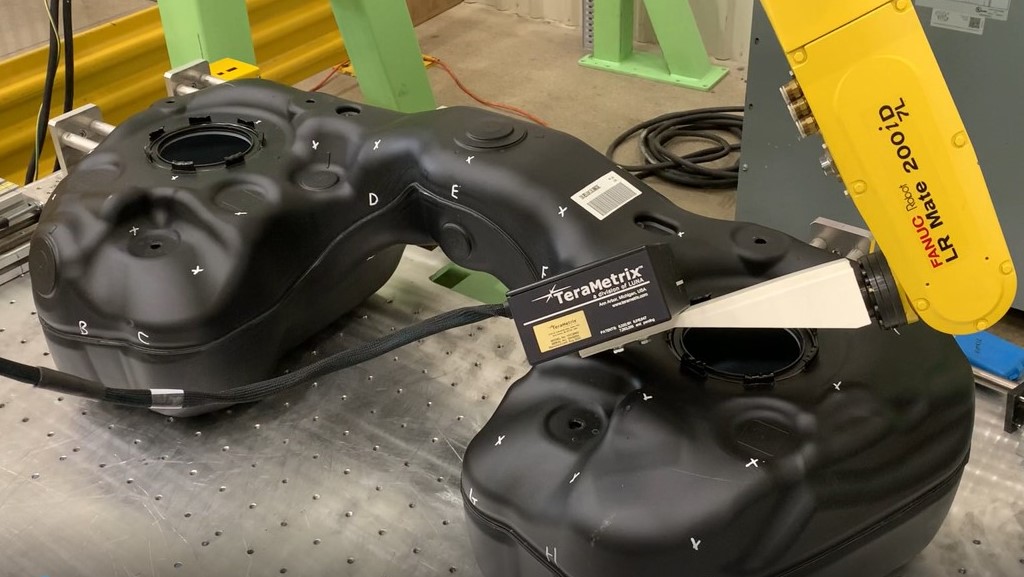
Figure 1: Terahertz sensors can be set up in a variety of configurations, including on the end of a robot arm (in yellow), as shown here, with an automotive fuel tank (in black).
Fuel Tanks
In Figure 1, a THz sensor can be seen at the end of the robot arm used to take measurements on a barrier-layer automotive fuel tank. The robot measured seven positions on the tank 88 times over one hour. Over this period, the ambient temperature of the plant increased from 70 degrees Fahrenheit to 105 degrees. The total thickness across the multiple points varied from 5mm to 8mm, with an average value of 6.29mm and an average standard deviation for repeated measurements of 0.0007mm. The individual layer thicknesses were also measured, with an average standard deviation of 0.0016mm.
Parisons and Bottles
Another use is measuring the thickness of a multilayer parison just before it is clamped in the mold. Such information can be used to assist development and manufacturing, and to measure the phasing of the extrusion process to get better control and distribution of the wall thickness throughout the object. This will lead to faster development and startup, more consistent wall-thickness distribution and efficient use of material and energy.
Luna's THz gauges and sensors have successfully measured barrier layers of ethylene vinyl alcohol, nylon and carbon black. In one example, the system took as many as four different measurements as barrier-layer bottles moved past on a conveyor over a period of nearly four hours. A sensor installed in front of a conveyor produced in-line point measurements. This type of real-time data can provide immediate feedback to identify and correct manufacturing problems quickly.
In one case, over a measurement run of 86 hours, the barrier layer was measured with a standard deviation of plus or minus 1.5 microns, demonstrating the stability and high precision of the measurement, giving bottle manufacturers more control.
Luna’s non-contact terahertz sensors have demonstrated the ability to measure wall thickness of nearly all blow molded products, including multilayer products, at very high rates with high accuracy and precision, at many locations in the blow molding process. From the extruded parison or preform to the molded fuel tank or bottle, THz sensors can provide a high-precision measurement of multiple layers, regardless of color or material.
To read the entire article by Dr. Irl Duling, director of terahertz business development; and Dr. Jeffrey White, senior research scientist at Luna Innovations Inc, visit the March 2021 issue of The Journal of Blow Molding.
See the full suite of Luna Terahertz solutions for process control and non-destructive test (NDT) here and the Terahertz products for gauging and imaging here.
Apart from their relevance for spectroscopy and imaging, terahertz signals have attracted a lot of interest for sensing. In this paper, a label free terahertz sensor is proposed, which can be employed to detect the presence of molecules in the environment. The proposed sensor consists of an array of ring resonators, resonating at the frequency of f=1.2 THz. By providing full-wave numerical simulations, it is shown that the proposed sensor is able to sense the variation of the refractive index in the environment. The proposed structure is found to show larger sensitivity compared to previous reports. Our findings provide a novel platform to realize label free terahertz sensors with extremely large sensitivity.
Z. Chen, C. B. Curry, R. Zhang, F. Treffert, N. Stojanovic, S. Toleikis, R. Pan, M. Gauthier, E. Zapolnova, L. E. Seipp, A. Weinmann, M. Z. Mo, J. B. Kim, B. B. L. Witte, S. Bajt, S. Usenko, R. Soufli, T. Pardini, S. Hau-Riege, C. Burcklen, J. Schein, R. Redmer, Y. Y. Tsui, B. K. Ofori-Okai, S. H. Glenzer
The experimental setup to measure terahertz (THz) transmission through free-standing gold foils excited by extreme ultraviolet (XUV) pulses.
Key insights in materials at extreme temperatures and pressures can be gained by accurate measurements that determine the electrical conductivity. Free-electron laser pulses can ionize and excite matter out of equilibrium on femtosecond time scales, modifying the electronic and ionic structures and enhancing electronic scattering properties. The transient evolution of the conductivity manifests the energy coupling from high temperature electrons to low temperature ions. Here we combine accelerator-based, high-brightness multi-cycle terahertz radiation with a single-shot electro-optic sampling technique to probe the evolution of DC electrical conductivity using terahertz transmission measurements on sub-picosecond time scales with a multi-undulator free electron laser. Our results allow the direct determination of the electron-electron and electron-ion scattering frequencies that are the major contributors of the electrical resistivity.